[SMM Daily Review] most of the non-ferrous metals fell back. Shanghai Copper, Shanghai Aluminum rose more than 1%. Last period crude oil fell more than 4%. Precious metals concussion is weak.

Publié: Sep 07, 2020 16:25 (GMT+8)
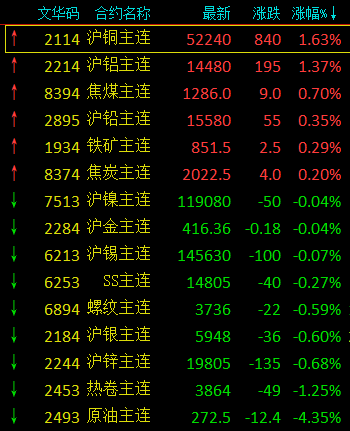
Today, non-ferrous metals rose higher and fell back in the afternoon. By the end of the day, Shanghai Copper rose 1.63%, Shanghai Aluminum rose 1.37%, Shanghai lead rose 0.35%, Shanghai Nickel fell 0.04%, Shanghai Tin fell 0.07%, and Shanghai Zinc fell 0.68%.

SMM9 March 7: non-ferrous metals rose and fell back in the afternoon today. By the end of the day, Shanghai Copper rose 1.63%, Shanghai Aluminum rose 1.37%, Shanghai lead rose 0.35%, Shanghai Nickel fell 0.04%, Shanghai Tin fell 0.07%, Shanghai Zinc fell 0.68%. In terms of nickel, the prices of nickel and various metals fell sharply, dominated by macro factors such as the collapse of US stocks and the appreciation of the US dollar, and there is a range of appropriate recovery and adjustment in the short term. The performance of nickel fundamentals is temporarily stable, but stainless steel prices tend to peak at a high level, and the upward pressure on nickel prices will increase, but at the same time, the space for callback will be limited; at present, the short-term fundamentals of nickel are good, and in the long run, it is also better than originally expected; 300 series stainless steel high output assist high nickel pig iron in the third quarter has changed from leftover to shortage, and in the fourth quarter or tight balance, the surplus is less than originally expected, so some nickel market fundamentals of nickel pig iron are good. In terms of pure nickel, although consumption is not good, the decrease in domestic spot nickel imports adjusts the market to a certain extent, so that the domestic social inventory is basically balanced and the market performance is relatively stable. It is estimated that this week, Shanghai nickel is 117500-124000 yuan / ton, Lunni is 15000-15800 US dollars / ton.

[SMM point of view] can the fundamentals of Shanghai Nickel continue to rise after several times approaching the 120000 mark?

In terms of black system, thread fell by 0.59%, hot coil by 1.25%, stainless steel by 0.27%, coke by 0.2%, coking coal by 0.7%, iron ore by 0.29%, and the operating rate of blast furnaces on the demand side remained high, but recently, there are still strict expectations of environmental production restrictions in Tangshan area. production restrictions hype or continue to affect demand. In addition, the situation of high inventory of steel downstream has not been alleviated, and there is a certain pressure on steel prices, the purchasing enthusiasm of steel mills is weak, and the current price of iron ore is favorable. However, the profits of steel mills have rebounded slightly recently, the structural contradiction of superimposed port spot has not been resolved, and iron ore prices are also strongly supported. There are many replenishment expectations near the National Day, which will still boost iron ore prices, so although the fundamentals of supply and demand weakened month-on-month in September, prices may remain volatile in a high range.

"SMM Analysis] the range of ore prices fluctuated after the month-on-month drop in iron ore imports in August.

The previous period of crude oil fell 4.35%, and on September 6th Saudi Aramco cut the price of all grades of crude oil exported to Asia and the United States in October, the first price cut for light oil exports to Asia since June, a sign that fuel demand in the world's largest oil exporter has shaken as the global epidemic intensifies. In addition, the cooling of market risk appetite has put collective pressure on global stock markets, a decline in commodities and a drag on the oil market.

In terms of precious metals, Shanghai gold fell 0.04%, Shanghai silver fell 0.6%, and US non-farm payrolls data were better than expected, making gold and silver lower. While Britain's Brexit talks worsened, the United States said it would blacklist SMIC, and the renewed risk aversion relationship between China and the United States provided some support for precious metals. Today, the dollar index rebounded during the day, and gold and silver shocks were weaker.

As of today's day close:
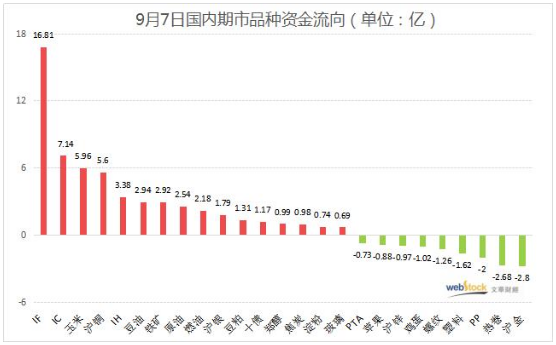
Today's capital flow

There was an obvious return of funds on Monday, with Wenhua commodities inflow of 1.318 billion yuan a day, of which 731 million yuan entered agricultural products and 588 million yuan went into industrial products futures. Feed sector was favored, 728 million supported its rally, corn monopolized nearly 600 million funds. Shanghai copper shot up and fell back, but there was still an increase of 561 million in capital, while the non-ferrous metal plate reaped a total of 443 million yuan. In addition, the crude oil sector that plummeted across the line received 474 million of the market for picking, while 330 million outflowed from the chemical sector.
Click to understand and sign up for the 2020 China Automotive New Materials Application Summit Forum.

Scan the QR code above to view the business cards of the participating companies and sign up online

Scan the code and apply to join the SMM Metal Industry Exchange Group.


Déclaration sur la source des données : À l'exception des informations publiques, toutes les autres données sont traitées par SMM sur la base d'informations publiques, d'échanges avec le marché et en s'appuyant sur le modèle de base de données interne de SMM. Ils sont fournis à titre indicatif uniquement et ne constituent pas des recommandations décisionnelles.

Pour toute demande d'information ou pour en savoir plus, veuillez contacter : lemonzhao@smm.cn
Pour plus d'informations sur l'accès à nos rapports de recherche, veuillez contacter :service.en@smm.cn
Actualités Connexes
La Tanzanie choisit la voie de traitement d'Imwelo après une hausse de la récupération d'or à 84,5 %
il y a 4 heures
La Tanzanie choisit la voie de traitement d'Imwelo après une hausse de la récupération d'or à 84,5 %
Lire la suite
La Tanzanie choisit la voie de traitement d'Imwelo après une hausse de la récupération d'or à 84,5 %
[SMM Gold Flash] Lake Victoria Gold a annoncé de nouveaux essais métallurgiques pour le minerai altéré de la zone C de son projet Imwelo Gold, entièrement autorisé, en Tanzanie. Le lavage par attrition suivi d'un débourbage a permis d'augmenter l'extraction d'or en 24 heures de 49,99 % à 84,54 % lors des essais de lixiviation agitée. La récupération en bouteille roulante a atteint 88,15 % après prétraitement, tandis que l'or récupérable par gravité a également augmenté. Les travaux ont été réalisés par Nesch Mintech Tanzania à Mwanza. La société a identifié le lavage par attrition et le débourbage comme la voie de prétraitement privilégiée pour une optimisation ultérieure du matériau proche de la surface, riche en argile. Lake Victoria Gold indique que ces résultats complètent les travaux antérieurs sur le matériau plus profond, où des récupérations d'environ 96 à 97 % avaient été rapportées. Il est important de noter que les récupérations annoncées concernent les fractions prétraitées testées et ne représentent pas encore la récupération globale de l'usine sur l'ensemble du minerai ; des travaux supplémentaires de bilan massique et d'optimisation sont prévus.
il y a 4 heures
Le forage d’Aurum livre une teneur de 155 g/t d’or à Boundiali, en Côte d’Ivoire
il y a 4 heures
Le forage d’Aurum livre une teneur de 155 g/t d’or à Boundiali, en Côte d’Ivoire
Lire la suite
Le forage d’Aurum livre une teneur de 155 g/t d’or à Boundiali, en Côte d’Ivoire
[SMM Gold Flash] Aurum Resources a publié de nouveaux résultats d'analyse provenant de 22 sondages au diamant totalisant 6 172,8 mètres sur le gisement BST1 de son projet aurifère Boundiali en Côte d'Ivoire. Les résultats comprennent 2,63 mètres à 76,74 g/t d'or à partir de 195,2 mètres, dont 1,3 mètre à 155 g/t, ainsi que 24 mètres à 6,31 g/t à partir de 108 mètres, dont 7 mètres à 19,25 g/t. Plusieurs intersections s'étendent au-delà de l'enveloppe de ressources existante de BST1. Ces résultats alimenteront la mise à jour prévue de la ressource minérale de Boundiali, ciblée pour le début du quatrième trimestre 2026. La société indique que la minéralisation reste ouverte le long de la direction et en profondeur, tandis que les forages se poursuivent sur l'ensemble du projet. Ces résultats constituent donc une avancée en matière d'exploration et de croissance des ressources plutôt qu'une production supplémentaire. Boundiali dispose actuellement d'une ressource minérale JORC de 3,22 millions d'onces, tandis qu'Aurum fait progresser une étude de faisabilité définitive.
il y a 4 heures
Le platine présente des liens plus forts avec l'inflation et les taux réels que l'or, selon une étude
il y a 4 heures
Le platine présente des liens plus forts avec l'inflation et les taux réels que l'or, selon une étude
Lire la suite
Le platine présente des liens plus forts avec l'inflation et les taux réels que l'or, selon une étude
[SMM Flash Or & MGP] Une nouvelle étude publiée dans le Journal of Commodity Markets révèle que le platine présente une co-variation plus large et plus persistante avec l'inflation et les taux d'intérêt réels que l'or. Les chercheurs Arusha Cooray et İbrahim Özmen ont examiné des données mensuelles de juillet 1999 à décembre 2024 pour les États-Unis, l'Allemagne, l'Italie, la France, la Suisse et les Pays-Bas, en utilisant l'analyse des points de retournement, la cohérence par ondelettes et les méthodes de causalité de Granger variables dans le temps. L'étude a constaté que les relations macroéconomiques de l'or étaient comparativement plus faibles et plus fragmentées, tandis que le platine et l'argent présentaient une synchronisation plus large, en particulier aux États-Unis et en Allemagne. Les chercheurs attribuent la plus forte sensibilité macroéconomique du platine en partie à son exposition industrielle substantielle, ce qui signifie que son prix reflète non seulement les conditions monétaires, mais aussi l'activité manufacturière, l'investissement et les contraintes d'offre. Les résultats n'établissent pas que le platine soit une couverture contre l'inflation universellement supérieure : les relations variaient selon les pays, les périodes et les régimes de politique monétaire. L'étude met plutôt en évidence une différence fondamentale entre les métaux, le rôle monétaire et défensif plus large de l'or produisant une réponse différente aux conditions d'inflation et de taux réels.
il y a 4 heures