[SMM thread] output peaked and fell, supply mountain finally loosened-SMM thread production report in July

Publié: Jul 10, 2020 19:47 (GMT+8)


According to SMM research, in July, the blast furnace steel mill, which mainly produces building materials, produced 9.0654 million tons of thread, down 2% from June, while the reel produced 2.694 million tons, an increase of 0.67% from the previous month. In addition, before the global epidemic can not be effectively controlled, domestic steel prices are still high, and the export volume of building materials from steel mills only maintains the basic level, which is basically unchanged from last month.

Table 1: an overview of the trend of thread production in China's mainstream building materials steel mills from 2019 to now


Source: SMM

Table 2: overhaul of building materials in steel mills from June to July (in ten thousand tons)


Source: SMM

From a sub-regional point of view, the output of South-Central and East China has dropped obviously this month, while that of North China and Northeast China has shown a slight upward trend. Specifically,


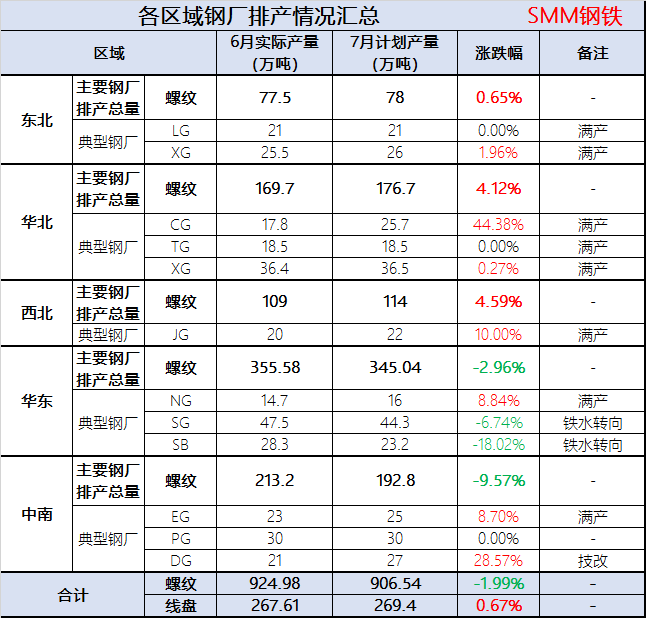
Northeast China: thread production increased by 0.65% month-on-month this month

Northwest China: thread production increased by 4.59% month-on-month this month

North China: thread production increased by 4.12% this month.

Mainly due to:

At present, the national market is still in a situation of "strong in the north and weak in the south". The northeast, northwest and even North China are less affected by seasonal interference, the terminal demand is good, the merchants' shipments are smooth, and the spot price is higher than the overall price level in the south. Take Beijing as an example, as of July 10, the base price of Beijing Hegang thread is 3700mur3720 yuan / ton, while the Hangzhou market Shagang thread is only 3660,670 yuan / ton. It is quite different from the situation in previous years (in 2019, the average price of Shagang thread in Hangzhou market is 153.7 yuan / ton higher than that in Beijing), the profitability of steel mills is good, the pressure on factories and depots is relatively small, and the willingness to produce is still high.


East China: thread production decreased by 2.96% month-on-month this month.

Central and South China: thread production decreased by 9.57% month-on-month this month.


Mainly due to:

Since mid-late June, various regions in the south have been deeply affected by the "Meiyu" weather, the construction rhythm of the construction site has been seriously dragged down, merchant shipments are not smooth, and the performance of rebar with stronger seasonality is particularly weak. the enthusiasm of steel mills to produce threads has cooled slightly under the double pressure of profit and inventory, and some steel mills have chosen to turn molten iron to plate coils, profiles and strips.


Table 3: production schedule of building materials in regional steel mills from June to July 2020
 

Source: SMM

Taken together-

The output of steel mills peaked and fell as scheduled in July. At a time when China has not yet completely got rid of the seasonal interference, it is difficult for the "steel needs" of the rebar terminal to break out substantially, and it is difficult to have an obvious strong-weak relationship between the profits of steel mills producing threads and other varieties. In the later period, the supply side is likely to maintain a narrow fluctuation pattern. At the same time, the demand side gradually warmed up under the contraction of the range of rain. Under the marginal improvement of fundamentals, the upward channel of thread spot price has been quietly opened.


Déclaration sur la source des données : À l'exception des informations publiques, toutes les autres données sont traitées par SMM sur la base d'informations publiques, d'échanges avec le marché et en s'appuyant sur le modèle de base de données interne de SMM. Ils sont fournis à titre indicatif uniquement et ne constituent pas des recommandations décisionnelles.

Pour toute demande d'information ou pour en savoir plus, veuillez contacter : lemonzhao@smm.cn
Pour plus d'informations sur l'accès à nos rapports de recherche, veuillez contacter :service.en@smm.cn
Actualités Connexes
Le Pérou prévoit une hausse d'un million de tonnes par an de sa production de cuivre d'ici cinq à six ans
26 Sep 2026 01:38 (GMT+8)
Le Pérou prévoit une hausse d'un million de tonnes par an de sa production de cuivre d'ici cinq à six ans
Lire la suite
Le Pérou prévoit une hausse d'un million de tonnes par an de sa production de cuivre d'ici cinq à six ans
Le ministre péruvien de l'Énergie et des Mines, Guillermo Shinno, a déclaré que le pays prévoit d'ajouter environ 1 million de tonnes de production annuelle de cuivre d'ici cinq à six ans grâce à de nouveaux projets miniers. Troisième producteur mondial de cuivre, le Pérou anticipe une production de 2,5 à 2,7 millions de tonnes en 2026, soit un niveau à peu près inchangé par rapport à 2023, la baisse des teneurs du minerai et les conflits sociaux récurrents pesant sur l'offre. Le gouvernement nouvellement élu cherche à inverser cette stagnation en réduisant la bureaucratie ; au cours des deux mois suivant son entrée en fonction, les sociétés minières ont intensifié leurs échanges avec le ministère. Shinno a indiqué que les autorités ont identifié 27 permis qui pourraient être supprimés parmi une centaine d'exigences du secteur minier, sans abaisser les normes environnementales.
26 Sep 2026 01:38 (GMT+8)
Le projet pilote BHP-Amazon sur le cuivre EAC suscite l'intérêt du secteur minier pour l'étiquetage bas carbone
25 Sep 2026 13:25 (GMT+8)
Le projet pilote BHP-Amazon sur le cuivre EAC suscite l'intérêt du secteur minier pour l'étiquetage bas carbone
Lire la suite
Le projet pilote BHP-Amazon sur le cuivre EAC suscite l'intérêt du secteur minier pour l'étiquetage bas carbone
Les médias miniers hispanophones rapportent que BHP et Amazon ont lancé le premier projet pilote de cuivre à faibles émissions à Escondida, utilisant des certificats d'attributs environnementaux qui certifient les réductions d'émissions au sein même du site minier plutôt que de les compenser ailleurs. Dévoilé le 22 septembre 2026, ce projet pilote s'appuie sur l'électricité renouvelable et l'eau dessalée d'Escondida, Amazon retirant les certificats afin d'associer des attributs bas carbone à son infrastructure d'IA. Escondida produit environ 1,2 million de tonnes de cuivre par an, ce qui en fait la plus grande mine au monde, et ce label devrait répondre à la demande croissante d'approvisionnement en métal bas carbone.
25 Sep 2026 13:25 (GMT+8)
La filiale de Western Mining obtient une licence de 17 ans pour la mine polymétallique du Qinghai
22 Sep 2026 16:11 (GMT+8)
La filiale de Western Mining obtient une licence de 17 ans pour la mine polymétallique du Qinghai
Lire la suite
La filiale de Western Mining obtient une licence de 17 ans pour la mine polymétallique du Qinghai
Le 22 septembre, Western Mining a annoncé que sa filiale à 100 %, Qinghai Ganxin Mining Development Co., Ltd. (« Ganxin Mining »), avait récemment obtenu un permis minier délivré par le Département des ressources naturelles de la province du Qinghai. La mine, dénommée mine polymétallique de fer de Geermu Tuwenchahan de Qinghai Ganxin Mining Development Co., Ltd., couvre le fer, le cuivre, l'or, le molybdène, le zinc, le plomb et l'argent comme substances minières autorisées. Le permis minier est valable du 3 août 2026 au 30 août 2043.
22 Sep 2026 16:11 (GMT+8)