Production data of Electrolytic Aluminum and Alumina in China from SMM in June

Publié: Jul 08, 2020 18:29 (GMT+8)
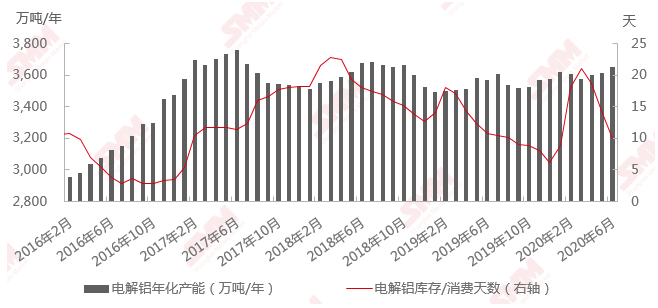
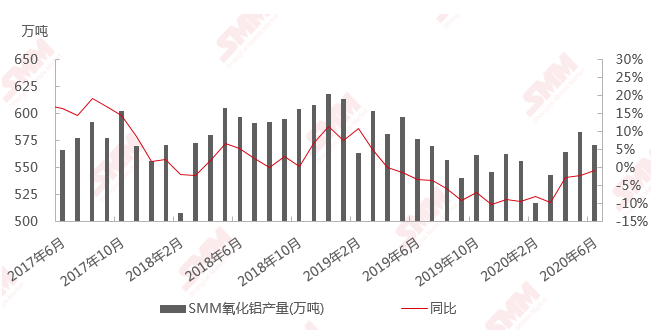
In June 2020, SMM China produced 3.004 million tons of electrolytic aluminum, an increase of 2.42 percent over the same period last year. By the end of June, the national operating capacity of electrolytic aluminum was 36.76 million tons per year. In June, SMM China produced 5.709 million tons of alumina, of which metallurgical grade alumina was 5.499 million tons, and the average daily output of metallurgical grade was 183000 tons, up 1.82 percent from the previous month and down 4.57 percent from the same period last year.

SMM, July 8:

Electrolytic aluminum:

According to SMM data, 3.004 million tons of electrolytic aluminum were produced in China in June 2020 (30 days), an increase of 2.42 per cent over the same period last year. By the end of June, the national operating capacity of electrolytic aluminum was 36.76 million tons / year, the completed capacity was 41.23 million tons / year, and the operating rate of national electrolytic aluminum enterprises was 89 percent. The overall operating rate was 0.3 percent higher than that at the end of May 2020. By the end of June, the operating capacity of domestic electrolytic aluminum has increased by 180000 tons / year compared with the end of May. Since June, under the stimulation of high profits, the domestic electrolytic aluminum production capacity has been gradually put into operation, and the monthly output growth rate has accelerated compared with the same period last year.

In the first half of 2020, the cumulative output of domestic electrolytic aluminum was 18.009 million tons, an increase of 2.93% over the same period last year; the cumulative consumption of domestic electrolytic aluminum was 17.69 million tons, and the cumulative year-on-year decline rapidly narrowed to 0.18%. Electrolytic aluminum continued to go to the warehouse in June, mainly due to the temperature at the supply end and the rise in demand for aluminum downstream. In July, the new capacity of electrolytic aluminum in Yunnan, Inner Mongolia and other places will continue to increase, and net imports are expected to increase slightly compared with June. SMM estimates that domestic electrolytic aluminum production in July (31 days) is 3.12 million tons, an increase of 1.79% over the same period last year, and the monthly consumption growth rate will narrow around 6.15% as supply rises and the margin of demand weakens.
Source: SMM

Alumina:

According to SMM data, China produced 5.709 million tons of alumina in June (30 days), of which metallurgical grade alumina was 5.499 million tons, and the average daily output of metallurgical grade was 183000 tons, an increase of 1.82% from the previous month and a decrease of 4.57% from the same period last year. In the first half of the year, China's cumulative metallurgical grade alumina output was 32.641 million tons, 7.6% lower than the same period last In the context of the mild rise in alumina prices during the month, the annual operating capacity of alumina in the northern region increased slightly compared with May, and the production reduction of individual alumina plants at the end of the month did not affect the output of that month.

As of the first ten days of July, the operating capacity of metallurgical grade alumina is 66.9 million tons, and the output of metallurgical grade alumina is expected to be 5.54 million tons in July (31 days), with the average daily output rising slightly to 184700 tons. On the whole, China's alumina market is still a month of increasing and reducing production in July. In terms of production reduction, the new materials of Chinalco Huaxing and Shanxi began to produce flexibly at the end of the month, and some alumina plants in southwest China had a roaster maintenance plan in July. In terms of increasing production, Guodian's Shanxi and Henan alumina plants have resumed or plan to resume production. Guodian Investment Sichuan will mass produce alumina products in July, and under the stimulation of rising alumina prices, there may be more reduced production capacity to resume production.
Source: SMM
 

Déclaration sur la source des données : À l'exception des informations publiques, toutes les autres données sont traitées par SMM sur la base d'informations publiques, d'échanges avec le marché et en s'appuyant sur le modèle de base de données interne de SMM. Ils sont fournis à titre indicatif uniquement et ne constituent pas des recommandations décisionnelles.

Pour toute demande d'information ou pour en savoir plus, veuillez contacter : lemonzhao@smm.cn
Pour plus d'informations sur l'accès à nos rapports de recherche, veuillez contacter :service.en@smm.cn
Actualités Connexes
Le laminoir à aluminium avancé de Henan Yirui entre en production, visant la croissance du marché haut de gamme
il y a 9 heures
Le laminoir à aluminium avancé de Henan Yirui entre en production, visant la croissance du marché haut de gamme
Lire la suite
Le laminoir à aluminium avancé de Henan Yirui entre en production, visant la croissance du marché haut de gamme
Le 20 septembre, le laminoir dégrossisseur à tôles fortes du projet de fabrication intelligente de nouveaux matériaux à base d'aluminium d'une capacité de 720 000 tonnes par an de Henan Yirui New Materials Technology Co., Ltd. a été officiellement mis en service. Avec un investissement total de 1,5 milliard de yuans, le projet exploite le site industriel existant pour construire une ligne de laminage à chaud continu « 1+4 » de niveau international, appuyée par des équipements de transformation de l'aluminium de pointe tels que des fours de réchauffage à longerons poussants. Le projet a également mis en place un système d'Internet industriel des objets capable de surveiller en temps réel et de réguler dynamiquement les paramètres de production essentiels tels que la force de laminage et la température, garantissant ainsi efficacement la stabilité de la qualité des produits en aluminium haut de gamme et augmentant continuellement la part de marché des produits à forte valeur ajoutée.
il y a 9 heures
La Guinée élargit sa coopération minière avec Glencore et vise à accroître ses revenus et son industrialisation
il y a 9 heures
La Guinée élargit sa coopération minière avec Glencore et vise à accroître ses revenus et son industrialisation
Lire la suite
La Guinée élargit sa coopération minière avec Glencore et vise à accroître ses revenus et son industrialisation
La Guinée prévoit d'étendre sa coopération avec Glencore au raffinage de l'alumine, à l'énergie, à l'or et aux métaux de base, afin d'accroître les revenus miniers, de promouvoir la transformation locale et l'industrialisation des ressources minérales, et de renforcer la coopération avec les marchés et les entreprises minières internationales en Chine, au Moyen-Orient et au-delà.
il y a 9 heures
Dingfeng Aluminium lance la phase II, visant une capacité annuelle de 200 000 tonnes au Cambodge
il y a 9 heures
Dingfeng Aluminium lance la phase II, visant une capacité annuelle de 200 000 tonnes au Cambodge
Lire la suite
Dingfeng Aluminium lance la phase II, visant une capacité annuelle de 200 000 tonnes au Cambodge
Le 21 septembre, la cérémonie de pose de la première pierre de la phase II (projet A3) de Dingfeng Aluminum Manufacturing (Cambodia) Co., Ltd., filiale du groupe Dihang, a eu lieu. Située dans la zone économique spéciale de la route n° 6, dans la province de Kampong Cham, au Cambodge, Dingfeng Aluminum est principalement engagée dans la R&D et la production de barres d'aluminium allié haut de gamme, de profilés d'aluminium haut de gamme et de produits destinés aux véhicules à énergie nouvelle, avec un ensemble complet de procédés et d'équipements de production couvrant la fusion et la coulée, l'extrusion, l'anodisation, l'usinage profond, l'usinage de précision et le traitement de surface. Une fois la phase II pleinement opérationnelle, la capacité de production annuelle atteindra 200 000 tonnes, pour une valeur de production annuelle pouvant atteindre 700 millions de dollars américains. La phase II (projet A3) prévoit un atelier de transformation pour véhicules à énergie nouvelle de 24 340 m² (bâtiment en structure acier d'un seul étage), un atelier d'extrusion de 15 291 m², ainsi que des installations annexes telles qu'un immeuble de bureaux, un poste de garde et un local de distribution électrique.
il y a 9 heures