China spodumene concentrate import price fell 31% YoY in March

Published: Apr 30, 2020 14:35
SMM expects the import prices of spodumene concentrate to fall further and approach $420/mt cif in the months ahead as domestic demand may decline with smelters shifting ore stockpiles into lithium salt finished products inventory.

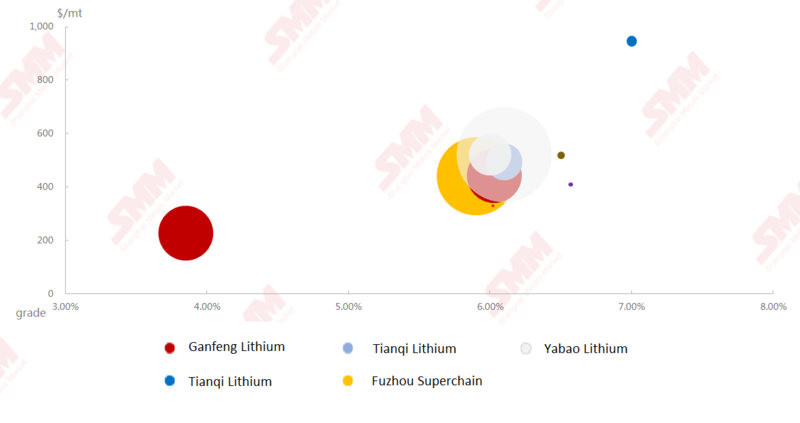
SHANGHAI, Apr 30 (SMM) – China imported about 130,000 mt in physical content of spodumene concentrate in March, with the average import price down 15.8% on the month and down 31% on the year to $456/mt, showed SMM calculations based on the latest customs data. 


A greater proportion of spodumene concentrate imports with a lower grade of 4% by major importer Ganfeng Lithium accounted for the reduced average import price. 


The amounts of domestic imports used to produce lithium salts stood at 130,000 mt in March, 17.7% higher on the month while 26.7% lower on the year, with the average import price at $453/mt, down 7.7% from a month ago and 31.9% from a year earlier. 


No seaborne spodumene raw ore entered China in March. 


Last month, Chinese lithium compounds producer Jiangxi Yabao Lithium was the top importer of spodumene concentrate, as it took about 6,800 mt of lithium carbonate equivalent (LCE) from overseas, which was used to produce lithium salts. The average import price stood at $521/mt on a cif basis.


Fuzhou Superchain ranked the second-largest Chinese importer of spodumene concentrate last month, who took 3,800 mt of LCE in March. Import prices for the company averaged $440/mt on a cif basis.


Excluding the import prices from Tianqi, Ganfeng and Yabao, which were agreed in long-term contracts, the prices of spodumene concentrate imports used to produce lithium salts averaged $439.8/mt in March. 


China spodumene concentrate import price and grade in March (Source: SMM, China customs) 

SMM expects the import prices of spodumene concentrate to fall further and approach $420/mt cif in the months ahead as domestic demand may decline with smelters shifting ore stockpiles into lithium salt finished products inventory. 


On the backdrop of weak power battery demand at home and abroad, end-users focused on destocking battery raw materials. This dented orders for battery-grade lithium carbonate and sustained the decline in its prices. 


SMM assessed prices of domestic 99.5% battery-grade lithium carbonate at 44,000-45,500 yuan/mt as of April 30, down 1,250 yuan/mt from a week ago and down 2,250 yuan/mt from a month earlier. 


Mining companies in Australia may further slow down operations in the second quarter. This, together with the cost pressure on the mining and smelting front, will cap the downsides of prices in the industry. 


Data Source Statement: Except for publicly available information, all other data are processed by SMM based on publicly available information, market communication, and relying on SMM's internal database model. They are for reference only and do not constitute decision-making recommendations.

For any inquiries or for more information, please contact: lemonzhao@smm.cn
For more information on how to access our research reports, please contact:service.en@smm.cn
Related News
GM move into sodium batteries spurs Korea to accelerate ESS push
3 hours ago
GM move into sodium batteries spurs Korea to accelerate ESS push
Read More
GM move into sodium batteries spurs Korea to accelerate ESS push
U.S. automotive giant General Motors (GM) has announced an investment in U.S. startup Peak Energy and plans to advance the commercialization of sodium-ion batteries, primarily for energy storage systems (ESS), with deployment targeted after 2029. This marks the first meaningful entry of a non-Chinese automaker into the field and is prompting Korea’s battery industry to incorporate sodium-ion technology into its strategic priorities, even as it accelerates efforts to catch up in LFP. Unlike ternary batteries (NCM/NCA) and LFP, which rely on lithium, sodium-ion batteries use more abundant and lower-cost sodium as a substitute, offering advantages such as greater supply chain stability, better low-temperature performance, and enhanced safety—making them particularly suitable for large-scale energy storage applications. At the same time, increased volatility in lithium prices has further strengthened the cost competitiveness of sodium-ion batteries. Korean players including LG Energy Solution, Samsung SDI, and SK On have already accelerated their efforts, aiming to advance sample production or commercialization around 2027. Overall, GM’s entry signals that a technology pathway previously dominated by Chinese companies is becoming globalized, and it is likely to push Korean battery manufacturers to accelerate adjustments to their technology and product portfolios.
3 hours ago
[Lithium Battery: EVE Energy's H1 2026 Net Profit Up 95% To 110% YoY]
4 hours ago
[Lithium Battery: EVE Energy's H1 2026 Net Profit Up 95% To 110% YoY]
Read More
[Lithium Battery: EVE Energy's H1 2026 Net Profit Up 95% To 110% YoY]
[Lithium Battery: EVE Energy's H1 2026 Net Profit Up 95% To 110% YoY]
On June 15, EVE Energy disclosed its performance forecast for the first half of 2026. During this period, the net profit attributable to shareholders of the listed company is expected to reach between 3.130 billion yuan and 3.371 billion yuan, representing a year-on-year increase of 95% to 110%. The performance growth is primarily attributed to product iteration, service upgrades, and process optimization, with operating revenue increasing by approximately 60% year-on-year in the first half of the year. Meanwhile, in the face of upward pressure on supply chain costs, EVE Energy effectively cushioned the impact of material cost fluctuations through diversified supply chain layouts, strategic procurement, and the prudent use of financial instruments, ensuring the stability of profitability in its core business.
4 hours ago
[Lithium Battery: Phase I 30,000-Ton Battery-Grade Lithium Carbonate Project Planned For Guizhou]
4 hours ago
[Lithium Battery: Phase I 30,000-Ton Battery-Grade Lithium Carbonate Project Planned For Guizhou]
Read More
[Lithium Battery: Phase I 30,000-Ton Battery-Grade Lithium Carbonate Project Planned For Guizhou]
[Lithium Battery: Phase I 30,000-Ton Battery-Grade Lithium Carbonate Project Planned For Guizhou]
Recently, the pre-approval public notice for the environmental impact report of the Kaiyang "Phosphorus-Titanium-Iron-Lithium" Coupling Cyclic Integration Project's annual 150,000-ton battery-grade lithium carbonate project (Phase I: 30,000 tons) has been released. The project is located in Kaiyang County, Guiyang City, Guizhou Province, with an estimated total investment of 881.67 million yuan, including an environmental protection investment of 40 million yuan. The planned construction period is 18 months. The project will establish a 30,000-ton-per-year battery-grade lithium carbonate production line, with an annual by-product of 84,960 tons of anhydrous sodium sulfate.
4 hours ago
China spodumene concentrate import price fell 31% YoY in March - Shanghai Metals Market (SMM)