[SMM Analysis] further extension of Action Control, revelation of the status quo of Copper scrap recovery in Malaysia

Publié: Apr 24, 2020 14:51 (GMT+8)

SMM4, 24th:

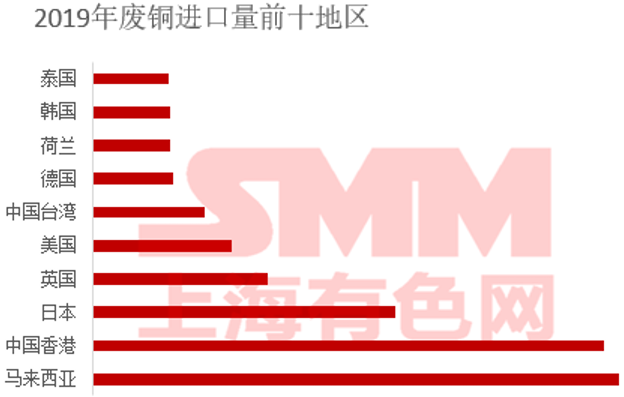
On the evening of April 23, Malaysian Prime Minister Muyuddin announced in a televised message of Ramadan that Malaysian copper scrap exports would continue to be affected by the further extension of the operation control order in Malaysia until 12 May. SMM data show that in 2019, China imported a total of 1.193 million tons of scrap copper, accounting for 61.39% of the total domestic scrap copper, and Malaysia accounted for about 16.54% of the total scrap copper imports. At present, China is the largest source of scrap copper import, and the recovery of its copper scrap industry has an important impact on the supply of China's scrap copper market.
Although the action control measures continue to be extended, the Malaysian Government has previously announced the gradual opening of eight areas, including the machinery and equipment industry, the aviation industry, the construction industry and construction-related services, the automotive industry and maintenance, legal-related services, oil and gas-related services, crown disease-related R & D activities, laboratories operating in specific areas, traditional and auxiliary medicine and Chinese medicine services. Scrap copper dismantling enterprises are not included for the time being, production is still strictly controlled, but the overall control measures have a trend of gradual liberalization.

According to SMM research, some factory areas have workers, and far from the urban area, relatively loose control of copper scrap dismantling enterprises have avoided supervision of private small-scale resumption of production, it is still impossible to large-scale resumption of production, once the resumption of production will face heavier fines. Under the order, most copper scrap enterprises are still in a state of shutdown. In addition, due to the reduction of waste copper exports from Europe and the United States, there is also a shortage of local waste wires, waste motors and other dismantling raw materials.

In addition to being affected by the national regulatory policy, the arrival of enterprise personnel also has a great impact on the resumption of work in copper scrap enterprises. In the process of tightening domestic copper import policy in the past two years, Southeast Asia, represented by Malaysia, has become a new concentration of waste in the world. More and more Chinese enterprises have invested and built factories in the region, and have a very important market share in the local market, including dismantling, smelting, smelting and copper processing enterprises. At present, in addition to the arrival of grass-roots workers in Malaysia's local copper scrap plants, the arrival rate of middle-level Chinese managers is also very low. In the context of countries focused on strictly preventing the import of the epidemic, it is expected that the Malay government's measures to restrict the entry of foreigners will not be lifted for quite some time, the lack of decision-making arrangements for managers, and to a certain extent obstacles to the resumption of production.

According to relevant sources, at present, Malaysia's local scrap copper dismantling enterprises have a backlog of scrap copper finished products, occupying a relatively high level of funds, and enterprises are speeding up exports to China in order to alleviate the pressure, but due to port logistics problems, it is expected that goods will arrive one after another in mid-May, when the supply of imported scrap copper is expected to gradually improve. However, in the short term, the domestic import supply is still relatively tight, the shortage of domestic supply is difficult to alleviate, and the production of waste enterprises continues to be disturbed, which is good for the consumption of refined copper.

Déclaration sur la source des données : À l'exception des informations publiques, toutes les autres données sont traitées par SMM sur la base d'informations publiques, d'échanges avec le marché et en s'appuyant sur le modèle de base de données interne de SMM. Ils sont fournis à titre indicatif uniquement et ne constituent pas des recommandations décisionnelles.

Pour toute demande d'information ou pour en savoir plus, veuillez contacter : lemonzhao@smm.cn
Pour plus d'informations sur l'accès à nos rapports de recherche, veuillez contacter :service.en@smm.cn
Actualités Connexes
【Flash | NAS relève le prix de base de l'inox laminé à froid type 316】
il y a 10 minutes
【Flash | NAS relève le prix de base de l'inox laminé à froid type 316】
Lire la suite
【Flash | NAS relève le prix de base de l'inox laminé à froid type 316】
North American Stainless (NAS), filiale d'Acerinox, a annoncé que les produits laminés à froid de type 316 expédiés à partir du 1er octobre bénéficieraient d'un prix de base plus élevé grâce à une réduction de deux points de la remise fonctionnelle. Toutes les demandes de devis en cours sont soumises à cet ajustement. Il s'agit d'une modification du mécanisme de prix de base et non d'une surtaxe mensuelle d'alliage.
il y a 10 minutes
【Flash | Industeel réduit les surcharges d'octobre sur les nuances inoxydables au molybdène】
il y a 12 minutes
【Flash | Industeel réduit les surcharges d'octobre sur les nuances inoxydables au molybdène】
Lire la suite
【Flash | Industeel réduit les surcharges d'octobre sur les nuances inoxydables au molybdène】
Industeel, filiale d'ArcelorMittal, a récemment mis à jour ses surcharges d'octobre pour les alliages inoxydables. Le 316L/316LN a reculé de 0,9 % en glissement mensuel à 3 684 €/t, le 316LMo de 0,7 % à 4 115 €/t, le 317L de 0,7 % à 4 758 €/t et le 904L de 1,0 % à 6 768 €/t. Les 2205+ et 2507 sont restés quasi stables à 3 724 €/t et 4 389 €/t, tandis que l'UR 254 s'est replié à 7 147 €/t. Le barème exclut la surcharge énergétique.
il y a 12 minutes
Le projet de cuivre MARA (Agua Rica–Alumbrera) de Glencore en Argentine obtient l'approbation du RIGI
il y a 16 minutes
Le projet de cuivre MARA (Agua Rica–Alumbrera) de Glencore en Argentine obtient l'approbation du RIGI
Lire la suite
Le projet de cuivre MARA (Agua Rica–Alumbrera) de Glencore en Argentine obtient l'approbation du RIGI
Glencore a annoncé que son projet Minera Agua Rica-Alumbrera (MARA) à Catamarca, en Argentine, a été approuvé dans le cadre du Régime d'incitation aux grands investissements (RIGI), avec un investissement prévu d'environ 4 milliards de dollars US et une stabilité fiscale, douanière et de change à long terme, incluant un taux d'impôt sur les sociétés de 25 %. Agua Rica recèle des ressources mesurées et indiquées d'environ 1,2 milliard de tonnes à 0,47 % de cuivre, 0,20 g/t d'or, 3,40 g/t d'argent et 0,03 % de molybdène. Le minerai sera traité à l'usine existante d'Alumbrera, située à 35 km, avec un potentiel de production moyenne de plus de 200 000 tonnes par an de cuivre en concentré au cours des dix premières années. Le redémarrage d'Alumbrera est avancé au second semestre 2027, avec près de 2 000 travailleurs sur site. Le gouvernement prévoit le début de la construction en novembre 2027 et la production à partir d'octobre 2031 ; l'étude d'impact environnemental de la phase d'exploitation a été soumise le mois dernier et son approbation ne constitue pas une décision finale de construction.
il y a 16 minutes