[SMM Analysis] interpretation of the Secrets behind the change of Electrolytic Copper inventory in Guangdong in the first quarter

Publié: Apr 03, 2020 18:29 (GMT+8)

SMM4, March 3: ups and downs in the first quarter of 2020 so passed, the global economy affected by the outbreak of a sharp decline, Guangdong electrolytic copper stocks have also experienced a roller coaster trend (see chart below). At one point, inventories of 119100 tonnes were set on March 5, but as consumption recovered, shipments fell sharply and inventories fell sharply. As of April 3, Guangdong inventories had fallen to 82800 tonnes, only 2500 tonnes more than in the same period last year.
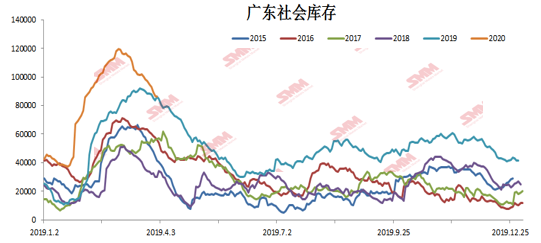
Why there is such a trend, we can interpret it from two aspects: out of storage and in storage:

Storage:
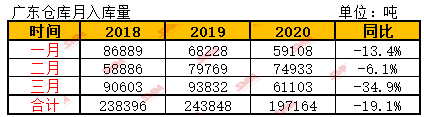
Although the volume of shipments fell in the first two months of the past two years compared with the same period last year, the decline was not significant; however, there was a cliff-like decline in March (- 34.9%). In addition to the reduction in production by smelters, the sharp reduction in imports of copper and the transfer of shipments by smelters are also important reasons. The sharp drop in arrivals was one of the important reasons for the rapid decline in inventories in March.

Out of the warehouse:
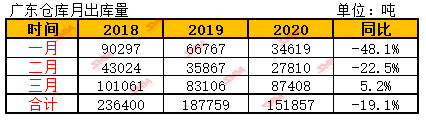
In the first quarter of 18 years, the level of outflow and storage is the same, which can be understood as a general balance between supply and demand. However, the output began to decline significantly from 19 years, on the one hand, affected by the decline in downstream consumption in that year, on the other hand, affected by the increase in the business of the smelter. With the easing of the epidemic in March 20, consumption in the lower reaches of Guangdong rebounded rapidly, and the output in March rose 5.2% from the same period last year, completely reversing the downturn of the previous two months.

Overall:
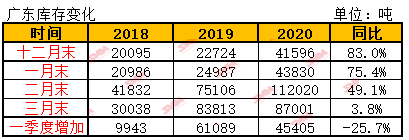
In 18 years, supply and demand were basically balanced, with inventory increasing only slightly by 10, 000 tons in the first quarter; in 19 years, supply exceeded demand due to the expected impact of the tax reform, and inventories increased sharply by more than 61100 tons in the first quarter; and in 20 years, affected by the epidemic, demand dropped noticeably, and inventories also increased significantly by 45400 tons in the first quarter. Looking forward to April, the volume of goods will hit bottom and rebound, but consumption growth is weak, and the removal of inventories is expected to slow in April.
Déclaration sur la source des données : À l'exception des informations publiques, toutes les autres données sont traitées par SMM sur la base d'informations publiques, d'échanges avec le marché et en s'appuyant sur le modèle de base de données interne de SMM. Ils sont fournis à titre indicatif uniquement et ne constituent pas des recommandations décisionnelles.

Pour toute demande d'information ou pour en savoir plus, veuillez contacter : lemonzhao@smm.cn
Pour plus d'informations sur l'accès à nos rapports de recherche, veuillez contacter :service.en@smm.cn
Actualités Connexes
Glencore vise un dépôt environnemental en 2027 pour El Pachón
il y a 9 minutes
Glencore vise un dépôt environnemental en 2027 pour El Pachón
Lire la suite
Glencore vise un dépôt environnemental en 2027 pour El Pachón
Glencore prévoit de soumettre l'étude d'impact environnemental de son projet de cuivre-molybdène El Pachón, situé à San Juan, en Argentine, en 2027, afin de faire avancer les autorisations dans le cadre du régime d'investissement RIGI du pays. El Pachón est un porphyre à l'échelle d'un district, avec environ 6 milliards de tonnes de ressources à 0,43 % de Cu, au stade de l'étude de faisabilité, conçu pour une production d'environ 280 000 t/an de cuivre sur une durée de vie de 30 ans, avec des dépenses d'investissement de phase 1 comprises entre 8,5 et 10,5 milliards de dollars américains (point médian de 9,5 milliards de dollars pour le dossier RIGI). Glencore l'associe à Agua Rica–MARA, dans la province de Catamarca, pour construire environ 1 Mt/an de cuivre argentin d'ici 10 à 15 ans, avec une production initiale d'environ 500 000 t/an. Le dépôt de l'étude d'impact environnemental constitue une étape d'autorisation déterminante qui façonnera l'offre de concentrés à moyen terme en Amérique du Sud.
il y a 9 minutes
BHP forme une alliance d'exploration du cuivre avec Kobrea à Mendoza
il y a 9 minutes
BHP forme une alliance d'exploration du cuivre avec Kobrea à Mendoza
Lire la suite
BHP forme une alliance d'exploration du cuivre avec Kobrea à Mendoza
BHP Metals Exploration et la société canadienne Kobrea Exploration ont formé une alliance d'exploration couvrant les sept projets de cuivre Western Malargüe de Kobrea, dans la province de Mendoza, en Argentine. BHP versera une avance unique de 3 millions de dollars US et financera au moins 5 millions de dollars US au cours d'une phase initiale de génération de projets de deux ans. Pour chaque projet retenu, BHP pourra acquérir une participation de 75 % en finançant seul au moins 40 millions de dollars US d'exploration sur huit ans, jusqu'à quatre projets pouvant évoluer en coentreprises (BHP 75 %, Kobrea 25 %). L'ensemble foncier s'étend sur 73 334 hectares de terrains porphyriques prospectifs à cuivre-or-molybdène. La campagne antérieure El Perdido de Kobrea a réalisé six sondages totalisant 2 358 m, confirmant une minéralisation porphyrique, et un programme de 4 millions de dollars US financé par BHP pour 2026/2027, avec forage au diamant à El Destino, a été approuvé.
il y a 9 minutes
Errington Metals publie une première estimation de ressources pour son projet du bassin de Sudbury
il y a 9 minutes
Errington Metals publie une première estimation de ressources pour son projet du bassin de Sudbury
Lire la suite
Errington Metals publie une première estimation de ressources pour son projet du bassin de Sudbury
Errington Metals a publié une première estimation des ressources minérales pour son projet du bassin de Sudbury, en Ontario, totalisant 14,2 millions de tonnes de ressources mesurées et indiquées en cuivre, zinc, plomb, or et argent sur les gisements d’Errington, de Vermillion et de Balfour. La propriété de 5 600 hectares se situe à environ 25 km au nord-ouest du Grand Sudbury et a été détenue par Glencore Canada et ses prédécesseurs jusqu’à sa mise en veille en 2014; Errington en a fait l’acquisition en 2025 et y a lancé l’exploration. La société exécute actuellement un programme de forage entièrement financé pouvant atteindre 55 000 m jusqu’en 2027 afin d’élargir la base de ressources et de faire progresser les études métallurgiques. Les trois gisements demeurent ouverts le long de la direction et en profondeur, positionnant le projet comme un nouveau fournisseur canadien potentiel de cuivre, de zinc et de métaux sous-produits.
il y a 9 minutes