Cobalt sulphate prices to extend declines in March amid inventory buildup 

Published: Mar 19, 2020 16:41
SMM expects cobalt sulphate prices to extend declines to 46,000-47,000 yuan/mt by end-March as demand from motive power battery sector may remain subdued this month. Downstream consumption in April will likely improve markedly from March, which may see cobalt sulphate prices stemming declines in the second half of April.

SHANGHAI, Mar 19 (SMM) – Reduced demand and bearish sentiment triggered by the coronavirus outbreak have depressed prices of cobalt sulphate, a major raw material of ternary batteries, since early March. SMM sees further downward potential in the near-term prices, before the resumption of end-users demand and stepped-up operations of automakers support prices in the second half of April as COVID-19 becomes more contained in China. 


SMM expects cobalt sulphate prices to extend declines to 46,000-47,000 yuan/mt by end-March as demand from motive power battery sector may remain subdued this month. Downstream consumption in April will likely improve markedly from March, which may see cobalt sulphate prices stemming declines in the second half of April.


As of March 19, spot prices of domestic cobalt sulphate stood at 48,000-51,000 yuan/mt, down 1,500 yuan/mt from the previous day and down 8,000 yuan/mt from a high level in early March, SMM assessments showed. 


According to SMM calculations, the cost price of cobalt sulphate is about 46,000 yuan/mt. Current downbeat demand may drive cobalt salt producers to sell at costs in the short term, but there is also a chance that prices will be lifted in May if escalations in the COVID0-19 development disrupt raw materials supply in late-April. Most cobalt salt plants in China have stored feedstock inventories that could meet demand until the second half of April. 


As of March 11, about 90% of automakers in China have restarted operations, with the rate of resumption for workers rising to 77%, showed a survey from the China Association of Automobile Manufacturers (CAAM). However, plunges in NEV sales over the past two months added to inventory pressure at distributors and capped the rebound in operating rates. SMM expects operations at carmakers to return to normal levels in the first half of April.


A delay in downstream demand recovery also constrained operations of motive power battery plants. Producers of ternary materials and precursors were compelled to reduce offers and slowed purchases of feedstock. 


Demand from the consumer battery market, meanwhile, revived at a faster pace and underpinned the demand for cobalt salts. But some consumer battery producers purchased cheap recycled products of cobalt sulphate as their requirement for the feedstock quality is looser than that of motive power battery plants. 


SMM data indicates that inventories of cobalt sulphate in China rose a net 206 mt in metal content in February. The stocks had increased an accumulative 984 mt in metal content since 2018.  


China cobalt sulphate demand and supply balance (source: SMM)
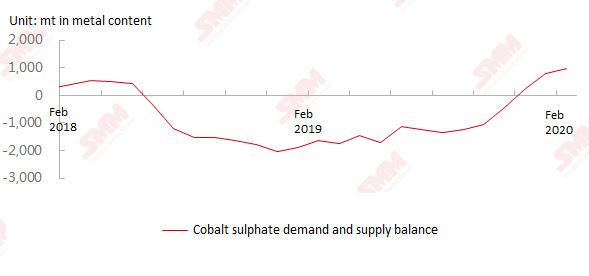

Overall consumption of cobalt sulphate in China is assessed at 1,500 mt in metal content last month, with demand from ternary precursor sector standing at 1,000 mt in metal content, down 68.8% on the month and down 62.5% on the year. SMM expects consumption of cobalt sulphate from the precursor sector to recover in March with the return of end-users demand. 


On the supply front, China produced 1,800 mt in metal content of cobalt sulphate in February, 40.3% lower on the month and 47.6% lower on the year. The impact of COVID-19 pandemic on production was less significant than that on the demand, which led to a continued buildup in cobalt sulphate inventories. 


SMM expects domestic cobalt sulphate output to rebound 113.5% on the month in March to 3,900 mt in metal content, 1% lower from a year earlier, as cobalt salt plants restarted operations this month.
 

Data Source Statement: Except for publicly available information, all other data are processed by SMM based on publicly available information, market communication, and relying on SMM's internal database model. They are for reference only and do not constitute decision-making recommendations.

For any inquiries or for more information, please contact: lemonzhao@smm.cn
For more information on how to access our research reports, please contact:service.en@smm.cn
Related News
GM move into sodium batteries spurs Korea to accelerate ESS push
9 hours ago
GM move into sodium batteries spurs Korea to accelerate ESS push
Read More
GM move into sodium batteries spurs Korea to accelerate ESS push
U.S. automotive giant General Motors (GM) has announced an investment in U.S. startup Peak Energy and plans to advance the commercialization of sodium-ion batteries, primarily for energy storage systems (ESS), with deployment targeted after 2029. This marks the first meaningful entry of a non-Chinese automaker into the field and is prompting Korea’s battery industry to incorporate sodium-ion technology into its strategic priorities, even as it accelerates efforts to catch up in LFP. Unlike ternary batteries (NCM/NCA) and LFP, which rely on lithium, sodium-ion batteries use more abundant and lower-cost sodium as a substitute, offering advantages such as greater supply chain stability, better low-temperature performance, and enhanced safety—making them particularly suitable for large-scale energy storage applications. At the same time, increased volatility in lithium prices has further strengthened the cost competitiveness of sodium-ion batteries. Korean players including LG Energy Solution, Samsung SDI, and SK On have already accelerated their efforts, aiming to advance sample production or commercialization around 2027. Overall, GM’s entry signals that a technology pathway previously dominated by Chinese companies is becoming globalized, and it is likely to push Korean battery manufacturers to accelerate adjustments to their technology and product portfolios.
9 hours ago
[Lithium Battery: EVE Energy's H1 2026 Net Profit Up 95% To 110% YoY]
10 hours ago
[Lithium Battery: EVE Energy's H1 2026 Net Profit Up 95% To 110% YoY]
Read More
[Lithium Battery: EVE Energy's H1 2026 Net Profit Up 95% To 110% YoY]
[Lithium Battery: EVE Energy's H1 2026 Net Profit Up 95% To 110% YoY]
On June 15, EVE Energy disclosed its performance forecast for the first half of 2026. During this period, the net profit attributable to shareholders of the listed company is expected to reach between 3.130 billion yuan and 3.371 billion yuan, representing a year-on-year increase of 95% to 110%. The performance growth is primarily attributed to product iteration, service upgrades, and process optimization, with operating revenue increasing by approximately 60% year-on-year in the first half of the year. Meanwhile, in the face of upward pressure on supply chain costs, EVE Energy effectively cushioned the impact of material cost fluctuations through diversified supply chain layouts, strategic procurement, and the prudent use of financial instruments, ensuring the stability of profitability in its core business.
10 hours ago
[Lithium Battery: Phase I 30,000-Ton Battery-Grade Lithium Carbonate Project Planned For Guizhou]
10 hours ago
[Lithium Battery: Phase I 30,000-Ton Battery-Grade Lithium Carbonate Project Planned For Guizhou]
Read More
[Lithium Battery: Phase I 30,000-Ton Battery-Grade Lithium Carbonate Project Planned For Guizhou]
[Lithium Battery: Phase I 30,000-Ton Battery-Grade Lithium Carbonate Project Planned For Guizhou]
Recently, the pre-approval public notice for the environmental impact report of the Kaiyang "Phosphorus-Titanium-Iron-Lithium" Coupling Cyclic Integration Project's annual 150,000-ton battery-grade lithium carbonate project (Phase I: 30,000 tons) has been released. The project is located in Kaiyang County, Guiyang City, Guizhou Province, with an estimated total investment of 881.67 million yuan, including an environmental protection investment of 40 million yuan. The planned construction period is 18 months. The project will establish a 30,000-ton-per-year battery-grade lithium carbonate production line, with an annual by-product of 84,960 tons of anhydrous sodium sulfate.
10 hours ago
Cobalt sulphate prices to extend declines in March amid inventory buildup  - Shanghai Metals Market (SMM)