Cobalt and lithium producers in Hubei to resume in mid-March

Publié: Mar 11, 2020 16:51 (GMT+8)
Full resumption of industrial production is expected across China on March 15, including producers in Hubei, the epicentre of the coronavirus, the latest SMM survey showed. Companies in Hubei are currently in preparation for the recovery. The operating rates of Chinese cobalt salts plants are expected to rise to normal levels in March, from only 30-40% in February. As of March 11, the rates stood at 50-60% for most cobalt salts mills.
SHANGHAI, Mar 11 (SMM) – All industrial enterprises across China will be allowed to resume operations on March 15, including producers in Hubei, the epicenter of the coronavirus, the latest SMM survey showed. Companies in Hubei are currently in preparation for the recovery. 


Cobalt salts


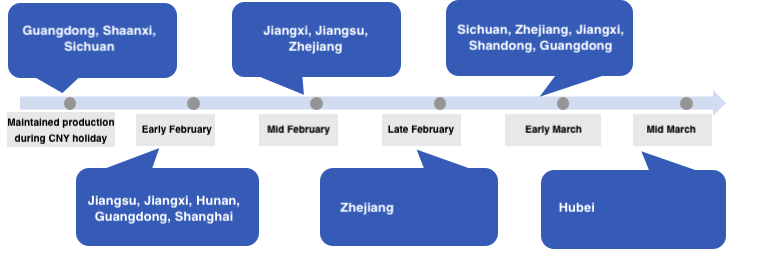
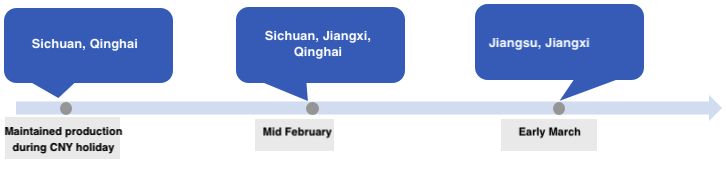
Producers of cobalt salts in Guangdong, Jiangxi, Shanghai and Hunan mostly maintained operations or restarted production in early February, given limited impact from the COVID-19. Some plants in Jiangxi, Jiangsu and Zhejiang reopened in the second half of February due to logistics restrictions and shortage of raw materials. Those producers kept operating rates at low levels for February, and have resumed 50-60% of capacity so far. Several cobalt salt producers in Sichuan, Zhejiang, Jiangxi, Shandong and Guangdong recovered production in early March, and are gradually raising operating rates. Producers in Hubei will officially resume operations in mid-March. 


The operating rates of Chinese cobalt salts plants are expected to rise to normal levels in March, from only 30-40% in February. As of March 11, the rates stood at 50-60% for most cobalt salts mills.


Lithium salts


Smelters in Jiangxi and Sichuan reduced production in February due to the virus impact. Output in Qinghai, areas that felt a limited impact from the virus, was also lower last month as producers usually schedule output cut on weather issues in winter and some plants scaled back production on elevated inventories. 
In February, production of lithium carbonate declined the most in Jiangxi, by 68.1% from a month earlier, SMM assessed. Lithium carbonate production in Qinghai was estimated to fall 17.9% last month, while output in Sichuan shrank only 10% given the continuous production of a major mill over the Chinese New Year holiday.  


Smelters in different areas had resumed operations in the second half of February, with the operating rates likely improving markedly in March. SMM expects the average rate to rise to 80% in the second half of March. 


Cobalt (II, III) oxide, ternary precursor


Producers of cobalt (II, III) oxide were limitedly hit by the COVID-19 given a high concentration ratio of the industry. Operating rates of most cobalt (II, III) oxide plants have reached 60-70% as of March 11, and the rate will remain buoyant in March. For most producers of ternary precursor, the operating rates have climbed to 60%, with some major producers lifting rates to 70-80%. 


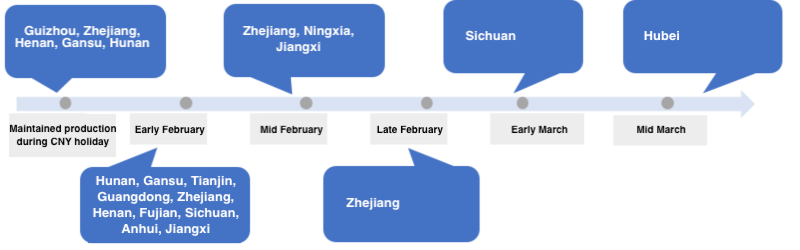
Some producers of cobalt (II, III) oxide and ternary precursor in Guizhou, Zhejiang, Gansu and Hunan maintained operations during the CNY holiday and have lowered their operating rates. Producers in most areas restarted work in early February, and some plants in Zhejiang, Ningxia and Jiangxi only recovered in the second half of February. Producers in Hubei are scheduled to return in mid-March. 


SMM research found that inventories of cobalt (II, III) oxide piled up in February due to sluggish purchases by downstream producers of batteries and lithium cobalt oxide (LCO), who operated at low rates last month. 


Cathode materials 


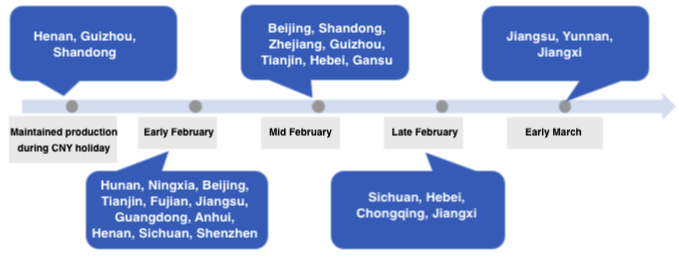
Operating rates of cathode materials plants were significantly weighed by the delayed resumption of downstream battery producers. A handful of cathode materials mills in Henan, Guizhou and Shandong continued their operations during the CNY holiday, while producers in most provinces and cities returned from holidays in early February, and focused on fulfilling pre-holiday orders. As of March 11, more than 90% of the cathode materials producers in China have restarted operations. 


As of March 11, operating rates of most cathode materials plants have recovered to 50-60% with the rates at major mills rising to 70-80%, compared to an overall rate below 40% in February. Some producers of lithium manganese oxide (LMO) and LCO reported higher operating rates of 70%, while producers of ternary materials and lithium iron phosphate (LFP) mostly kept their rates at 60%. SMM expects overall operating rates to normalise between late-March and April. 


Battery


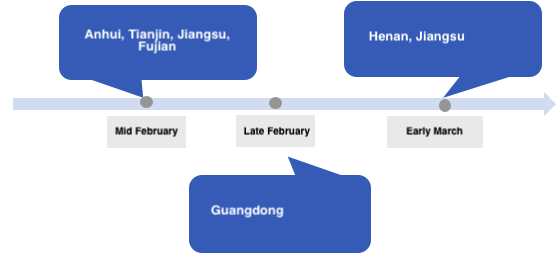
Battery mills and carmakers, except for major producers such as Tesla, maintained low operating rates last month as the epidemic dampened consumption and resulted in sharp declines in production of new energy vehicles and batteries. Battery mills in Anhui, Tianjin, Jiangsu, Fujian and Guangdong resumed operations successively in the second half of February. About 60% of battery makers in China have reopened as of March 11, with the operating rates also climbing. Producers of consumer batteries resumed at a faster pace compared to power battery mills, and have started to restock raw materials. 


Déclaration sur la source des données : À l'exception des informations publiques, toutes les autres données sont traitées par SMM sur la base d'informations publiques, d'échanges avec le marché et en s'appuyant sur le modèle de base de données interne de SMM. Ils sont fournis à titre indicatif uniquement et ne constituent pas des recommandations décisionnelles.

Pour toute demande d'information ou pour en savoir plus, veuillez contacter : lemonzhao@smm.cn
Pour plus d'informations sur l'accès à nos rapports de recherche, veuillez contacter :service.en@smm.cn
Actualités Connexes
Highpower International prévoit une croissance de son bénéfice net en glissement annuel pour les trois premiers trimestres
il y a 38 minutes
Highpower International prévoit une croissance de son bénéfice net en glissement annuel pour les trois premiers trimestres
Lire la suite
Highpower International prévoit une croissance de son bénéfice net en glissement annuel pour les trois premiers trimestres
【Highpower International prévoit une hausse de son bénéfice net pour les trois premiers trimestres 2026】Highpower International a publié ses prévisions de résultats pour les trois premiers trimestres 2026, anticipant un bénéfice net attribuable aux actionnaires de 233 à 241 millions CNY, en hausse de 33 % à 38 % sur un an, et un chiffre d'affaires de 5,153 à 5,271 milliards CNY, en hausse de 17 % à 20 % sur un an. L'entreprise attribue cette croissance au renforcement des partenariats avec ses principaux clients dans l'activité batteries pour l'électronique grand public et à l'expansion vers de nouveaux scénarios d'application, notamment l'IA en périphérie et la robotique, ainsi qu'à l'accélération des livraisons de commandes et à la montée en puissance des capacités dans son activité de stockage d'énergie.
il y a 38 minutes
EVE Energy prévoit une forte croissance de son bénéfice net en glissement annuel pour les trois premiers trimestres
il y a 39 minutes
EVE Energy prévoit une forte croissance de son bénéfice net en glissement annuel pour les trois premiers trimestres
Lire la suite
EVE Energy prévoit une forte croissance de son bénéfice net en glissement annuel pour les trois premiers trimestres
【EVE Energy prévoit une forte croissance du bénéfice net pour les trois premiers trimestres 2026】EVE Energy a publié ses prévisions de résultats pour les trois premiers trimestres 2026, anticipant un bénéfice net attribuable aux actionnaires de 5,068 à 5,350 milliards de yuans, en hausse de 80 % à 90 % sur un an, et un bénéfice net hors éléments non récurrents de 3,875 à 4,262 milliards de yuans, en hausse de 100 % à 120 % sur un an, avec un chiffre d'affaires en progression d'environ 60 % sur un an. L'entreprise attribue cette croissance à l'itération des produits et à l'amélioration des services, à l'optimisation des processus, au développement continu de son portefeuille d'activités diversifié et de son réseau de production mondial, ainsi qu'à la montée en puissance des capacités et aux livraisons de nouveaux produits.
il y a 39 minutes
【SMM Flash】Glencore débute sa cotation sur l'ASX dans le cadre d'une cotation secondaire sous le symbole GLC
il y a 40 minutes
【SMM Flash】Glencore débute sa cotation sur l'ASX dans le cadre d'une cotation secondaire sous le symbole GLC
Lire la suite
【SMM Flash】Glencore débute sa cotation sur l'ASX dans le cadre d'une cotation secondaire sous le symbole GLC
【Glencore fait ses débuts sur l'ASX dans le cadre d'une cotation secondaire sous le symbole GLC】Glencore a commencé à être négocié sur l'Australian Securities Exchange dans le cadre d'une cotation secondaire sous forme de CHESS Depositary Interests (CDI), sous le symbole GLC, chaque CDI correspondant à une action ordinaire ; la cotation principale de la société reste à Londres. Glencore exploite 16 mines en production et sept installations de traitement des métaux en Australie, employant 16 820 salariés et sous-traitants. L'action a clôturé à 11,23 dollars australiens lors de sa première journée de cotation, en dessous de son cours d'ouverture de 11,44 dollars australiens, avec plus de 4 millions d'actions échangées.
il y a 40 minutes