Tesla is likely to use lithium iron phosphate (LFP) batteries from CATL in Tesla Model 3 vehicles made at its China plant, which triggered talks about future development of LFP and ternary batteries. High-nickel ternary materials and LFP batteries are the two major development trend in the new energy market. CATL (CTP technology) and BYD (“Blade” battery) are the two major LFP battery producers, and major battery producers in the world began to use high-nickel ternary materials from 2017. Analysis of status and future development of LFP batteries and high-nickel ternary materials is as follows.
Use of high-nickel ternary materials to seek market shares
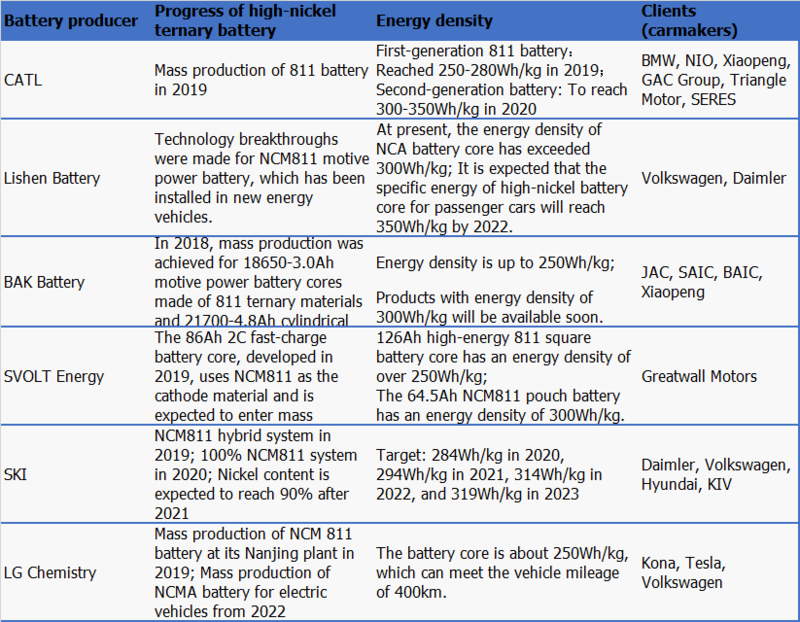
In the recent two years, domestic battery producers* have used NCM811 high-nickel cathode material in their products. Ronbay Technology, a domestic producer of ternary materials, has led in sales of high-nickel ternary materials. Bai Houshan, chairman of the company, indicated that NCM811, as a product with mature technology, will maintain leading market shares in the next two to three years. Producers of ternary materials and ternary precursors have also set up production lines of high-nickel materials, expecting to seek technological innovation of high-nickel materials rapidly.
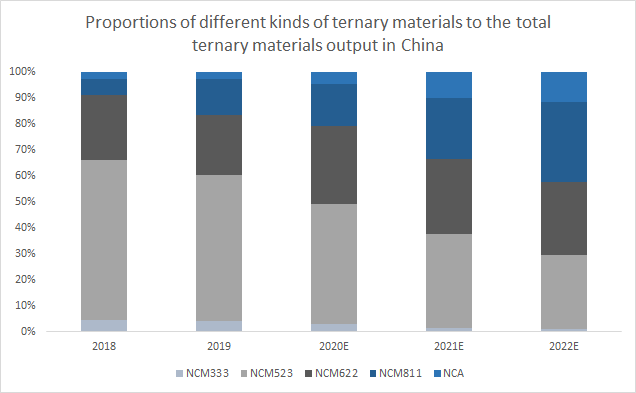
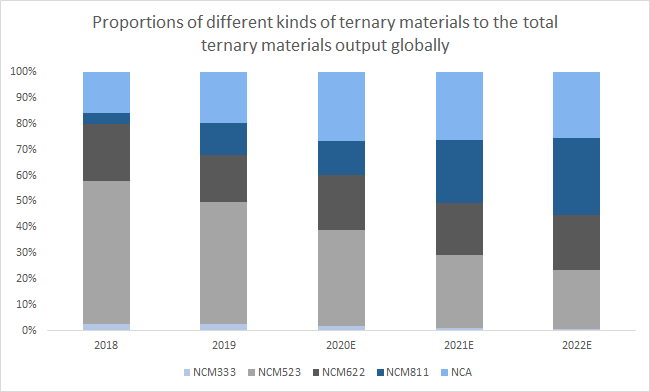
Currently, 523-type ternary materials remained a major product in domestic and overseas market, but high-nickel ternary materials that boasts high nickel content and low cobalt content, high energy density and low costs are likely to be the mainstream product in the future. Energy density of NCM 811 and NCA stands above 300 Wh/kg, far higher than that of NCM 523 and NCM 622. SMM expects that high-nickel ternary materials will be popularised in Chinese new energy market in 2023, and the global market is likely to fulfill the target of high-nickel materials in 2021.
*domestic producers- CATL, Guoxuan High-tech, BAK Power, Tianjin Lishen Battery Joint-stock, Envision ASEC, Svolt, Tafel New Energy Technology, Wanxiang Group, Eve Battery, Farasis, BYD, Soundon New Energy, First Battery, Great Power, CENAT, and overseas producers such as LG Chem, SKI and Samsung SDI
Data source: SMM
System power density higher by 10%-15%
Battery producers and automakers sought to reduce production costs amid subsidy cuts in the new energy industry. CATL and BYD released their new battery technologies.
CATL’s CTP technology, based on the high-nickel ternary lithium structure, used standardised battery packs consisting of several large-capacity cells to stack up larger battery modules in order to meet energy storage demand from different vehicles. BYD’s “Blade” battery, based on the LFP technology, expanded battery capacity and bundled up several cells that are more flat and narrow into battery packs. The two technologies increased utilisation rate of battery volume to increase energy density and reduce production costs.
BYD announced in 2019 that it will launch new LFP batteries during May-June 2020. Energy density of the new batteries will be increased by 50%, the service life will be up to 8 years and the cost will be saved by 30%, which can meet electric vehicles’ 600 km endurance. BYD’s "Han" EV/DM was in the second batch of the Catalogue of Recommended New Energy Vehicles released by the Ministry of Industry and Information Technology in 2020. EV has two versions of endurance mileage of 550km and 605km, and the system energy density stands at 140Wh/kg, which is expected to be increased to more than 160Wh/kg in 2020. Volume utilisation rate of CATL’s CTP battery was increased by 15%-20%, the number of parts was decreased by 40%, production efficiency was increased by 50% and the system power density was raised by 10%-15%.
As SMM learned, powder density of LFP cathode material was the same as that of NCM 622 ternary material, which is expected to be launched in Q3 2020. SMM expects that utilisation rate of NCM 523 and NCM 622 ternary materials is expected to decline amid application of LFP batteries, and LFP batteries are likely to replace some ternary batteries.
Performance of high-nickel ternary materials vs LFP
Energy density
CATL has improved the energy density of its LFP battery by 10%-15% via its CTP technology, while its rival BYD is expected to increase the system energy density of its "blade" battery to over 160 Wh/Kg this year.
The energy density of CATL’s high-nickel ternary battery could reach 240Wh/kg, which will enable its motive power battery pack to realise a system energy density of 200Wh/kg this year. The dominant advantage in energy density will make high-nickel ternary battery a preferred choice in mid-end and high-end passenger cars.
High-nickel ternary battery is expected to be a preferred choice in mid-range and high-end passenger cars in the next three years, considering the dominant advantage in energy density that it enjoys and the technology bottlenecks regarding mass energy density that LFP battery faces.
Battery cost
At present, the cost of LFP battery core stands at 0.5-0.6 yuan/Wh, compared to 0.7-0.8 yuan/Wh for ternary battery core. SMM expects the costs of LFP and ternary battery core to decline further to 0.3-0.4 yuan/Wh and 0.5 yuan/Wh respectively this year.
LFP battery is expected to dominate the A0 and A00 new energy passenger car market as its travel range could reach a maximum of 600 km on a single charge. However, LFP may lose its cost advantage if CTP technology could be applied in high-nickel ternary battery, which could bring its cost close to that of LFP battery.
Safety and cycle life
At present, LFP is safer than other batteries as it enjoys the highest thermal and structural stability among all cathode materials. This advantage has enabled LFP battery to grab 96% of market share in new energy buses. Ternary battery, on the other hand, has poor stability as it could compose and release oxygen under external temperature of about 200 ° C, which could potentially burn together with flammable electrolyte and carbon materials inside battery.
The cycle life of LFP battery could exceed 3,500 times, much higher than 1,000-2000 times for ternary battery.
Preference of carmakers and consumers
Tesla is likely to choose LFP battery for use in its Model 3 cars, in light of its low cost and long travel range. Chinese automakers such as BAIC and SAIC have also started to use LFP battery. Some carmakers may adopt the same strategy as Tesla, but the implementation is likely to wait until the end of the year.
While the phasing-out of subsidies led to declines in production and sales of new energy vehicles last year, production and sales are expected to recover in the future along with technology progress, introduction of new policies and a large influx of foreign auto companies.
As a major driver of new energy vehicles, passenger vehicles also have many problems that dampen consumer interest, including frequent accidents, high inconsistency between the alleged and actual travel range, low value preservation, as well as insufficient charging poles.
In summary, SMM believes that high-nickel ternary battery will maintain its mainstream trend in new energy vehicles over the next three years, considering the technology constraints facing LFP battery in mass density and the downward trend in costs of high-nickel ternary battery.