CEO: economic slowdown in mining enterprises is still optimistic about copper demand, declining taste in mines and promoting technological innovation.

Publié: Oct 30, 2019 17:46

SMM10, March 30 -: According to Deep-South Resources CEO Pierre Leveille talked about his views on the future trend of the copper market in a recent interview. He believes that despite the economic slowdown, copper use will rise as transport is electrified.

Decline of mine taste promotes technical innovation

At present, the average grade of copper ore in the world has a downward trend. For example, the taste of copper produced 100 years ago was 8 per cent. According to a mining intelligence survey conducted in 2017, the global taste in copper mines is only 0.53 per cent. In the past 100 years, there has been a significant decline. This means that near-surface deposits have been mined and few new discoveries have been made to balance the sharp decline in grade. Low-end projects will be the norm, and that won't change any time soon. Production is also slowing as reserves and resources dry up.

The decline in mine taste has driven the demand for alternative extraction technologies. The traditional methods of grinding, milling, baking and leaching, flotation are not only high power consumption, but also high demand for funds. Different types of heap leaching methods will be the preferred method in low-grade copper operation. These technologies are more environmentally friendly and less capital intensive than traditional methods.

BHP Billiton is using chloride technology, while Japanese mining and metals companies are using iodine leaching technology. Both focus on heap leaching, which seems to be an important trend in the future.

Low-end projects, which can be as profitable as high-end projects that use more traditional methods. As we will have more low-grade projects, the technology will become more important.

How important is grade and tonnage in assessing potential deposits?

Ore grade is less than 1%, we say 0.53% as the world average, although less than 1%, you can still make money. We know that the future standard will be less than 0.53%, so it is important to observe the grade and how to extract the metal. The type of deposit or mineralogy attached to the grade, and how to extract metals.

When you control the rating, you should look at other factors that affect the valuation of the project. This is when tonnage starts to work. If the grade is low, it is preferable to have a larger tonnage, as it may involve bulk mining and lower operating costs.

What is the impact of copper prices on retail investment in the industry?

In general, the investment objectives of retail investors in the mining market are short-term. They want something in return in a month, a week or even a day. Copper prices have fallen 14 per cent in the past 12 months. Markets are afraid of a trade war and a potential recession. As a result, base metals prices have fallen and retail investors have stopped investing in base metals exploration companies because they believe prices will fall.

It has an important impact on investment in the industry as the retail market helps to maintain the correct valuation and financing exploration of the company.

How do the strategic investors of large mining companies adapt to the current copper investment pattern?

"Professional Capital" is seriously considering investing in or acquiring advanced copper projects. They do not worry about short-term copper prices, because even if the economy slows down, supply and demand markets will be in short supply by 2021. Copper prices will be boosted, which could raise the valuation of the project. Some participants look to the longer term and want to invest in projects that will go into production. Their investment period is five to ten years. There is a big difference between large companies and the retail market, which sadly will make a comeback when valuations rise sharply.

(translated by SMM)

A grand event for thousands of people in China's non-ferrous metal industry

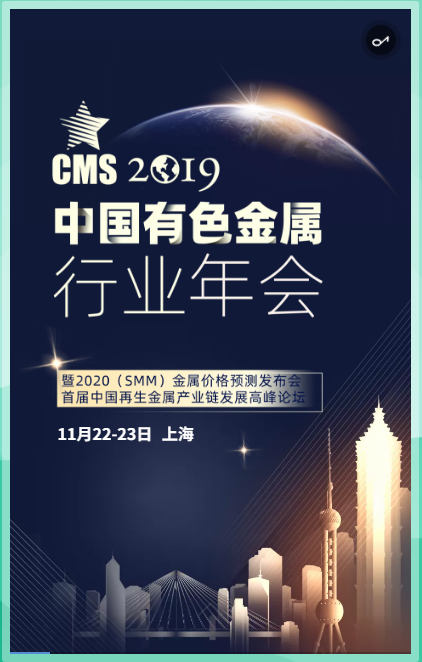
Shanghai colored net (SMM) annual meeting is the annual event of the metal industry, with an annual participation scale of thousands of people, domestic and foreign metal industry people gathered together to review and summarize the experience and harvest of the year, and lay the groundwork for the production, operation and operation of the coming year.

This year's "2019 China Nonferrous Metals Industry Annual meeting and 2020 (SMM) Metal Price Forecast Conference" was jointly created by SMM and China Renewable Resources Industry technological Innovation Strategic Alliance and Shanghai Nonferrous Metals Industry Association. At the same time, the first "China recycled Metal Industry chain Development Summit Forum" was held at the same time. At the same time, you will enjoy the establishment of the SMM Metal Price forecasting Conference and the waste Battery Recycling Exchange. From the development of the non-ferrous metal market to the recovery and utilization of renewable resources, from the detailed explanation of the policy system to the technical research and development of the industrial chain.

This is not only a meeting, but also a brainstorm for the industry to exchange information and collide with the spark of thinking!

"Click to sign up for SMM Annual meeting
Déclaration sur la source des données : À l'exception des informations publiques, toutes les autres données sont traitées par SMM sur la base d'informations publiques, d'échanges avec le marché et en s'appuyant sur le modèle de base de données interne de SMM. Ils sont fournis à titre indicatif uniquement et ne constituent pas des recommandations décisionnelles.

Pour toute demande d'information ou pour en savoir plus, veuillez contacter : lemonzhao@smm.cn
Pour plus d'informations sur l'accès à nos rapports de recherche, veuillez contacter :service.en@smm.cn
Actualités Connexes
Lundin Mining réduit ses prévisions de production de cuivre pour 2026 après de violentes tempêtes au Chili
il y a 59 minutes
Lundin Mining réduit ses prévisions de production de cuivre pour 2026 après de violentes tempêtes au Chili
Lire la suite
Lundin Mining réduit ses prévisions de production de cuivre pour 2026 après de violentes tempêtes au Chili
Lundin Mining a revu à la baisse ses prévisions de production de cuivre pour 2026 après qu'une deuxième violente tempête hivernale a perturbé les opérations de sa mine de Caserones, dans la région d'Atacama au Chili, prolongeant l'arrêt et retardant la reprise du site. La dernière tempête a débuté le 13 août, apportant de fortes précipitations à basse altitude, ainsi que des chutes de neige exceptionnellement abondantes et des vents violents en altitude. Caserones a subi une seconde panne de courant le 14 août, les intempéries ayant de nouveau endommagé un pylône de transmission déjà affecté par une précédente tempête en juillet. La mine avait déjà connu une panne de courant du 18 au 30 juillet. Lundin s'attendait initialement à ce que l'impact de cette première perturbation reste dans le bas de sa fourchette prévisionnelle initiale, mais la seconde tempête a retardé le retour à la pleine capacité et entraîné une nouvelle révision des perspectives de l'entreprise. La prévision de production de cuivre de Caserones pour 2026 a été ramenée entre 120 000 et 130 000 tonnes, contre 130 000 à 140 000 tonnes précédemment. La prévision de coût cash a également été relevée, passant de 2,05–2,25 $/lb à 2,15–2,35 $/lb. Au niveau du groupe, Lundin Mining table désormais sur une production de cuivre consolidée pour 2026 comprise entre 300 000 et 325 000 tonnes. Candelaria devrait toujours atteindre ses objectifs de production annuels, limitant ainsi l'impact des perturbations météorologiques principalement à Caserones. Les équipes de réparation s'emploient à restaurer l'infrastructure de transmission endommagée, le rétablissement complet de l'électricité étant prévu d'ici la fin de la semaine, avant une montée en puissance progressive des opérations. En attendant, des générateurs de secours continuent d'alimenter les infrastructures critiques du site. Du point de vue du marché du cuivre, cette révision des prévisions s'ajoute à une série de perturbations de l'offre liées aux conditions météorologiques au Chili cette année. La réduction à Caserones est relativement modeste à l'échelle mondiale, mais les revers opérationnels répétés dans les principales mines chiliennes continuent d'alimenter les inquiétudes quant à la fiabilité de l'offre à court terme en provenance du premier pays producteur de cuivre au monde.
il y a 59 minutes
Korea Eximbank va accorder 1 milliard de dollars à Glencore pour sécuriser son approvisionnement en cuivre.
il y a 4 heures
Korea Eximbank va accorder 1 milliard de dollars à Glencore pour sécuriser son approvisionnement en cuivre.
Lire la suite
Korea Eximbank va accorder 1 milliard de dollars à Glencore pour sécuriser son approvisionnement en cuivre.
La Banque d’exportation et d’importation de Corée a annoncé le 17 août qu’elle accorderait 1 milliard de dollars de soutien financier à Glencore, à condition que l’entreprise fournisse du cuivre à des sociétés coréennes pendant la durée du prêt. Les fonds serviront de fonds de roulement général à Glencore, et le montage financier vise à aider les entreprises coréennes à sécuriser des matières premières essentielles. Glencore exploite des mines, des actifs d’affinage et des réseaux de négoce dans plusieurs régions, notamment dans des pays producteurs de cuivre comme le Chili et le Pérou. Korea Eximbank a indiqué que la base d’actifs et de négoce diversifiée de Glencore pourrait offrir des circuits d’approvisionnement alternatifs en cas de perturbations dans un pays ou une mine spécifique. L’accord n’augmente pas la production de cuivre à court terme, mais renforce la sécurité d’approvisionnement en cuivre pour les entreprises coréennes.
il y a 4 heures
Vale accélère la flottation de particules grossières à Salobo, ajoutant 30 kt de cuivre d'ici le premier semestre 2028
il y a 4 heures
Vale accélère la flottation de particules grossières à Salobo, ajoutant 30 kt de cuivre d'ici le premier semestre 2028
Lire la suite
Vale accélère la flottation de particules grossières à Salobo, ajoutant 30 kt de cuivre d'ici le premier semestre 2028
Vale Base Metals a confirmé poursuivre le projet de flottation des particules grossières sur son complexe cuprifère Salobo au Brésil, ce qui porte la capacité annuelle de traitement du minerai de 6 millions de tonnes à 42 millions de tonnes et ajoute jusqu'à environ 30 000 tonnes de cuivre en concentré par an, avec environ 15 000 onces d'or comme sous-produit. La mise en service est avancée au premier semestre 2028, avec environ un an d'avance sur le calendrier. Les dépenes d'investissement ont été optimisées à environ 215 millions de dollars américains, contre une fourchette de 225 à 275 millions, Wheaton Precious Metals finançant 40 millions, ce qui laisse une dépenes nette d'environ 175 millions pour VBM et un TRI du projet supérieur à 50 %. Il s'agit de la dexième étape du pipeline cuprifère brownfield à faible capital de Carajás de VBM.
il y a 4 heures
CEO: economic slowdown in mining enterprises is still optimistic about copper demand, declining taste in mines and promoting technological innovation. - Shanghai Metals Market (SMM)