[SMM Thread] Regional differences are prominent, and spot prices fall differently after National Day.

Publié: Oct 22, 2019 17:29
Recently, environmental production restrictions have not been significantly effective, supply does not reduce but rose slightly, making the market bearish sentiment shrouded in heavy inventory for a long time. According to SMM statistics, the current mainstream market thread spot price decline in 30-270 yuan / ton, of which most concentrated in the 100-200 yuan / ton decline range. Due to the great differences between regions, SMM has carried out a follow-up study of this phenomenon.

SMM10, 22nd:

Recently, environmental production restrictions have not been significantly effective, supply does not reduce but rose slightly, making the market bearish sentiment shrouded in heavy inventory for a long time.
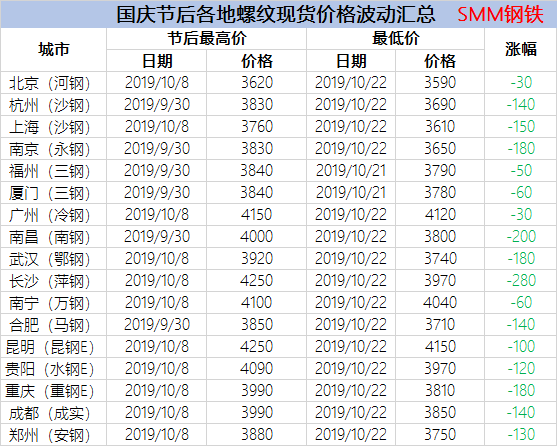
According to SMM statistics, the current mainstream market thread spot price decline in 30-270 yuan / ton, of which most concentrated in the 100-200 yuan / ton decline range. Due to the great differences between regions, SMM has carried out a follow-up study of this phenomenon.

Tons of steel fell in the area of 100-200 yuan: the mainstream area.

According to SMM research, in addition to the northeast due to the gradual cold weather, demand weakening, the current rigid demand for building materials in other regions show full toughness, good shipping condition. However, the phenomenon of large inventory pressure is more common. And at present, in addition to Beijing, Tianjin, Hebei and surrounding areas, other areas controlled by environmental protection and production restrictions in previous years (such as Jiangsu) have no policy notice, the market generally has increased expectations for supply pressure, so the operation of selling goods at low prices before the arrival of the off-season is more common.

At the same time, as pessimism still occupies the mainstream of the market, if the scope of production restriction has not been further expanded, the late spot price or weak back to the sky, continue to operate weakly.

In the range of $30 to $60 per ton of steel:

North China: Hebei, Shanxi and other Beijing-Tianjin-Hebei and surrounding areas have entered the stage of environmental protection and production restriction during the heating season, especially under the influence of pollution weather. Tangshan City, a "major town", issued two more stringent notices on the 15th and 18th of this month, and a number of traders reported that they had fewer supplies in their hands, supporting the market price to a certain extent. In addition, in Beijing, for example, inventories in September have been lower than in the same period last year. Although the recent year-on-year growth turned negative to positive, but the current local demand performance is still good, inventory pressure is not great, so the market mentality is also more rational, spot prices are more resilient.

Fujian market: steel mills have a large bargaining power for the market, with a strong willingness to raise prices, coupled with some business feedback has part of the phenomenon of relative shortage of specifications.

South China market: the demand performance is good, the Nanning market has the specification shortage situation, the spot price has the strong support. However, it is reported that the north material southward is already in the start-up, and there will be a more concentrated increment in November, when the increase in supply pressure will suppress the local spot price.

Region with a decline of more than 200 yuan per ton of steel: Hunan

Spot prices in Hunan rose rapidly in September, mainly due to on the one hand, a number of mainstream steel mills production reduction, making the market out of stock phenomenon is more common; on the other hand, the demand suppressed by torrential rain has been concentrated.

The production of mainstream steel mills resumed in October, and due to the high prices in the previous period and the small inflow of external resources, the shortage phenomenon was solved, at the same time, the demand was also stable, so the decline in spot prices after the festival was also beyond the reach of other regions.


 

Déclaration sur la source des données : À l'exception des informations publiques, toutes les autres données sont traitées par SMM sur la base d'informations publiques, d'échanges avec le marché et en s'appuyant sur le modèle de base de données interne de SMM. Ils sont fournis à titre indicatif uniquement et ne constituent pas des recommandations décisionnelles.

Pour toute demande d'information ou pour en savoir plus, veuillez contacter : lemonzhao@smm.cn
Pour plus d'informations sur l'accès à nos rapports de recherche, veuillez contacter :service.en@smm.cn
Actualités Connexes
L'Australie réexamine les droits antidumping sur l'acier galvanisé en provenance d'Inde, de Malaisie et du Vietnam dans un contexte de préoccupations liées au zinc
11 Sep 2026 18:30
L'Australie réexamine les droits antidumping sur l'acier galvanisé en provenance d'Inde, de Malaisie et du Vietnam dans un contexte de préoccupations liées au zinc
Lire la suite
L'Australie réexamine les droits antidumping sur l'acier galvanisé en provenance d'Inde, de Malaisie et du Vietnam dans un contexte de préoccupations liées au zinc
Le 9 septembre 2026, l'Australie a lancé son deuxième réexamen au titre du crépuscule des mesures antidumping visant les tôles d'acier galvanisé originaires d'Inde, de Malaisie et du Vietnam, et a ouvert séparément un réexamen au titre du crépuscule des mesures compensatoires sur les importations en provenance d'Inde. Le réexamen couvre la période juillet 2025-juin 2026, le rapport final étant attendu pour le 11 février 2027. L'acier galvanisé étant le principal secteur d'utilisation finale du zinc, ces mesures affectent directement les coûts d'exportation et la compétitivité, avec un impact potentiel sur la demande intérieure de zinc et la chaîne d'approvisionnement en Australie. Le maintien des droits offrirait une certaine protection aux capacités nationales de production d'acier et de revêtement, tandis que leur suppression pourrait accroître les importations à bas prix et affecter la consommation régionale de zinc. L'issue finale reste soumise à la décision des autorités.
11 Sep 2026 18:30
Le projet d'expansion de 200 millions de dollars de JCC Hongyuan Copper vise à porter la capacité à 550 000 tonnes d'ici 2027
7 Sep 2026 15:43
Le projet d'expansion de 200 millions de dollars de JCC Hongyuan Copper vise à porter la capacité à 550 000 tonnes d'ici 2027
Lire la suite
Le projet d'expansion de 200 millions de dollars de JCC Hongyuan Copper vise à porter la capacité à 550 000 tonnes d'ici 2027
Le projet d'expansion de 300 000 tonnes par an de cathodes de cuivre de JCC Hongyuan Copper, filiale de Jiangxi Copper Corporation, est entré le 4 septembre dans la phase de consultation publique préalable à l'approbation de son étude d'impact environnemental, avec un investissement total d'environ 1,416 milliard de yuans. Le projet devrait démarrer en septembre 2026 et s'achever en décembre 2027. Une fois terminé, la capacité totale de JCC Hongyuan passera de 250 000 à 550 000 tonnes.
7 Sep 2026 15:43
Le yen japonais s'apprécie, l'USD/JPY passe sous 159 dans un contexte de spéculation sur une intervention
3 Sep 2026 19:00
Le yen japonais s'apprécie, l'USD/JPY passe sous 159 dans un contexte de spéculation sur une intervention
Lire la suite
Le yen japonais s'apprécie, l'USD/JPY passe sous 159 dans un contexte de spéculation sur une intervention
[SMM Express Métaux Précieux] Le yen japonais a fortement grimpé lors de la séance de mercredi, l'USD/JPY passant sous 159 et clôturant en baisse de 0,92 % à 158,69, alimentant les spéculations sur une intervention monétaire japonaise. L'indice du dollar a également fortement reculé, un environnement de dollar plus faible soutenant les métaux précieux.
3 Sep 2026 19:00