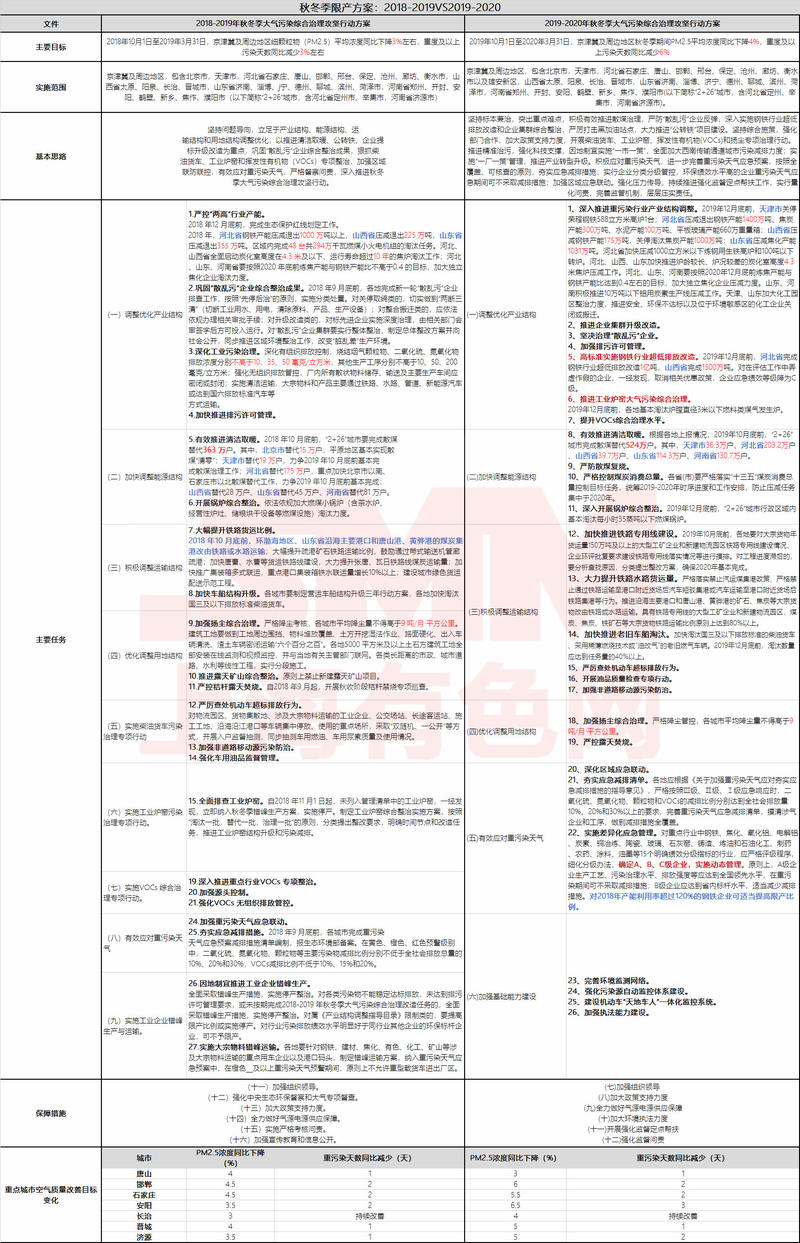
[SMM interpretation] comparison of "two-term" production restriction schemes in autumn and winter-the front wave is stronger than the back wave

Publié: Oct 16, 2019 17:56 (GMT+8)
Today, the Ministry of Ecological Environment, the Development and Reform Commission, and other ten departments, together with the people's governments of Beijing, Tianjin, and other cities, jointly issued the "Action Plan for Comprehensive Air pollution Control in Autumn and Winter 2019-2020 in Beijing, Tianjin, Hebei, and surrounding areas."

Today, the Ministry of Ecological Environment, the Development and Reform Commission, and other ten departments, together with the people's governments of Beijing, Tianjin, and other cities, jointly issued the "Action Plan for Comprehensive Air pollution Control in Autumn and Winter 2019-2020 in Beijing, Tianjin, Hebei, and surrounding areas."

As far as the documents are concerned: first of all, as far as the main objectives are concerned, the average concentration of PM2.5 in Beijing, Tianjin, Hebei and surrounding areas during autumn and winter this year fell by 4% compared with the same period last year, and the number of days of severe and above pollution decreased by 6% compared with the same period last year. More stringent task targets have also been set for key cities with strong production capacity in the steel and coking industries, although slightly relaxed than the recommendations released earlier, but generally more stringent than last year.

Second, judging from the reduction and withdrawal of iron and steel coking capacity in various provinces and cities, Hebei's target for eliminating iron and steel coking capacity this year is 14 million tons, an increase of 4 million tons over last year. The target for eliminating production capacity in Shanxi and Shandong Province has decreased slightly, with one increase and one decrease. The overall scale of de-production capacity is basically stable compared with last year. At the same time, all provinces and cities have increased the reduction of production capacity in the coking industry, with the reduction target of 23.31 million tons in Hebei, Shanxi and Shandong provinces alone.

In addition, this year's heating season environmental protection production restrictions have a more prominent "differential control" characteristics-clearly require "2X26" cities to divide key industries into A, B and C grades according to strict rating procedures, and carry out dynamic management according to different stages and different weather characteristics. For example, since October alone, Tangshan has issued two documents on environmental protection and production restrictions aimed at different grades and specific conditions of different enterprises.

In general, the autumn and winter environmental protection and production restriction plan released last year shows that the "one size fits all" and formal implementation of differential control has made the actual implementation worse than expected. However, after learning from the previous experience, the probability of environmental protection and production restriction in Beijing, Tianjin, Hebei and its surrounding areas this year is more stringent than that of last year.
Déclaration sur la source des données : À l'exception des informations publiques, toutes les autres données sont traitées par SMM sur la base d'informations publiques, d'échanges avec le marché et en s'appuyant sur le modèle de base de données interne de SMM. Ils sont fournis à titre indicatif uniquement et ne constituent pas des recommandations décisionnelles.

Pour toute demande d'information ou pour en savoir plus, veuillez contacter : lemonzhao@smm.cn
Pour plus d'informations sur l'accès à nos rapports de recherche, veuillez contacter :service.en@smm.cn
Actualités Connexes
La filiale de Western Mining obtient une licence de 17 ans pour la mine polymétallique du Qinghai
22 Sep 2026 16:11 (GMT+8)
La filiale de Western Mining obtient une licence de 17 ans pour la mine polymétallique du Qinghai
Lire la suite
La filiale de Western Mining obtient une licence de 17 ans pour la mine polymétallique du Qinghai
Le 22 septembre, Western Mining a annoncé que sa filiale à 100 %, Qinghai Ganxin Mining Development Co., Ltd. (« Ganxin Mining »), avait récemment obtenu un permis minier délivré par le Département des ressources naturelles de la province du Qinghai. La mine, dénommée mine polymétallique de fer de Geermu Tuwenchahan de Qinghai Ganxin Mining Development Co., Ltd., couvre le fer, le cuivre, l'or, le molybdène, le zinc, le plomb et l'argent comme substances minières autorisées. Le permis minier est valable du 3 août 2026 au 30 août 2043.
22 Sep 2026 16:11 (GMT+8)
Le projet américain de 7,4 milliards de dollars de Korea Zinc passe l'évaluation environnementale et devrait entrer en phase d'essai en 2029
21 Sep 2026 17:02 (GMT+8)
Le projet américain de 7,4 milliards de dollars de Korea Zinc passe l'évaluation environnementale et devrait entrer en phase d'essai en 2029
Lire la suite
Le projet américain de 7,4 milliards de dollars de Korea Zinc passe l'évaluation environnementale et devrait entrer en phase d'essai en 2029
Le 21 septembre, Korea Zinc a annoncé que son projet manufacturier américain de 7,4 milliards de dollars avait passé l'évaluation d'impact environnemental. L'installation devrait commencer ses opérations d'essai en 2029 et la production commerciale l'année suivante, produisant 11 minéraux critiques, 12 métaux non ferreux et de l'acide sulfurique de qualité semi-conducteur. En avril, Korea Zinc a déclaré avoir finalisé l'acquisition d'une fonderie de zinc locale et d'autres sociétés liées. L'entreprise prévoit de mettre en œuvre le projet en agrandissant et en modernisant les installations existantes.
21 Sep 2026 17:02 (GMT+8)
L'Australie réexamine les droits antidumping sur l'acier galvanisé en provenance d'Inde, de Malaisie et du Vietnam dans un contexte de préoccupations liées au zinc
11 Sep 2026 18:30 (GMT+8)
L'Australie réexamine les droits antidumping sur l'acier galvanisé en provenance d'Inde, de Malaisie et du Vietnam dans un contexte de préoccupations liées au zinc
Lire la suite
L'Australie réexamine les droits antidumping sur l'acier galvanisé en provenance d'Inde, de Malaisie et du Vietnam dans un contexte de préoccupations liées au zinc
Le 9 septembre 2026, l'Australie a lancé son deuxième réexamen au titre du crépuscule des mesures antidumping visant les tôles d'acier galvanisé originaires d'Inde, de Malaisie et du Vietnam, et a ouvert séparément un réexamen au titre du crépuscule des mesures compensatoires sur les importations en provenance d'Inde. Le réexamen couvre la période juillet 2025-juin 2026, le rapport final étant attendu pour le 11 février 2027. L'acier galvanisé étant le principal secteur d'utilisation finale du zinc, ces mesures affectent directement les coûts d'exportation et la compétitivité, avec un impact potentiel sur la demande intérieure de zinc et la chaîne d'approvisionnement en Australie. Le maintien des droits offrirait une certaine protection aux capacités nationales de production d'acier et de revêtement, tandis que leur suppression pourrait accroître les importations à bas prix et affecter la consommation régionale de zinc. L'issue finale reste soumise à la décision des autorités.
11 Sep 2026 18:30 (GMT+8)
[SMM interpretation] comparison of "two-term" production restriction schemes in autumn and winter-the front wave is stronger than the back wave - Shanghai Metals Market (SMM)