Why do investors use copper as a hedge against inflation?

Publié: Mar 07, 2018 16:31 (GMT+8)

SMM, March 7: every year, large amounts of copper are used to make a variety of goods to boost the global economy.

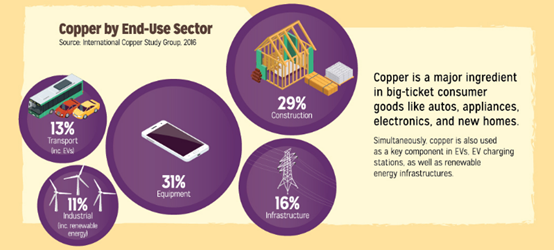
Copper is a major component of large consumer goods, such as cars (13 per cent), home appliances, electronics and new homes. At the same time, copper is widely used in many industrial areas, including telecommunications (31 per cent), utilities (16 per cent), construction (29 per cent) and industrial machinery (11 per cent).
The weathervane of the economy

The following figure shows the important role of copper in the economy and why it has become a famous economic vane.

Growing demand

When the economy is doing well and new projects continue to go into production, demand for copper will rise.

Rise in price

When demand rises, the price of copper goes up.

The market pays close attention to the price of copper

As a result of this historic relationship, analysts around the world are keeping a close eye on copper prices.

Dr. Copper.

Copper prices have long hinted at the direction of the economy, so it is known as a metal with a doctorate in economics.

In other words, while construction and manufacturing are growing, sales of copper products are also growing. But as an economic indicator, the link has other important implications, especially for investors who want to build a sound portfolio.

Rising prices; rising copper prices

When copper is interestingly linked to economic trends, its ability to protect portfolios from inflation is even more bizarre.

Rising prices come from overheating the economy and strong consumer spending-which is also one of the factors affecting copper prices. As a result of this link, research shows that for every 1 per cent increase in consumer prices since 1992, copper prices have risen by nearly 18 per cent.
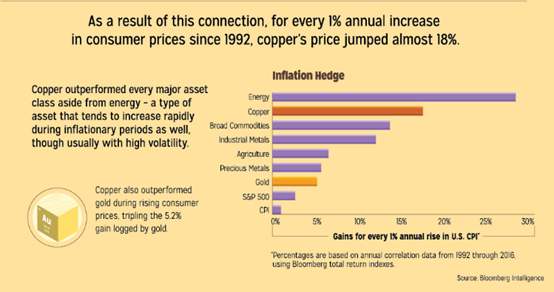
In a Bloomberg analysis, copper outperformed all major asset classes and, with the exception of energy as an inflation hedge, rose more than twice as much as gold during the rise in consumer prices.

Threaten the portfolio

Inflation can kill an unprotected portfolio.

Why? If inflation is higher than the rate of return on the portfolio, the portfolio actually produces a negative real return. (example: 2% growth-3% inflation =-1% return)

In other words, inflation can be a "hidden" threat that erodes returns, especially for fixed-income portfolios. The good news: holding copper or other commodities can prevent prices from rising.

Copper: the best way to fight inflation

In general, the use of other industrial metals is limited to specific areas, and precious metals are often driven by investor sentiment.

Copper is widely used in fields such as industry and technology, which makes it a bellwether for the economy as a whole.
Déclaration sur la source des données : À l'exception des informations publiques, toutes les autres données sont traitées par SMM sur la base d'informations publiques, d'échanges avec le marché et en s'appuyant sur le modèle de base de données interne de SMM. Ils sont fournis à titre indicatif uniquement et ne constituent pas des recommandations décisionnelles.

Pour toute demande d'information ou pour en savoir plus, veuillez contacter : lemonzhao@smm.cn
Pour plus d'informations sur l'accès à nos rapports de recherche, veuillez contacter :service.en@smm.cn
Actualités Connexes
Les fabricants de fils émaillés maintiennent une production élevée avant la fête nationale malgré une demande en baisse
il y a 35 minutes
Les fabricants de fils émaillés maintiennent une production élevée avant la fête nationale malgré une demande en baisse
Lire la suite
Les fabricants de fils émaillés maintiennent une production élevée avant la fête nationale malgré une demande en baisse
D'une part, soutenus par la livraison des commandes enregistrées la semaine précédente, les fabricants de fils émaillés ont maintenu des taux d'exploitation élevés pour répondre aux exigences d'expédition en aval avant les congés. D'autre part, les fabricants ont planifié des arrêts et des réductions de production pour les congés de la fête nationale et ont donc accéléré les calendriers de production avant la pause. En conséquence, les usines de fils émaillés ont continué de fonctionner à des taux d'utilisation élevés cette semaine. Néanmoins, la plupart des clients en aval ont largement terminé leurs activités de stockage après les commandes en gros de la semaine dernière. Combiné à des prix du cuivre élevés pesant sur le sentiment du marché, la volonté d'achat s'est nettement affaiblie cette semaine et les nouvelles commandes ont fortement diminué.
il y a 35 minutes
Le calendrier de production pré-vacances soutient des taux d'exploitation élevés, mais les nouvelles commandes reculent nettement [Revue hebdomadaire du marché du fil émaillé SMM]
il y a 42 minutes
Le calendrier de production pré-vacances soutient des taux d'exploitation élevés, mais les nouvelles commandes reculent nettement [Revue hebdomadaire du marché du fil émaillé SMM]
Lire la suite
Le calendrier de production pré-vacances soutient des taux d'exploitation élevés, mais les nouvelles commandes reculent nettement [Revue hebdomadaire du marché du fil émaillé SMM]
Le taux d'utilisation des machines dans l'industrie du fil émaillé a baissé en glissement hebdomadaire cette semaine (18/09-24/09) ....
il y a 42 minutes
Données : évolution des marchés SHFE et DCE (24 sept.)
il y a 42 minutes
Données : évolution des marchés SHFE et DCE (24 sept.)
Lire la suite
Données : évolution des marchés SHFE et DCE (24 sept.)
Le tableau suivant présente les mouvements des métaux ferreux et non ferreux sur le SHFE et le DCE au 24 septembre 2026.
il y a 42 minutes