
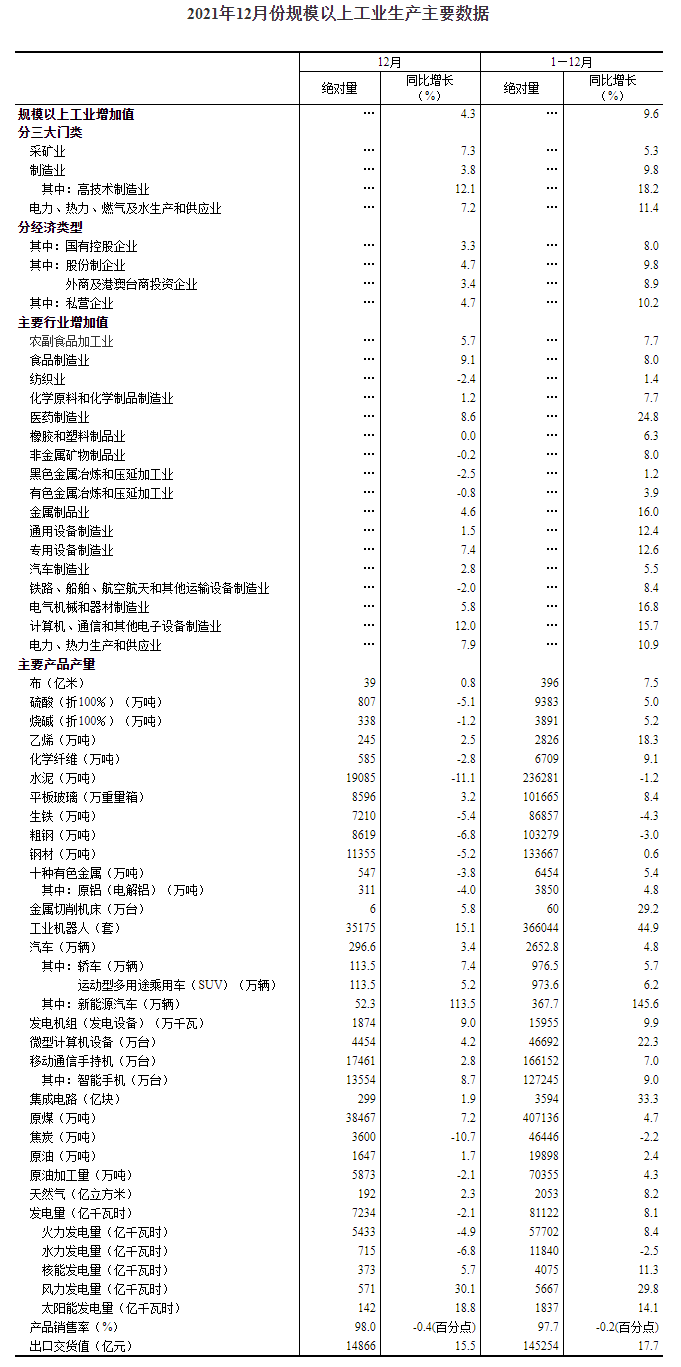
In December 2021, the value-added of industries above scale increased by 4.3% in real terms compared with the same period last year (the following growth rates are all real growth rates excluding price factors), an increase of 11.9% over the same period in 2019, with an average growth rate of 5.8% over the same period in 2019. On a month-on-month basis, the added value of industries above scale increased by 0.42% in December over the previous month. In 2021, the added value of industries above scale will increase by 9.6% over the previous year, with an average growth rate of 6.1% in two years.

Divided into three major categories, in December, the added value of the mining industry increased by 7.3% compared with the same period last year; the manufacturing industry grew by 3.8%; and the electricity, heat, gas and water production and supply sector grew by 7.2%.
In terms of economic type, in December, the added value of state-owned holding enterprises increased by 3.3% compared with the same period last year; joint-stock enterprises grew by 4.7%; foreign investors and Hong Kong, Macao and Taiwan business investment enterprises increased by 3.4%; and private enterprises grew by 4.7%.
In terms of sectors, in December, 30 of the 41 major industries maintained year-on-year growth in added value. The agricultural and non-staple food processing industry increased by 5.7%, the textile industry decreased by 2.4%, the chemical raw materials and chemical products manufacturing industry increased by 1.2%, the non-metallic mineral products industry decreased by 0.2%, and the ferrous metal smelting and Calendering processing industry decreased by 2.5%. The non-ferrous metal smelting and Calendering processing industry decreased by 0.8%, the general equipment manufacturing industry increased by 1.5%, and the special equipment manufacturing industry increased by 7.4%. The automobile manufacturing industry grew by 2.8 per cent, the railway, shipping, aerospace and other transport equipment manufacturing industries decreased by 2.0 per cent, the electrical machinery and equipment manufacturing industry grew by 5.8 per cent, and the computer, communications and other electronic equipment manufacturing industries grew by 12.0 per cent. Electricity, thermal production and supply increased by 7.9%.
In terms of products, the output of 288 of the 612 products increased in December compared with the same period last year. 113.55 million tons of steel, down 5.2 percent from the same period last year; 190.85 million tons of cement, down 11.1 percent; 5.47 million tons of 10 non-ferrous metals, down 3.8 percent; 2.45 million tons of ethylene, up 2.5 percent; 2.966 million cars, up 3.4 percent, including 523000 new energy vehicles, up 113.5 percent; electricity generation was 723.4 billion kilowatt hours, down 2.1 percent; and crude oil processing volume was 58.73 million tons, down 2.1 percent.
In December, the product sales rate of industrial enterprises was 98.0%, down 0.4% from the same period last year; the export delivery value of industrial enterprises was 1.4866 trillion yuan, a nominal increase of 15.5% over the same period last year.


Notes
1. Index interpretation
The growth rate of industrial value added, that is, the rate of industrial growth, is an index used to reflect the degree of change in the volume of industrial production in a certain period of time. By using this index, we can judge the operation trend of the short-term industrial economy and the prosperity degree of the economy, and it is also an important reference and basis for formulating and adjusting economic policies and implementing macro-control.
Product sales rate: the ratio of sales output value to total industrial output value, which is used to reflect the connection between production and marketing of industrial products.
Export delivery value: refers to the value of products exported by industrial enterprises (including those sold to Hong Kong, Macao and Taiwan) or handed over to foreign trade departments for export, as well as the value of products produced by foreign businessmen, such as sample supplied, supplied material processing, supplied parts assembly and compensation trade, etc.
Average daily output: it is calculated by dividing the total output of industrial enterprises above the size announced in that month by the number of calendar days of the month.
2. Statistical range
The statistical scope of industries above scale is industrial enterprises with annual main business income of 20 million yuan or more.
As the scope of industrial enterprises above scale changes from year to year, in order to ensure that this year's data is comparable to that of last year, the number of the same period used to calculate the year-on-year growth rate of product output and other indicators is consistent with the statistical scope of enterprises in this period as far as possible, there is a caliber difference with the data released last year. The main reasons are: (1) the range of statistical units has changed. Every year, some enterprises reach the scale to be included in the scope of the survey, and some enterprises withdraw from the scope of the survey because of the smaller scale. there are also new production enterprises, bankruptcy, injection (hanging) sales enterprises and other effects; (2) the product output data of some enterprise groups (companies) have the phenomenon of cross-regional repeated statistics, and the cross-regional repeated output of enterprise groups (companies) is eliminated according to the special survey.
3. Investigation method
Industrial production reports of industrial enterprises above scale shall be comprehensively investigated on a monthly basis (data exemption in January).
4. Industry classification standard
Implement the national economic industry classification standard (GB/T 4754-2017), see http://www.stats.gov.cn/tjsj/tjbz/hyflbz for details.
5. Revision of month-on-month data
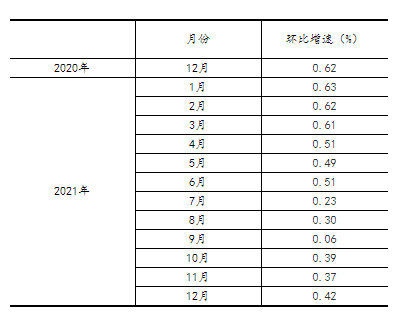
According to the results of automatic correction of the seasonal adjustment model, the month-on-month growth rate of industrial value added above scale from December 2020 to November 2021 is revised. The revised results and month-on-month data for December 2021 are as follows:
6. The two-year average growth rate shows
The two-year average growth rate refers to the growth rate calculated by the geometric average method based on the corresponding period in 2019.