Shandong Introduces Comprehensive Measures for Industrial Renewable Resources Recycling and Utilization

Publicado: Aug 30, 2026 21:02
Regarding the issuance of the “Management Measures for the Standardized Recycling and Utilization of Industrial Renewable Resources in Shandong Province (Trial)” (hereinafter referred to as the “Management Measures”), SMM learned that the Management Measures implemented in Shandong Province this time are a “local implementation version” of a series of central policy requirements, but they are not a simple translation of any single central document

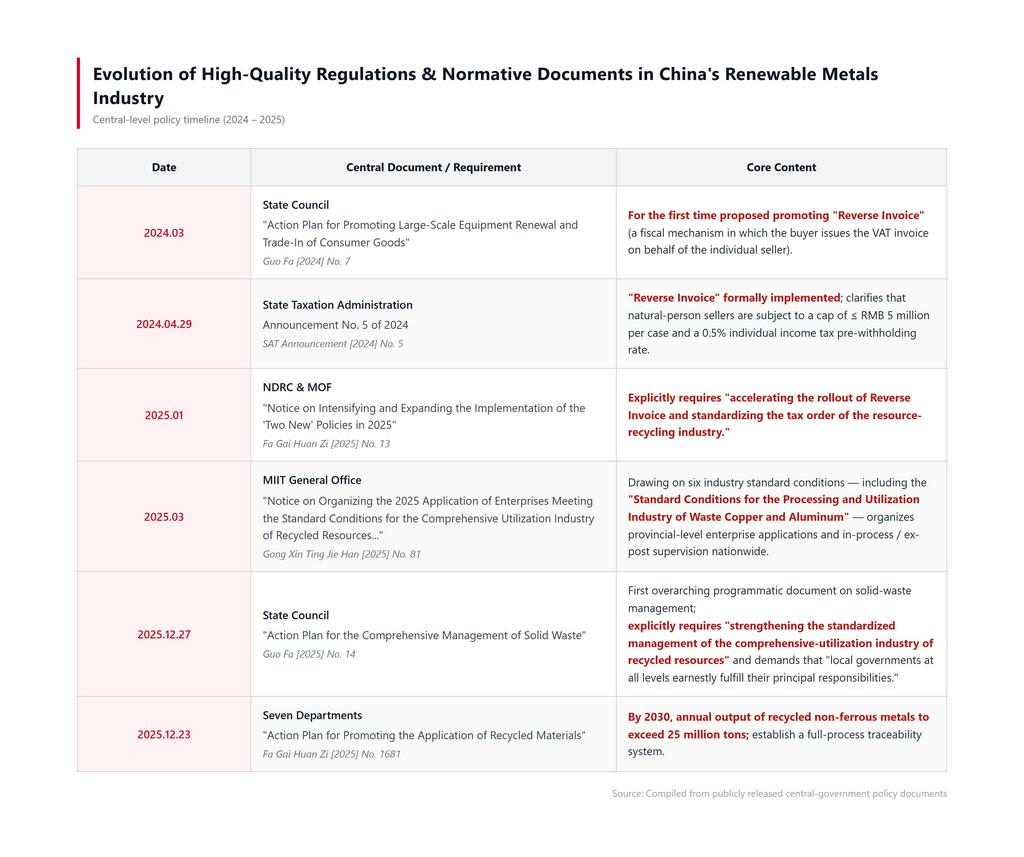
Regarding the issuance of the “Management Measures for the Standardized Recycling and Utilization of Industrial Renewable Resources in Shandong Province (Trial)” (hereinafter referred to as the “Management Measures”), SMM learned that the Management Measures implemented in Shandong Province this time are a “local implementation version” of a series of central policy requirements, but they are not a simple translation of any single central document; rather, they are the first provincial full-chain comprehensive management measures formed by integrating the multi-ministry and multi-dimensional policy lines of the central government over the past year or more. 

I. At the Central Level, Not “One Document at the Start of the Year” but a Progressive Layering of Multiple Policy Lines
II. The "Integrated Innovation" of the Shandong Measures

1. Upgrading from "Three Flows in One" to "Five Flows in One"

In the rollout of reverse invoicing, the State Taxation Administration requires the "three flows in one" (invoice flow, fund flow, and personnel flow) — a July 2025 reply letter from the Ma'anshan Taxation Bureau explicitly states that it is piloting the "three flows in one." Building on this, the Shandong Measures add "contract flow" and "goods flow," forming a more complete digital supervision chain: contract flow + goods flow + invoice flow + fund flow + information flow = "five flows in one." This extends and strengthens the central government's "three flows in one" approach.

2. Building a Provincial Smart Monitoring Platform

At the central level, MIIT relies on the "Industrial Energy Conservation and Green Development Management Platform" (green.miit.gov.cn) to manage enterprises under industry standards. Shandong, by contrast, has built a dedicated Shandong Provincial Industrial Renewable Resources Recycling and Processing Smart Monitoring Platform, turning platform registration, information filing, and data reporting into management requirements for enterprises.

3. First Systematic Coverage of the Entire "Waste Generation–Recycling–Processing–Waste Utilization" Chain

Previously, central policies were fragmented: MIIT managed market access for enterprises under the standard conditions, tax authorities managed reverse invoicing, and the NDRC managed the circular economy. Through a joint document issued by eight departments (led by the Department of Industry and Information Technology + NDRC + Department of Public Security + Department of Finance + Department of Ecology and Environment + Department of Commerce + Market Regulation Administration + Taxation Bureau), the Shandong Measures have bridged regulatory gaps between departments.

III. Summary

1. Policy intensity is increasing at an accelerating pace: from March 2024 to September 2026, in less than two years, central and local governments have already formed a complete chain of "action plan → reverse invoicing → standard conditions → solid waste action plan → provincial comprehensive management measures," and the high-pressure policy posture is clear.

2. "Five flows in one" is stricter than "three flows in one": for the secondary copper industry, this means the survival space of purely trade-based intermediate links (with no actual logistics and no contract trail) will be further compressed, accelerating the industry's transformation toward entity-based and clustered operations. 3. As the country's core hub for industrial recycled resources, Shandong took the lead in introducing measures, serving as a bellwether—other provinces are highly likely to follow suit, leading to nationwide regulatory convergence.

4. Tax supervision is the key lever: the measures explicitly focus on "tax-related risks such as fraudulent invoicing and fictitious circular transactions." This echoes the data released by the State Taxation Administration in 2025, which showed "a reverse invoicing amount of nearly 900 billion yuan" and 14,800 recycling enterprises, indicating that regulators' attention to tax compliance in the recycled resources industry has reached an unprecedented level. 

Declaración de Fuente de Datos: Excepto la información disponible públicamente, todos los demás datos son procesados por SMM basándose en información pública, comunicación de mercado y confiando en el modelo de base de datos interna de SMM. Son solo para referencia y no constituyen recomendaciones para la toma de decisiones.

Para cualquier consulta o para obtener más información, por favor contacte: lemonzhao@smm.cn
Para más información sobre cómo acceder a nuestros informes de investigación, contacte con:service.en@smm.cn
Noticias relacionadas
China reforma el crédito inmobiliario y fija condiciones de préstamo y normas de desembolso
29 Aug 2026 18:10
China reforma el crédito inmobiliario y fija condiciones de préstamo y normas de desembolso
Leer más
China reforma el crédito inmobiliario y fija condiciones de préstamo y normas de desembolso
El Banco Popular de China y la Administración Nacional de Regulación Financiera publicaron conjuntamente las Opiniones sobre la reforma y mejora de la gestión del crédito inmobiliario y la aceleración del establecimiento de un nuevo modelo de desarrollo inmobiliario. Las Opiniones establecen que los préstamos para el desarrollo inmobiliario estarán sujetos a un sistema de banco principal, con plazos no superiores a 5 años para proyectos en preventa y 7 años para proyectos de venta de vivienda terminada. Asimismo, disponen que los préstamos personales para vivienda tendrán un plazo máximo de 40 años; si la vivienda de nueva construcción adquirida se vende como vivienda terminada, el préstamo personal para vivienda se desembolsará tras la inscripción de la venta; si se vende en preventa, el préstamo se desembolsará únicamente tras la inscripción de la finalización de la obra.
29 Aug 2026 18:10
Chile, Argentina, Bolivia y Perú firman pacto para la cooperación minera regional y el desarrollo sostenible
29 Aug 2026 18:07
Chile, Argentina, Bolivia y Perú firman pacto para la cooperación minera regional y el desarrollo sostenible
Leer más
Chile, Argentina, Bolivia y Perú firman pacto para la cooperación minera regional y el desarrollo sostenible
Funcionarios de las autoridades mineras de Chile, Argentina, Bolivia y Perú celebraron el 28 una reunión ministerial en Santiago, capital de Chile, y firmaron una declaración conjunta en la que abogan por una mayor cooperación regional, el desarrollo sostenible de minerales críticos, intercambios técnicos e inversión, y esfuerzos conjuntos para elevar la posición de la región en la cadena mundial de suministro de minerales críticos. La declaración conjunta subrayó que la minería es un importante motor del crecimiento económico, la creación de empleo, el desarrollo del capital humano y el progreso social. Los cuatro países cooperarán para promover el desarrollo sostenible de los minerales críticos, fortalecer el intercambio de experiencias en investigación geológica, regulación minera, políticas públicas y formación de talento profesional, y explorar mecanismos de cooperación técnica e institucional, alentando a los sectores público y privado a participar conjuntamente en proyectos de investigación científica e innovación.
29 Aug 2026 18:07
Codelco reporta una utilidad de US$1.966 millones en el primer semestre, con una caída del 11% en la producción de cobre.
29 Aug 2026 18:05
Codelco reporta una utilidad de US$1.966 millones en el primer semestre, con una caída del 11% en la producción de cobre.
Leer más
Codelco reporta una utilidad de US$1.966 millones en el primer semestre, con una caída del 11% en la producción de cobre.
Codelco informó el viernes que su utilidad antes de impuestos del primer semestre fue de 1.966 millones de dólares, más de cuatro veces los 429 millones de dólares del mismo período del año anterior. La empresa señaló que la producción de cobre en el período enero-junio fue de 564.000 toneladas métricas, un 11% menos que las 634.000 toneladas métricas del mismo período de 2025.
29 Aug 2026 18:05