SMM May 22 update:
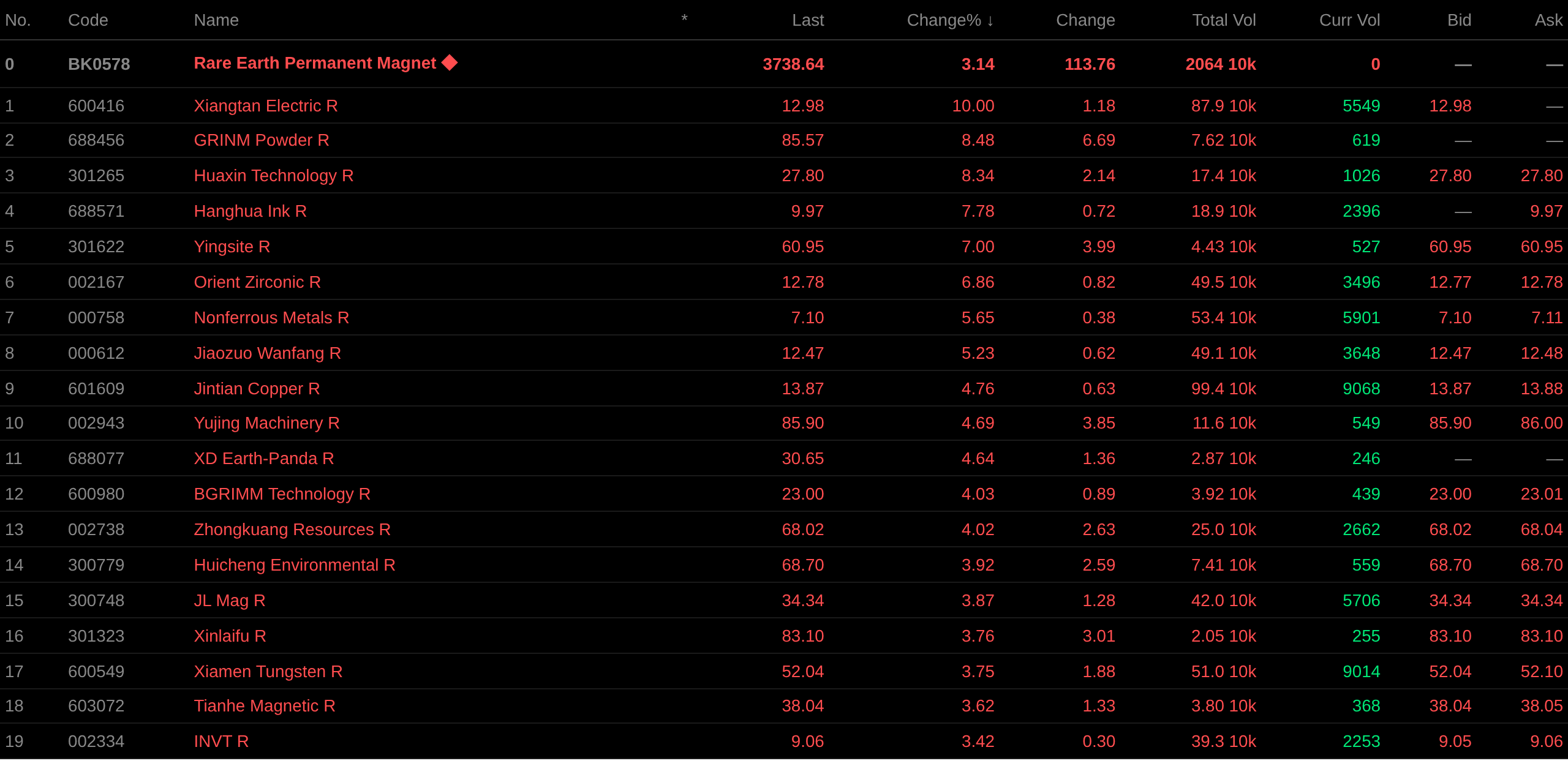
The "Regulations for the Implementation of the Mineral Resources Law of the People's Republic of China" was recently promulgated and will take effect from June 15, 2026. The tight supply situation on the raw material side remained unchanged. Pr-Nd oxide saw a notable increase on May 21, boosted by major manufacturers' procurement, but underwent a slight correction on May 22 under the influence of inquiries pushing for lower prices. Nevertheless, the recovery in market confidence provided some support for Pr-Nd prices. Demand side, the NEV, wind power, and humanoid robot industries continued to develop favorably, and the market expected promising growth in high performance NdFeB demand. Additionally, after the previous period of adjustment, some market funds flowed back into the rare earth permanent magnet sector, driving a notable rise in the rare earth permanent magnet concept on May 22. As of the close on May 22, the rare earth permanent magnet concept rose 3.14%. In terms of individual stocks: Xiangtan Electric Manufacturing hit the daily limit, while Advanced Technology & Materials, Hanghua Co., Huaxin Technology, Innuovo Technology, and Orient Zirconic Industry led the gains.
News
[Li Qiang Signs State Council Decree Promulgating the "Regulations for the Implementation of the Mineral Resources Law of the People's Republic of China"]Premier Li Qiang recently signed a State Council decree promulgating the "Regulations for the Implementation of the Mineral Resources Law of the People's Republic of China" (hereinafter referred to as the "Regulations"), which will take effect from June 15, 2026. The Regulations aim to ensure the effective implementation of the revised Mineral Resources Law, promote the rational development and utilization of mineral resources, strengthen the protection of mineral resources and the ecological environment, drive high-quality development of the mining industry, and safeguard mineral resource security. The Regulations consist of 8 chapters and 79 articles, mainly covering the following contents. First, further improving the mining rights system, with specific provisions on the establishment, transfer by tender, renewal, and assignment of mining rights. Second, refining systems related to mineral resource exploration and extraction, including establishing and improving technical standards and normative systems for basic geological surveys, clarifying procedures for applying for exploration permits and mining permits, strengthening land use guarantees for mining, promoting comprehensive utilization of mineral resources, and clarifying the legal effect of mineral resource reserve reports. Third, refining systems related to ecological restoration in mining areas, clarifying that mining right holders are responsible for ecological restoration in mining areas, detailing the contents that ecological restoration plans for mining areas should specify, and stipulating the completion deadlines and acceptance procedures for ecological restoration in mining areas.Fourth, further improving mineral resource reserve and emergency response systems, clarifying the principles to be followed in building a strategic mineral resource reserve system, further refining systems related to strategic mineral resource product reserves, capacity reserves, and production site reserves, and improving emergency response measures for mineral resources.Fifth, further improving the supervision and management system, refining the evaluation system for mineral resource development and utilization levels, implementing registration and tiered and classified supervision for entities engaged in mineral resource exploration, and clarifying dispute resolution mechanisms between mining right holders. Legal responsibilities were improved, specifying that violations involving strategic mineral resources shall be subject to heavier penalties within the statutory range. (Xinhua News Agency)
Pr-Nd oxide price pulled back slightly on May 22; dysprosium oxide and terbium oxide prices remained stable
Spot market: On May 22, the average price of Pr-Nd oxide edged down 0.57% from the previous trading day. Dysprosium oxide and terbium oxide prices remained flat compared to the previous trading day.
Currently, rare earth market prices showed a slight correction. Focusing on the Pr-Nd market, mid-week, magnetic material enterprises conducted a round of concentrated procurement, but as the weekend approached, their inquiry activities decreased significantly, with most inquiries pushing for lower prices. Affected by this, the metal market inquiries came under pressure, and some metal enterprises slightly lowered their quotes. The oxide market was also affected; impacted by metal enterprises' price-pushing inquiries, some traders lowered their quotes. However, market confidence recovered somewhat in the short term, and suppliers had low willingness to sell at lower prices, so the overall decline in Pr-Nd products remained limited.
Turning to the medium-heavy rare earth market, although market inquiry activities decreased, suppliers showed little willingness to sell at lower prices. Prices of products such as dysprosium and terbium therefore showed no significant fluctuations, maintaining overall stable operation. Overall, as downstream inquiry activities decreased near the weekend with price-pushing inquiries, Pr-Nd product prices saw a slight correction, while medium-heavy rare earth market prices remained relatively firm with stable overall operation. In the short term, as market trading activity picks up, Pr-Nd product prices are expected to move sideways.
Institutional Views
Guojin Securities research report noted: Rare earth: From the beginning of the year to date, the price center has been continuously rising, which we believe is likely highly correlated with supply-side policy documents issued from 2024 to 2025, as industry supply-side reform continues to advance. Full-year exports in 2025 were -1% YoY, while exports from early 2026 to date increased significantly, indicating that ex-China restocking demand remains substantial. The rare earth sector will continue to see dual appreciation in valuation and earnings, and 2026 is also a critical year for resolving horizontal competition among key targets. Resource side, we recommend attention to China Rare Earth (medium-heavy rare earth leader, biggest beneficiary of supply reform), China Rare Metals and Rare Earth (undervalued, high-growth South China rare earth leader), China Northern Rare Earth (light rare earth leader, significant cost advantages), Bao Gang United Steel (beneficiary of dual supply reform in rare earth and steel); magnetic material segment beneficiary: JL MAG Rare-Earth (magnetic material leader, robotics contributing growth potential). Other related targets include Zhenghai Magnetic Material and Ningbo Yunsheng.
According to a Huaxi Securities research report: per the U.S. Geological Survey (USGS), rare earths are relatively abundant in the Earth's crust, but mineable reserves are less than most other mineral products. In 2025, global rare earth reserves were estimated at 85 million mt (in rare earth oxide equivalent, same below), of which China's reserves were 44 million mt, accounting for 51.76%. Production side, global rare earth production in 2025 was 380,000 mt, of which China's production was 270,000 mt, accounting for 71.05%. Midstream, 90% of smelting and processing demand in 2025 was handled by China. Downstream, according to Frost & Sullivan's forecast, global rare earth permanent magnet production in 2025 was 310,200 mt, of which sintered NdFeB production was 296,700 mt (95.65%); China's rare earth permanent magnet production was 284,200 mt (91.62% of global production), of which sintered NdFeB production was 271,800 mt (95.64%). Overall, global rare earth resources are highly concentrated, and China ranks first globally in both rare earth production and reserves. On November 7, 2025, the Ministry of Commerce and the General Administration of Customs jointly announced that from that date until November 10, 2026, six export control measures involving superhard materials, rare earth-related items, lithium batteries, and artificial graphite anode materials would be temporarily suspended, indicating some easing in China-US relations. The US government is actively rebuilding its domestic rare earth industry chain, with US magnet manufacturer eVAC recently shipping its first batch of NdFeB permanent magnets from its Sumter, South Carolina plant. However, in the short term, global rare earth permanent magnet production remains highly concentrated in China. Considering that ex-China capacity release still requires time and given the scale of China's new capacity, China remains the only country in the world with production capabilities across the entire rare earth industry chain for all product categories. The overall scale of the Western rare earth industry chain is far below that of China, with incomplete industry chains and obvious shortcomings. Looking ahead, although downstream new orders remain weak with most enterprises primarily digesting existing orders, some small and medium-sized enterprises' raw material inventory is approaching low levels, highlighting rigid restocking demand.
According to a CITIC Securities research report, in 2025 and Q1 2026, earnings growth in the metals sector generally accelerated, with tungsten, lithium, lead-zinc, and rare earth magnetic materials leading the gains, while aluminum, copper, nickel-cobalt-tin-antimony, and gold performed relatively weakly since the beginning of the year. Current metals sector valuations remain at reasonable levels, with aluminum, copper, nickel-cobalt-tin-antimony, and gold valuations at relatively low levels, and valuation rebounds are still expected. Industry dividends pulled back slightly, but forecast dividend yields for some individual stocks still exceed 5%. Looking ahead to 2026, with liquidity shocks easing, supply disruptions occurring frequently, and certain downstream sectors sustaining relatively high prosperity, it is recommended to continue focusing on allocation opportunities in lithium, copper, rare earth, strategic metals, aluminum, and gold sectors.
Recommended Reading:
![Rare Earth Export Prices Saw Slight Correction This Week as Geopolitical Tensions and Supply Chain Restructuring Accelerated [SMM Rare Earth Ex-China Weekly Review]](https://imgqn.smm.cn/usercenter/UXEpx20251217171743.jpeg)