In mid-May 2026, CAAM and the China Automotive Battery Innovation Alliance successively released data on the auto and power battery markets for April 2026. CAAM stated that in April, auto production and sales declined slightly compared to the same period last year, with the cumulative decline in production and sales narrowing further. Among them, domestic demand still needs improvement and stimulation; exports continued to grow rapidly, providing stable support for the overall market........SMM has compiled relevant data on the auto market and power battery market for April 2026 for readers' reference.
Auto Sector
CAAM: Auto Production and Sales Reached 2.575 Million and 2.526 Million Units Respectively in April
In April, auto production and sales reached 2.575 million and 2.526 million units respectively, down 11.7% and 12.9% MoM, and down 1.7% and 2.5% YoY. From January to April, auto production and sales reached 9.614 million and 9.574 million units respectively, down 5.5% and 4.8% YoY.
CAAM: NEV Production and Sales Both Grew in April, with NEV Sales Accounting for 53.2% of Total Auto Sales
In April, NEV production and sales reached 1.32 million and 1.344 million units respectively,up 5.5% and 9.7% YoY. NEV sales accounted for 53.2% of total new auto sales.
From January to April, NEV production and sales reached 4.285 million and 4.304 million units respectively, with production down 3.2% YoY andsales up 0.1% YoY. NEV sales accounted for 45% of total new auto sales.
CAAM: NEV Exports More Than Doubled YoY
In April, auto exports reached 901,000 units,up 3% MoM and up 74.4% YoY. From January to April, auto exports reached 3.127 million units,up 61.5% YoY.
In April, NEV exports reached 430,000 units,up 16% MoM and up 1.1 times YoY; traditional fuel vehicle exports reached 472,000 units, down 6.5% MoM andup 49% YoY. From January to April, NEV exports reached 1.384 million units, up 1.2 times YoY; traditional fuel vehicle exports reached 1.743 million units, up 34.6% YoY.
CAAM commented that since the beginning of this year, China's economy has started strongly, with major indicators exceeding expectations. China's automotive industry has maintained steady progress in transformation and upgrading, foreign trade has demonstrated strong resilience, and overall competitiveness has continued to improve. The recently concluded Beijing auto show showcased cutting-edge achievements in electrification, intelligence, and cross-industry integration, vividly demonstrating that China has become the core market and innovation hub of the global automotive industry.
Regarding the April auto market, CAAM stated that in April, auto production and sales declined slightly compared to the same period last year, with cumulative production and sales declines narrowing further. Specifically, domestic demand still needs improvement and stimulation; exports continued to grow rapidly, providing stable support for the overall market. In detail, the passenger vehicle market declined, the commercial vehicle market maintained growth, and NEVs operated steadily.
On April 28, the CPC Central Committee Political Bureau held a meeting to analyze and study the current economic situation and economic work, and made a series of important arrangements. The meeting emphasized the need to fully utilize macro policies, deeply tap domestic demand potential, accelerate the construction of a modern industrial system, and systematically respond to external shocks and challenges. This will help improve the domestic auto market, consolidate foreign trade advantages, and promote stable operation and high-quality development of the industry.
CPCA also released data on the April passenger vehicle market. April national passenger vehicle retail sales reached 1.384 million units, down 21.5% YoY and down 16.0% MoM; cumulative retail sales from January to April reached 5.604 million units, down 18.5% YoY. The April national passenger vehicle market exhibited complex characteristics of "total volume under pressure with structural divergence."
NEV side, April passenger NEV retail sales reached 849,000 units, down 6.8% YoY and down 0.3% MoM; January-April passenger NEV retail sales reached 2.758 million units, down 17.2% YoY. April conventional fuel passenger vehicle retail sales were 530,000 units, down 37% YoY and down 33% MoM.
NEV export side, as the scale advantages of China's NEVs become apparent and market expansion demand grows, Chinese-manufactured new energy brand products are increasingly going global, with overseas recognition continuing to rise. April passenger NEV exports reached 406,000 units, up 111.8% YoY and up 18.3% MoM, accounting for 52.7% of passenger vehicle exports, up 8 percentage points YoY; among which, BEVs accounted for 57.2% of new energy exports (65.5% in the same period last year), and A00+A0 class BEVs as the core focus accounted for 51.2% of BEV exports (46% in the same period last year).
CPCA stated that this year's passenger vehicle market, affected by multiple factors including NEV purchase tax policy adjustments, weak consumer confidence, and high oil prices, has exhibited an operating trend of "China slowing down, exports growing rapidly; fuel vehicles contracting, new energy dominating."High oil prices dealt a heavy blow to domestic retail of internal combustion engine vehicles, directly affecting the domestic retail recovery process. From January to February this year, internal combustion engine vehicle retail declined by 740,000 units YoY, accounting for 40% of the passenger vehicle retail decline; in March, internal combustion engine vehicle sales declined by 345,000 units YoY, accounting for 52% of the passenger vehicle retail decline; in April, internal combustion engine vehicle sales declined by 365,000 units YoY, with the decline share further expanding to 84%. Under the atmosphere of cost anxiety, consumer demand is accelerating its shift from internal combustion engine vehicles to new energy vehicles, and the market's "fuel-electric divergence" pattern is becoming increasingly prominent. However, on the export side, the opposite was true: from January to February, internal combustion engine vehicle exports grew by 100,000 units YoY, accounting for 25% of the passenger vehicle export growth; in March, internal combustion engine vehicle exports grew by 100,000 units, accounting for 32% of the passenger vehicle export growth; in April, internal combustion engine vehicle exports grew by 130,000 units, climbing to 38%.
Due to the notable effects of recent anti-involution measures in the auto market, the scale of price cuts was small, promotional levels remained stable, and many consumers' expectations of waiting for price reductions gradually faded, with some users in stalemate beginning to make car purchases. The Beijing Auto Show in April has become the world's largest auto show, with enormous industry chain scale and influence, providing a strong boost to auto sales recovery in late April.
Characteristics of the passenger vehicle market in April 2026: First, overall volume was under pressure with significant structural divergence, with "cold fuel, hot new energy" becoming the biggest focal point. The core reason for the domestic retail decline was the "collapse of fuel vehicles," with new energy retail penetration rate reaching 61.4% (breaking through 60% for the first time in history), and the pace of electrification substitution exceeding expectations. Second, domestic brand share continued to strengthen, with traditional domestic brands successfully transforming, while joint venture brands lagged in electrification progress, solidifying the "domestic brand dominance" pattern. Third, exports showed explosive growth, with new energy accounting for 52.7% (breaking through 50% for the first time in history), driven by the "new energy + domestic brands" dual engine, making "going global" the core growth engine. Fourth, passive destocking characteristics were evident, with channel inventory declining rapidly, listed dealers suffering comprehensive losses, and dealer survival pressure continuing to intensify. Fifth, dramatic structural changes within new energy occurred, with B-class EVs surging and economy EVs under pressure, showing "high-end rising, low-end struggling." Sixth, new model contribution declined: April producer sales of new models launched in 2026 reached 108,400 units, accounting for 5.1% of total volume, while new models launched in 2025 sold 130,000 units in April 2025, with some classic car models maintaining stable leading sales positions.
Power battery segment
Power and ESS battery sales up 39.0% YoY in April, up 48.9% YoY cumulatively from January to April
In April, China's power and ESS battery sales reached 164.2 Gwh, down 6.2% MoM,up 39.0% YoY. Among them, power battery sales were 108.9 GWh, accounting for 66.4% of total sales, down 5.0% MoM and up 25.8% YoY; ESS battery sales were 55.2 GWh, accounting for 33.6% of total sales, down 8.5% MoM and up 75.5% YoY.
From January to April, China's cumulative power and ESS battery sales reached 601.2 GWh,up 48.9% YoY cumulatively. Among them, cumulative power battery sales were 400.9 GWh, accounting for 66.7% of total sales, up 31.9% YoY cumulatively; cumulative ESS battery sales were 200.4 GWh, accounting for 33.3% of total sales, up 100.4% YoY cumulatively.
China's Power Battery Installations Up 15.2% YoY in April, Cumulative Installations Up 1.6% YoY from January to April
In April, China's power battery installations were 62.4 GWh,up 10.4% MoM and up 15.2% YoY. Among them, ternary battery installations were 11.5 GWh, accounting for 18.5% of total installations, up 7.6% MoM and up 24.2% YoY; LFP battery installations were 50.8 GWh, accounting for 81.5% of total installations, up 11.0% MoM and up 13.4% YoY.
From January to April, China's cumulative power battery installations were 187.2 GWh,up 1.6% YoY cumulatively. Among them, cumulative ternary battery installations were 37.4 GWh, accounting for 20.0% of total installations, up 8.9% YoY cumulatively; cumulative LFP battery installations were 149.8 GWh, accounting for 80.0% of total installations, down 0.1% YoY cumulatively.
Leap Motor Continued to "Lead" Among New Forces in April, BYD's Overseas Sales Hit a Record High
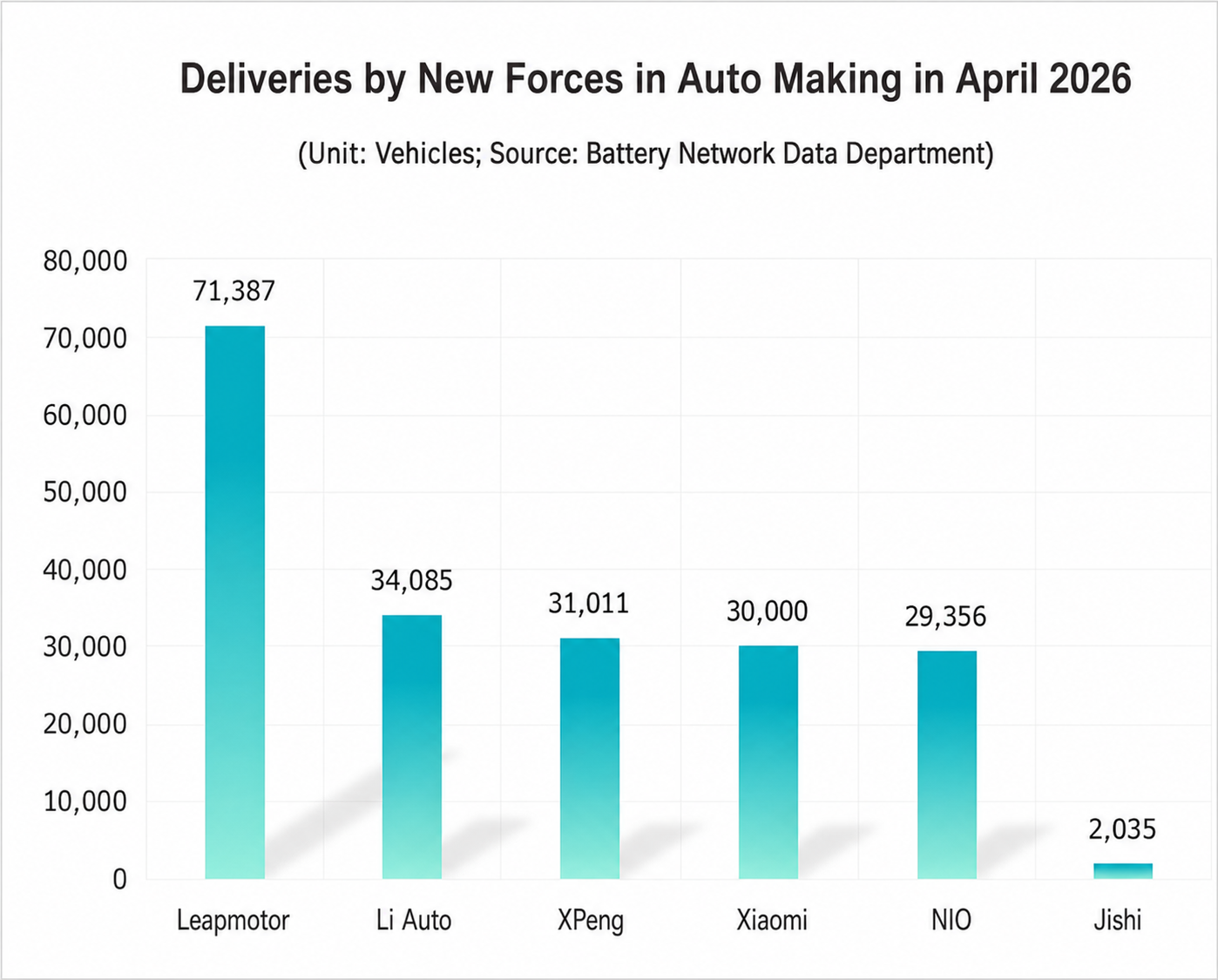
April sales/delivery data for new automaking forces were released. Leap Motor continued to "lead," delivering 71,387 units in April, up 73.9% YoY. Delivery momentum continued to surge, with back-end production running at full capacity simultaneously. Currently, Leap Motor's A10 factory capacity has exceeded 1,000 units/day.
Starting from April, Leap Motor's intelligent features also entered a phase of large-scale popularization. Currently, urban navigation-assisted driving has been made available for experience across multiple Leap Motor car models, and in the future, nationwide urban NAP and parking-space-to-parking-space navigation assistance will be rolled out in batches. Leveraging its full-domain self-developed capabilities, Leap Motor has achieved full coverage of assisted driving from the 100,000-yuan-level A10 to the flagship D19, making smarter and safer advanced intelligent assisted driving no longer a privilege of the few, but an accessible part of everyday travel.
Li Auto delivered a total of 34,085 new vehicles in April. As of April 30, 2026, Li Auto's cumulative historical deliveries reached 1,669,442 units. As of April 30, 2026, Li Auto had 511 retail centers nationwide, covering 160 cities, and 550 after-sales repair centers and authorized service centers, covering 223 cities. Li Auto had put into use 4,077 Li Auto supercharging stations nationwide, with 22,509 charging piles.
XPeng Motors delivered 31,011 new vehicles in April. As of April, cumulative deliveries of the XPeng MONA M03 exceeded 250,000 units, ranking first among pure electric sedans in the 100,000-200,000 yuan segment for 19 consecutive months. As of April 30, XPeng's charging network covered over 430 cities, with over 3,550 cumulative self-operated charging stations, including over 3,000 self-operated ultra-fast charging stations. To ensure smooth travel during the Labour Day holiday, XPeng completed dedicated inspections and maintenance of charging stations along highways and at popular scenic areas.
Xiaomi Auto delivered over 30,000 units in April. On May 6, Xiaomi Auto announced that the new-generation SU7 had received over 80,000 locked orders in just 48 days since its launch. The new-generation SU7 Standard Edition was priced at 219,900 yuan, the Pro Edition at 249,900 yuan, and the Max Edition at 303,900 yuan.
NIO delivered 29,356 new vehicles in April, up 22.8% YoY. Among them, the NIO brand delivered 19,024 units; the ONVO brand delivered 5,352 units, up 21.6% YoY; and the firefly brand delivered 4,980 units. In the first four months of this year, NIO delivered a total of 112,821 vehicles, up 71.0% YoY. To date, NIO has cumulatively delivered 1,110,413 vehicles.
In April 2026, the all-new NIO ES8 achieved 13,020 new vehicle deliveries. To date, the all-new ES8 has accumulated over 100,000 users and set the record for the fastest delivery of 100,000 units among high-end car models priced above 400,000 yuan in China. In addition, the all-new ES8 has been the sales champion among large SUVs and car models priced above 400,000 yuan for four consecutive months.
BYD, China's leading EV maker, recorded auto sales of 321,123 units in April. Exports exceeded 130,000 units, hitting a new all-time high. Cumulative NEV sales surpassed 16.1 million units. On May 9, BYD and China Auto Rental (CAR Inc.) officially signed a Flash Charging China strategic cooperation agreement and a 100,000-unit vehicle procurement framework agreement in Shenzhen. Under the agreement, the two parties will conduct in-depth cooperation around the "Flash Charging China Strategy," deploying BYD flash charging pile facilities at eligible CAR Inc. stores nationwide to build a widely covered, efficient, and convenient charging service network, jointly enhancing user travel experiences. Meanwhile, the two parties signed a 100,000-unit vehicle procurement framework agreement, further consolidating BYD's core position in CAR Inc.'s NEV fleet and supporting its continued expansion of green transportation capacity.
The CPCA stated that the current auto market is at a critical stage of smooth transition from "policy-driven" to "market-guided" and "product-driven." Although the market is under pressure in the short term, with multiple heavyweight new car models entering the market around the auto show period, supply-side efforts are expected to gradually drive demand-side recovery, and the overall auto market is expected to see a more robust rebound in Q2.
In addition, CPCA Secretary General Cui Dongshu noted that the NEV penetration rate exceeded 60% in April, a "leapfrog" development compared to approximately 52% in March, with a key reason being the sharp decline in internal combustion engine vehicle demand, which in turn pushed up the NEV penetration rate.
Recently, some automakers announced raises in optional intelligent driving features pricing, drawing market attention. In response, Cui Dongshu stated that China's auto market currently exhibits significant differentiation in automaker gross margins: high-end automakers maintain relatively high gross margin levels, with many models still sustaining gross margins above 20% supported by pricing, facing relatively small profitability pressure and having no substantive need to raise prices; low and mid-end automakers, however, face notable profitability pressure. Yet as industry competition continues to intensify and the overall market is in a state of volume contraction, broad-based price increases by automakers lack feasibility.
Looking ahead to May, the CPCA stated that May this year has 19 working days, consistent with the 19 working days in May 2025. Auto market production and sales are expected to continue the prior gradual rebound trend. From the end-user pace and consumption perspective, the MoM recovery momentum of the May auto market is generally improving. The 2026 truck renewal subsidy standards remain unchanged, while passenger vehicle trade-in subsidies were reduced, and the impact of passenger vehicle sales losses is expected to diminish over time. Sales losses previously caused by the cooling of industry price wars and sales promotions falling short of expectations have been gradually absorbed. The Labour Day holiday combined with local auto shows activated car purchase demand, driving pre-holiday order locking and post-holiday concentrated deliveries, with monthly trends showing strength early and stability later. The surge in fuel prices is an exceptionally significant factor affecting consumption, bringing uncertainty to market sales. Currently, residents' income expectations remain cautious, wait-and-see sentiment toward car purchases persists, and coupled with tightening auto finance and higher credit thresholds, rigid demand is supported only by local subsidies and automaker concessions. China's consumption recovery is mild, with notable structural differentiation.
Under the intertwined influence of multiple factors including international oil price fluctuations and intensive new product launches, these will dominate the May auto market performance. The Labour Day long holiday is a dividend driving MoM sales recovery, but consumption shortcomings are difficult to repair quickly, constraining YoY growth. High oil prices have reshaped car purchase preferences and accelerated the electrification transition, while the comprehensive new energy industry chain continues to empower export growth. The overall picture presents a weak recovery pattern of "MoM recovery, YoY pressure, domestic demand differentiation, exports leading, and continuously rising NEV penetration rate."