SMM May 9 News:
Metals market:
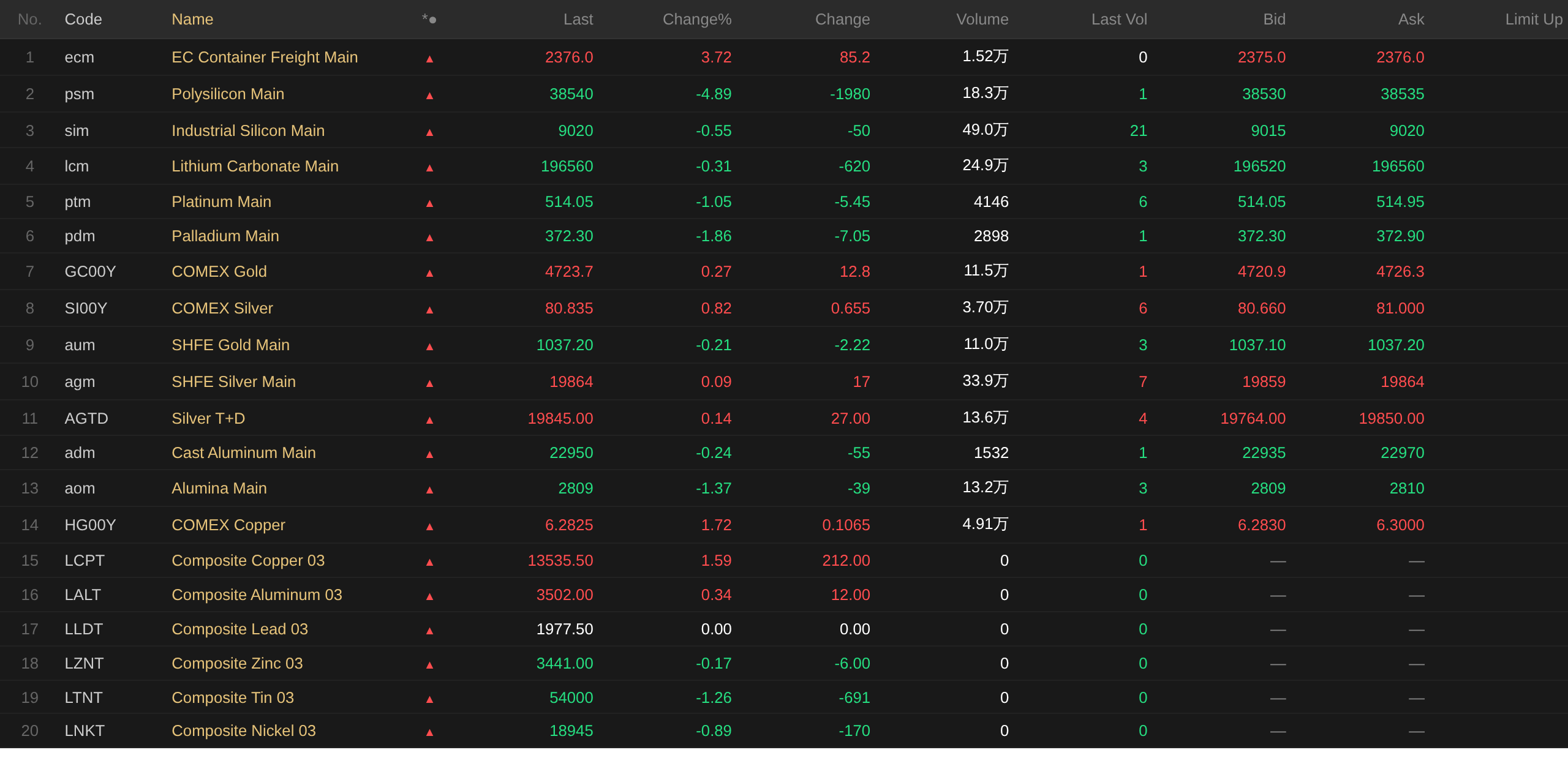
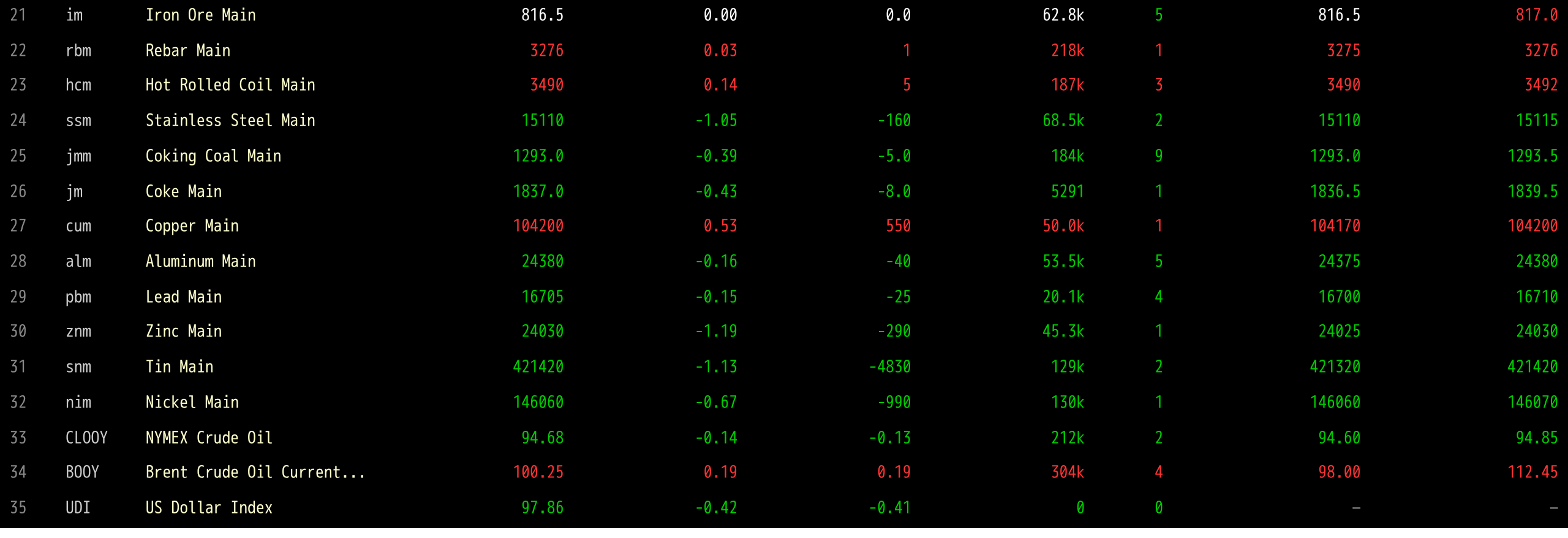
Overnight domestic market base metals mostly fell. SHFE copper rose 0.53%. SHFE aluminum fell 0.16%, SHFE lead fell 0.15%. SHFE zinc fell 1.19%. SHFE tin fell 1.13%. SHFE nickel fell 0.67%. In addition, the most-traded alumina futures contract fell 1.37%, and foundry aluminum continuous contract fell 0.24%.
Overnight ferrous metals mostly fell. Iron ore was flat at 816.5 yuan/mt, stainless steel fell 1.05%, rebar edged up slightly, and hot-rolled coil rose 0.14%. Coking coal and coke: coking coal fell 0.39%, coke fell 0.43%.
Overnight overseas market metals: LME base metals showed mixed performance. LME copper rose 1.59%. LME aluminum rose 0.34%, LME lead was flat at $1,977.5/mt. LME zinc fell 0.17%. LME tin fell 1.26%. LME nickel fell 0.89%.
Overnight precious metals:COMEX gold rose 0.27%, COMEX gold gained 1.71% on a weekly basis; COMEX silver rose 0.82%, COMEX silver gained 5.76% for the week. Overnight SHFE gold continuous contract fell 0.21%, with its weekly gain at 3.24%; SHFE silver continuous contract rose 0.09%, with SHFE silver gaining 11.4% on a weekly basis.
As of 8:39 AM on May 9, overnight closing prices:
Macro front
China:
[General Administration of Customs: China's goods trade imports and exports grew 14.9% in the first 4 months, with electromechanical product exports up 17.6%]According to customs statistics, in the first 4 months of 2026, China's total goods trade imports and exports reached 16.23 trillion yuan, up 14.9% YoY (the same hereinafter). Of this, exports were 9.33 trillion yuan, up 11.3%; imports were 6.9 trillion yuan, up 20%. In April, China's total goods trade imports and exports were 4.38 trillion yuan, up 14.2%. Of this, exports were 2.48 trillion yuan, up 9.8%; imports were 1.9 trillion yuan, up 20.6%.
[Four departments: Explore direct-connection power supply from nuclear and hydrogen energy to computing facilities, continuously increase the share of green electricity in computing facilities]The Plan proposes enhancing the diversified power supply capacity for computing facilities. Based on actual conditions such as the scale of computing facility grid connections, power grid voltage levels, power grid new energy penetration rates, power quality requirements, and computing facility business types, standards for energy supply planning and construction of computing facilities are to be established and improved. It explores direct-connection power supply from nuclear energy, hydrogen energy, and other energy sources to computing facilities. Encouraging computing power facilities to be equipped with grid-forming ESS to enhance power supply stability and active support capability for the power system.
[Three Departments Issued the "Implementation Opinions on Standardized Application and Innovative Development of Intelligent Agents"] The Cyberspace Administration of China, the National Development and Reform Commission (NDRC), and the Ministry of Industry and Information Technology jointly issued the "Implementation Opinions on Standardized Application and Innovative Development of Intelligent Agents." The Implementation Opinions clarified that the development of intelligent agents should adhere to the basic principles of safety and controllability, standardized and orderly development, innovation-driven approach, and application-led guidance, and proposed measures in four areas: First, consolidating the development foundation, improving the technology base, and building standards and protocols. Second, safeguarding the safety bottom line, clarifying product guidelines, preventing safety risks, improving governance systems, and strengthening industry self-discipline. Third, strengthening application-led guidance, proposing 19 typical application scenarios around scientific research, industrial development, consumption stimulation, people's well-being, and social governance. Fourth, building an innovation ecosystem, promoting industrial cooperation, and strengthening application promotion.
[China's April Warehousing Index Remained in Expansion Territory, Warehousing Industry Continued Stable and Positive Trend]The China Federation of Logistics and Purchasing released the April China Warehousing Index today (9th). The index continued to stay in expansion territory, with the warehousing industry maintaining a stable and positive operating trend. The April China Warehousing Index was 51%, remaining in expansion territory for two consecutive months. In terms of sub-indices, the new orders index, facility utilization rate index, and ending inventory index remained in expansion, while the average inventory turnover index maintained a relatively high prosperity level, indicating steady growth in warehousing business demand, good cargo turnover efficiency, and smooth supply chain connectivity. By product category, the peak production and construction season drove a rebound in warehousing demand for bulk commodities such as chemicals, coal, and machinery equipment, while Labour Day holiday stockpiling boosted notable growth in warehousing demand for consumer goods such as food, home appliances, and agricultural by-products. In terms of market expectations, the April business activity expectations index was 55.1%, remaining at a relatively high level, reflecting that enterprises maintained optimistic expectations. Overall, the warehousing industry operated steadily in April, market vitality continued to be released, and Q2 got off to a good start. (CCTV)
[Shanghai Shipping Exchange (SSE): Geopolitical Situation Tended to Stabilize, Freight Rates Rose on Most Routes]The Shanghai Shipping Exchange (SSE) stated in its weekly report that the ceasefire in the Middle East military conflict continued, with the geopolitical situation remaining relatively stable, though the future situation still faced significant uncertainty. This week, China's export container shipping market remained stable, with freight rates on most routes edging up, driving the composite index higher. On May 8, the Shanghai Export Containerized Freight Index (SCFI) stood at 1,954.21 points, up 2.2% from the previous period.
US Dollar:
The US dollar index fell 0.43% overnight, closing at 97.86. On a weekly basis, the US dollar index posted its second consecutive weekly decline, down 0.36% for the week. Data released by the US Bureau of Labor Statistics on Friday showed that non-farm payrolls increased by 115,000 in April, marking the first consecutive growth in nearly a year and the largest two-month gain since 2024, far exceeding the median forecast of 65,000 from economists surveyed by Bloomberg. March data was also revised up to 185,000. The unemployment rate remained unchanged at 4.3%, in line with expectations. (Wallstreetcn)
"Fed whisperer" Nick Timiraos: An increasing number of sell-side institutions and Fed watchers are removing or postponing interest rate cut expectations from their outlooks, including several forecasters who adjusted their views after the April non-farm payrolls data release. Currently, half of them believe there will be no interest rate cuts this year (given the inertia of such forecasts, this camp is likely to continue to grow). Additionally, Chicago Fed President Goolsbee stated that all interest rate options are currently on the table, not just rate cuts. At the end of April, the US Fed kept interest rates unchanged, with three officials opposing language in the statement that hinted the next move could be a rate cut, arguing that the possibility of a rate hike should be preserved. Goolsbee's remarks reflected a shift among Fed policymakers — no longer considering near-term rate cuts, primarily due to the energy price shock triggered by the Iran war pushing up inflation. He reiterated that both rate cuts and rate hikes are on the table, and expressed anxiety about inflation, noting that price pressures exist beyond the energy shock. (Jin10 Data)
As consumers worried about the impact of inflation on personal finances and purchasing conditions,US consumer confidence fell to a new all-time low in recent weeks.University of Michigan data showed that the preliminary May consumer sentiment index fell to 48.2 from 49.8 in April. Consumers expected prices to rise at an annual rate of 4.5% over the next year, a slight pullback MoM; longer-term inflation expectations for the next 5 to 10 years stood at 3.4%. As Americans' anxiety over overall living costs intensified, compounded by a sharp rise in gasoline prices, consumer confidence remained subdued. Data from the American Automobile Association (AAA) showed that the average US gasoline price this week surpassed $4.50 per gallon for the first time since July 2022, having risen more than 50% since the outbreak of the Iran war. Survey director Joanne Hsu stated: "About one-third of consumers voluntarily mentioned gasoline prices, and about 30% mentioned tariff concerns."Overall, consumers continued to feel the impact of cost pressure, with the primary driver being surging gasoline prices. "The May preliminary current conditions index fell to 47.8, hitting a record low; the expectations index rebounded for the first time since January. Consumers' assessment of their own current financial situation dropped to the lowest level since 2009, and the buying conditions indicator also fell to a five-month low. (Jin10 Data)
On the macro front:
Data to be released next week include: China April CPI YoY, China April PPI YoY, US April existing home sales annualized, Germany April CPI MoM final, Germany May ZEW Economic Sentiment Index, Eurozone May ZEW Economic Sentiment Index, US April NFIB Small Business Optimism Index, US weekly ADP employment change for the week ending April 25, US April CPI YoY (non-seasonally adjusted), US April seasonally adjusted CPI MoM, US April seasonally adjusted core CPI MoM, US April core CPI YoY (non-seasonally adjusted), Japan March trade balance, France Q1 ILO unemployment rate, France April CPI MoM final, Eurozone Q1 GDP YoY revised, Eurozone Q1 seasonally adjusted employment QoQ final, Eurozone March industrial output MoM, US April PPI YoY, US April PPI MoM, UK Q1 GDP YoY preliminary, UK March three-month GDP MoM, UK March manufacturing output MoM, Canada March wholesale sales MoM, US initial jobless claims for the week ending May 9, US April retail sales MoM, US April import price index MoM, US May NY Fed Manufacturing Index, US April industrial output MoM, and China April total electricity consumption YoY (TBD).
In addition, key events to watch next week include: US Treasury Secretary Bessent visiting Japan to meet with the Japanese Prime Minister, central bank governor, and finance minister; the Bank of Japan releasing the summary of opinions from its April monetary policy meeting; FOMC permanent voting member and NY Fed President Williams participating in a panel discussion on monetary policy; Chicago Fed President Goolsbee participating in a Q&A session hosted by a local chamber of commerce; 2028 FOMC voting member and Boston Fed President Collins speaking at the Boston Economic Club; 2026 FOMC voting member and Minneapolis Fed President Kashkari participating in a discussion hosted by a local chamber of commerce; the Bank of Canada releasing its monetary policy meeting minutes; 2026 FOMC voting member and Dallas Fed President Logan participating in a dialogue on the energy sector; 2026 FOMC voting member and Cleveland Fed President Hammack delivering opening remarks at an online discussion on central bank independence; US Fed Governor Barr delivering a speech; FOMC permanent voting member and NY Fed President Williams participating in a discussion; and the National Energy Administration releasing total electricity consumption data around the 15th of each month.
Crude oil:
Overnight, the two benchmark oil futures moved sideways, with WTI down 0.14% and Brent up 0.19%. On a weekly basis: WTI futures declined for the week, falling 7.12%; Brent also declined for the week, falling 7.32%. Middle East conflicts have resurfaced, and market concerns over the fragility of ceasefire agreements persist.
A CMG reporter learned on the 8th that ship-tracking data showed that as of the morning of the 8th local time, no large vessels had transited the Strait of Hormuz in the past 24 hours. This reportedly marked the second consecutive day since the 7th that no large commercial vessels had passed through the strait. (CCTV)
US energy services company Baker Hughes said in its closely watched report that US energy enterprises increased oil and natural gas rig counts for the third consecutive week, marking the first three-week streak of increases since early February. Data showed that for the week ending May 8, the total US oil and natural gas rig count, a leading indicator of future production, increased by 1 to 548, the highest since early April. (Webstock Inc.)
According to foreign media reports, sources said that since shipping through the Strait of Hormuz was disrupted, enterprises including Aramco Trading and Abu Dhabi National Oil Company (Adnoc) of the UAE have continued to transport crude oil cargoes through the strait. Although current shipment volumes represent only a fraction of what they were before Iran closed this oil route nearly 10 weeks ago, the actions of both companies serve as a reminder to the market that some supply can still reach global markets. Sources said Adnoc was among the first companies to attempt moving crude oil, fuel, and natural gas cargoes out through the strait. The company supplied clients with Upper Zakum crude, a grade typically loaded at Zirku Island, but in this case delivered in Fujairah waters outside the Persian Gulf. According to Vortexa data, at the end of April, a very large crude carrier (VLCC) loaded with Abu Dhabi crude turned off its transponder and transited the Strait of Hormuz out of the Persian Gulf. Kpler data showed that as of Thursday, another VLCC, Fujairah Energy, remained anchored near Abu Dhabi waters, carrying a half-load of crude obtained from Zirku Island via ship-to-ship transfer. A chartering agreement showed that the vessel had been temporarily chartered by Adnoc and plans to load crude between May 15 and 17 for delivery to Asia. (Jin10 Data)
Citi stated: The current base-case scenario projects an average Brent crude price of $110 in Q2 2026, followed by a decline to $95 in Q3 and $80 in Q4. Fitch expects Brent crude prices to remain at $100–$110 per barrel from May to July during the Strait of Hormuz blockade, before pulling back to $70 per barrel by September.
In addition, JPMorgan analysts stated that US gasoline prices "could very well" rise to $5 per gallon as refineries prioritize jet fuel production at the expense of other products. The analyst team noted in a Friday report that in Asia, currently the region hardest hit by the energy crisis, the price shock triggered by the Iran war is transmitting significantly faster through refined product markets such as jet fuel and diesel than through the crude oil market. If refinery operations continue to be constrained by limited crude oil supply, fuel prices could become "the primary transmission channel for demand destruction." "In this scenario, crude oil prices could still stabilize around $100 per barrel even as refined product crack spreads widen significantly. At that point, the next phase of the shock would no longer resemble a traditional crude oil price surge, but rather a refining and end-user fuel supply crisis." The product most visibly impacted at present is jet fuel, which is prompting refineries to maximize jet fuel output as much as possible, and this typically means diesel production declines. The chain reaction has also spread to gasoline production. Analysts said: "This may explain why US gasoline prices have already risen to $4.55 per gallon, and also why the risk of gasoline prices reaching $5 can no longer be ignored." (Jin10 Data)
Recommended Reading:
![Mine-Side Disruptions Drove Copper Prices Higher, SHFE Copper BC Copper Price Spread Inversion Widened Further [SMM BC Copper Commentary]](https://imgqn.smm.cn/usercenter/JnFuh20251217171711.jpg)
![Forecast for Next Week: Ferrous Metals Expected to Fluctuate at Highs in the Short Term [SMM Steel Industry Chain Weekly Report]](https://imgqn.smm.cn/usercenter/VYrIs20251217171747.jpg)
![[SMM Flash News] US Enterprise Layoffs Up 38% MoM in April, Down 50% YoY Year-to-Date](https://imgqn.smm.cn/usercenter/obeMy20251217171735.jpg)