【SMM Analysis】Falling Chrome Ore Imports, Supported by Demand and Costs, Drive Strong Price Performance

Published: Mar 23, 2026 14:15
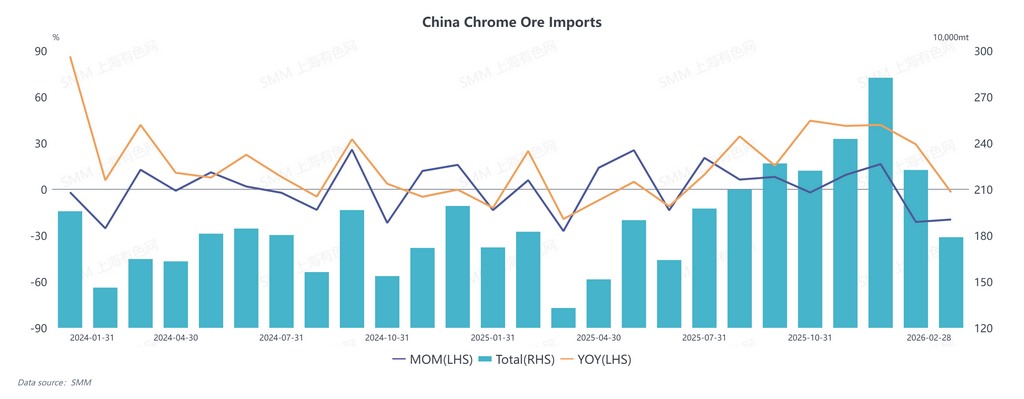
Combined for January and February 2026, China’s cumulative chrome ore imports reached 4.0144 million tons, up 13.2% year-on-year. Breakdown by origin: imports from South Africa were 3.2422 million tons (up 6.2% year-on-year), imports from Turkey were 184,700 tons (up 55.8% year-on-year), and imports from Zimbabwe were 400,000 tons (up 70.3% year-on-year).
News release: March 23, 2026

In January 2026, China's total chrome ore imports amounted to 2.2256 million tons, down 21.2% month-on-month and up 29.2% year-on-year. Specifically, imports from South Africa reached 1.8050 million tons, a month-on-month decrease of 19.4% and a year-on-year increase of 24.0%; imports from Turkey stood at 77,500 tons, dropping 35.0% month-on-month; and imports from Zimbabwe were 224,500 tons, declining 20.2% month-on-month.

In February 2026, China imported 1.7888 million tons of chrome ore in total, falling 19.6% month-on-month and 2.0% year-on-year. Among this volume, imports from South Africa were 1.4372 million tons, down 20.4% month-on-month and 10.1% year-on-year; imports from Turkey hit 107,100 tons, rising 38.1% month-on-month; and imports from Zimbabwe totaled 175,400 tons, a month-on-month drop of 21.9%.

Combined for January and February 2026, China’s cumulative chrome ore imports reached 4.0144 million tons, up 13.2% year-on-year. Breakdown by origin: imports from South Africa were 3.2422 million tons (up 6.2% year-on-year), imports from Turkey were 184,700 tons (up 55.8% year-on-year), and imports from Zimbabwe were 400,000 tons (up 70.3% year-on-year).

Affected by the rainy season, chrome ore mining and shipments in South Africa and Zimbabwe have been relatively constrained. According to South African customs data, South Africa’s total chrome ore exports in January 2026 were 2.1261 million tons, down 5.3% month-on-month and up 54.4% year-on-year, including 1.3831 million tons exported to China, a month-on-month decrease of 5.7% and a year-on-year surge of 138.3%. In addition, Zimbabwe has imposed additional export tariffs on chrome ore. Coupled with unresolved port congestion issues at the Port of Beira, chrome ore shipments have decreased accordingly. Escalating geopolitical conflicts worldwide have pushed up fuel prices and ocean freight rates, lifting the cost of overseas chrome ore and driving chrome ore prices to a relatively high level of 60 yuan per metric ton unit. On the downstream demand side, raw materials purchased for pre-holiday inventory have been consumed, while high ferrosilicon chromium production schedules have sustained steady and growing purchasing demand for chrome ore. Overall, buoyed by rising costs and robust demand, chrome ore prices are expected to maintain a strong trend in the short term.

Data Source Statement: Except for publicly available information, all other data are processed by SMM based on publicly available information, market communication, and relying on SMM‘s internal database model. They are for reference only and do not constitute decision-making recommendations.

For any inquiries or to learn more information, please contact: lemonzhao@smm.cn
For more information on how to access our research reports, please contact:service.en@smm.cn
Related News
Rotterdam APT Prices Stable, European Scrap Declines, Indian Market Rebounds Slightly
5 hours ago
Rotterdam APT Prices Stable, European Scrap Declines, Indian Market Rebounds Slightly
Read More
Rotterdam APT Prices Stable, European Scrap Declines, Indian Market Rebounds Slightly
[SMM Tungsten Express] SMM May 14: Rotterdam APT prices remained stable at $2,900-3,200/mtu this week, with suppliers holding prices firm with strong sentiment. Affected by tight spot cargo supply, market transactions fell into a deadlock again, with the situation of quoted prices but no actual deals continuing. European scrap prices continued to decline, with transactions in the range of 98-105 euros/kg; the Indian scrap market rebounded slightly by 4.5% WoW, with scrap tungsten carbide drill bits FOB closed at $110-120/kg.
5 hours ago
[SMM Analysis] Futures Weakened with Rigid Demand Providing Support, Stainless Steel Social Inventory Slightly Destocking
6 hours ago
[SMM Analysis] Futures Weakened with Rigid Demand Providing Support, Stainless Steel Social Inventory Slightly Destocking
Read More
[SMM Analysis] Futures Weakened with Rigid Demand Providing Support, Stainless Steel Social Inventory Slightly Destocking
[SMM Analysis] Futures Weakened with Rigid Demand Providing Support, Stainless Steel Social Inventory Slightly Destocking
[SMM Analysis: Futures in the Doldrums with Rigid Demand Providing Support, Stainless Steel Social Inventory Saw Mild Destocking] On May 14, SMM reported that stainless steel social inventory continued its mild destocking trend this week. Total inventory across the two core markets of Wuxi and Foshan pulled back slightly, dropping from 955,200 mt on May 7, 2026 to 947,100 mt on May 14, down 0.85% WoW, showing mild destocking characteristics. SS futures were in the doldrums this week. On Thursday, SS futures dropped sharply due to uncertainties surrounding the Fed Chairman transition policy, putting macro sentiment under pressure. However, the spot market showed strong resilience against declines, with stainless steel spot prices falling only narrowly and not following futures to swing wildly. Supply side, steel mills' earlier cargo distribution pace was relatively low, limiting market arrival pressure; traders were cautious in purchasing high-priced cargoes, and speculative purchasing willingness in the market remained weak. Demand side, rigid demand transactions in the market were moderate this week, with end-user rigid demand maintaining a steady pace to pick up goods, largely unaffected by the weak futures performance. Rigid demand resilience supported continued destocking, jointly driving social inventory to pull back slightly this week. Overall, despite futures being under pressure and ongoing macro uncertainties this week, firm spot prices, low steel mill arrivals, and resilient downstream rigid demand collectively drove mild inventory destocking. Currently, the high production schedule pattern at steel mills has not changed, supply-side pressure persists, and futures may maintain wild swings amid the uncertain macro environment. Combined with the traditional peak consumption season gradually...
6 hours ago
Magnesium Market First Weakened Then Strengthened, Consolidating at Lows and Stabilizing; Supply-Demand Divergence Continued [SMM Magnesium Weekly Review]
7 hours ago
Magnesium Market First Weakened Then Strengthened, Consolidating at Lows and Stabilizing; Supply-Demand Divergence Continued [SMM Magnesium Weekly Review]
Read More
Magnesium Market First Weakened Then Strengthened, Consolidating at Lows and Stabilizing; Supply-Demand Divergence Continued [SMM Magnesium Weekly Review]
[SMM Magnesium Weekly Review: Magnesium Market Weakened First Then Strengthened, Consolidating at Lows and Stabilizing; Supply-Demand Divergence Continued] This week, the magnesium market overall exhibited a pattern of weakening first then strengthening, gradually consolidating at lows and stabilizing. Dolomite prices remained stable, with transportation costs supporting delivery-to-factory prices to fluctuate at highs. Magnesium ingot prices drifted slightly lower at the beginning of the week under bearish sentiment, then bottomed out as producers held back from selling, speculative demand entered the market, and cost support held firm. The export market remained sluggish, with FOB quotes stabilizing at low levels before rebounding slightly. The magnesium powder and magnesium alloy markets operated steadily, with orders declining compared to Q1, operating rates edging down slightly, and new orders primarily driven by rigid demand. The magnesium alloy market showed notable supply-demand divergence, with stable demand in the automotive sector, weak two-wheeler demand, and processing fees under pressure. Overall, short-term bottom support for magnesium prices has emerged, but demand divergence will continue to constrain upside room.
7 hours ago
【SMM Analysis】Falling Chrome Ore Imports, Supported by Demand and Costs, Drive Strong Price Performance - Shanghai Metals Market (SMM)