Vietnam's lead ore resources rank among the top in Southeast Asia and are an important part of global lead ore reserves. According to data from China Customs and SMM, in 2025, Vietnam cumulatively exported approximately 24,000 tons of lead concentrate to China, accounting for about 31% of China's total lead concentrate imports from Southeast Asia, and is one of the core raw material supply sources for lead smelting enterprises in South China.
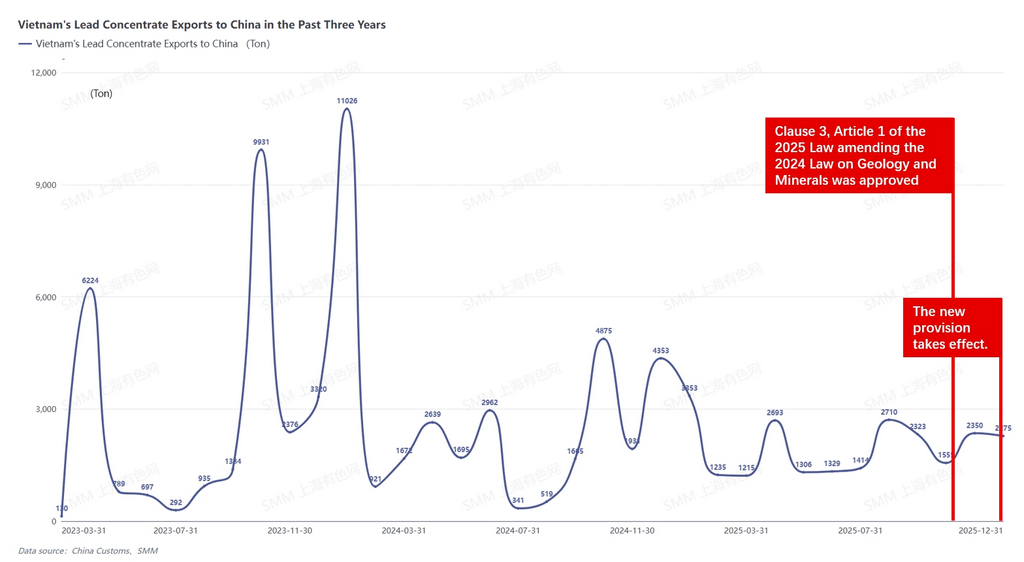
Affected by the upgrade of Vietnam's Mineral Law in 2026, the pace of exports to China has already shown signs of slowing down by the end of 2025, subsequent export volumes may come under pressure, potentially leading to a slowdown in future.
On December 11, 2025, the National Assembly of Vietnam reviewed and passed the new clauses for the "Revised Law on Geology and Minerals", which officially came into effect on January 1, 2026. This revision has updated a total of six core provisions, including adjustments to mineral classification, optimization of mining permit rules, and upgrading of mineral control. All of which may have a significant impact on mining enterprises, especially those mining metallic minerals in Vietnam. The core potential impacts are as follows:
1. Tighter regulation on upstream mining and higher compliance thresholds.
Reclassify metallic minerals from Group II to Group I, as Group I minerals pose a strategically importance to country's economic development; this means that the approval authority for exploration and mining is highly centralized, strict adherence to national strategic plans is required, and cross-border operation models are somewhat restricted to denounce any breach of resources.
(1) Permitting procedures are more difficult: Metal mining enterprises must comply with stricter permitting procedures when conducting course of mineral activities, while the time and cost of obtaining a mining license is expected to increased.
(2) Supervision and Reporting: the mining activities possibly undergone detailed supervision and reporting obligations, covering mining operations, trade, environmental protection, and resource management.
2. Tighter regulation on upstream mining and higher compliance thresholds.
Reclassify metallic minerals from Group II to Group I, as Group I minerals pose a strategically importance to country's economic development; this means that the approval authority for exploration and mining is highly centralized, strict adherence to national strategic plans is required, and cross-border operation models are somewhat restricted to denounce any breach of resources.
(1) Permitting procedures are more difficult: Metal mining enterprises must comply with stricter permitting procedures when conducting course of mineral activities, while the time and cost of obtaining a mining license is expected to increased.
(2) Supervision and Reporting: the mining activities possibly undergone detailed supervision and reporting obligations, covering mining operations, trade, environmental protection, and resource management.
3. Stricter Policies and Taxes
Taxes and Fees: Metal mining enterprises will comply higher taxes and fees on Class I resources to balance the state's interests in mineral resources.
4. New Trends in Supportive Industries and Metal Resource Recycling
Technology transfer and development of supporting industries: Strict management of metallic minerals create opportunities for the green supporting industries related to mineral recycling.
![Tug-of-War Between Sellers and Buyers Continues, Short-Term Lead Price Fluctuation Trend Difficult to Break [Lead Futures Brief Review]](https://imgqn.smm.cn/usercenter/TmYox20251217171721.jpeg)