| 4 de enero de 2026 | 17:54
El auge del almacenamiento en baterías ha reforzado la perspectiva de demanda de litio para 2026, alimentando las esperanzas de una recuperación acelerada para una industria que lucha contra el exceso de oferta.

El mercado del litio ha estado lidiando con un exceso de oferta desde la segunda mitad de 2022, ya que la demanda no logró mantener el ritmo del aumento de la oferta impulsado por una fuerte subida de precios ese año, desatada por el auge de las baterías para vehículos eléctricos.
Pero las reformas del sector energético de China ayudaron a impulsar una demanda de litio para baterías de almacenamiento en sistemas eléctricos más fuerte de lo esperado en la segunda mitad de 2025, respaldando una visión cautelosamente optimista sobre las perspectivas para el nuevo año.
El auge de la construcción de centros de datos en China y a nivel mundial también ha impulsado una creciente demanda de almacenamiento de energía para litio, dijo Jinyi Su, analista de la consultora Fubao con sede en Wuxi, añadiendo que el rápido crecimiento de la demanda de litio para almacenamiento de energía en la segunda mitad de 2025 ha superado las expectativas.
"De cara al futuro, el almacenamiento de energía podría ser un factor de cambio para el litio, mejorando sus fundamentos, pero un precio demasiado alto podría socavar la economía del almacenamiento, poniendo un techo a los precios", dijo Su.
Los sistemas de almacenamiento en baterías se han convertido en la exportación de tecnología limpia más rentable de China, con ventas de casi 66.000 millones de dólares en los primeros 10 meses de 2025, seguidas por alrededor de 54.000 millones en exportaciones de vehículos eléctricos.
Morgan Stanley pronostica un déficit de 80.000 toneladas métricas de carbonato de litio equivalente (LCE) en 2026, mientras que UBS estima un déficit de 22.000 toneladas, en comparación con un superávit esperado de 61.000 toneladas en 2025. Otros tres analistas chinos dijeron que esperan un superávit menor en el mercado del litio este año.
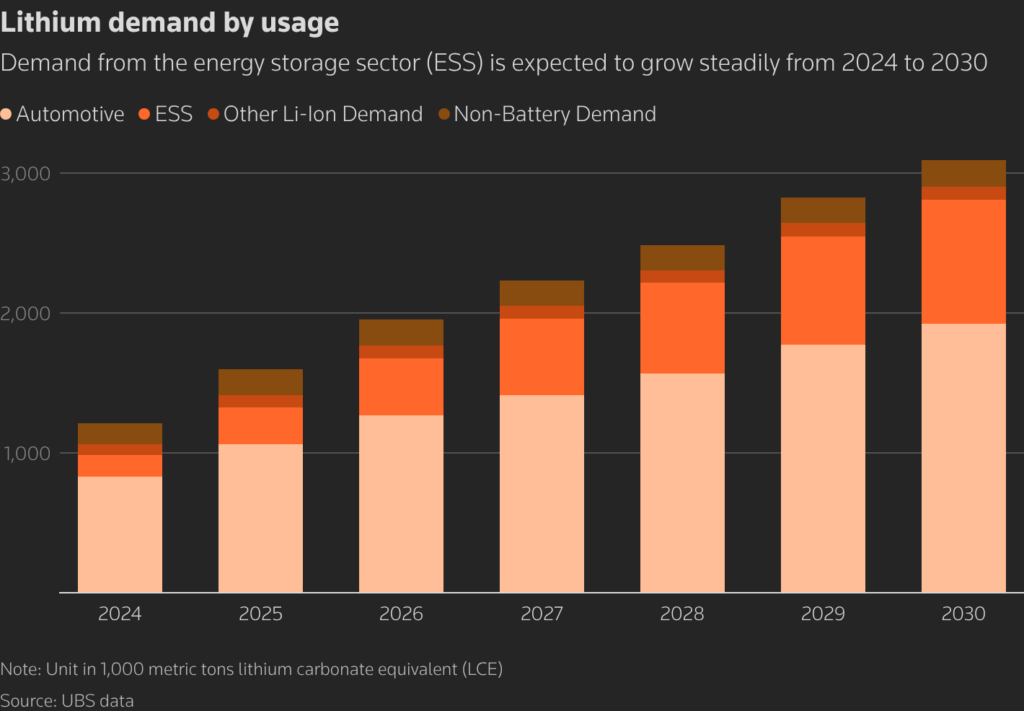
La demanda global de litio crecerá entre un 17% y un 30% en 2026, mientras que se espera que la oferta aumente entre un 19% y un 34%, según un rango de pronósticos de cuatro analistas, que declinaron ser identificados por no estar autorizados a hablar con los medios.
Los analistas pronostican un rango de precio de 80.000-200.000 yuanes (11.432-28.580 dólares) por tonelada en 2026, frente a 58.400-134.500 yuanes en 2025.
¿Punto de inflexión?
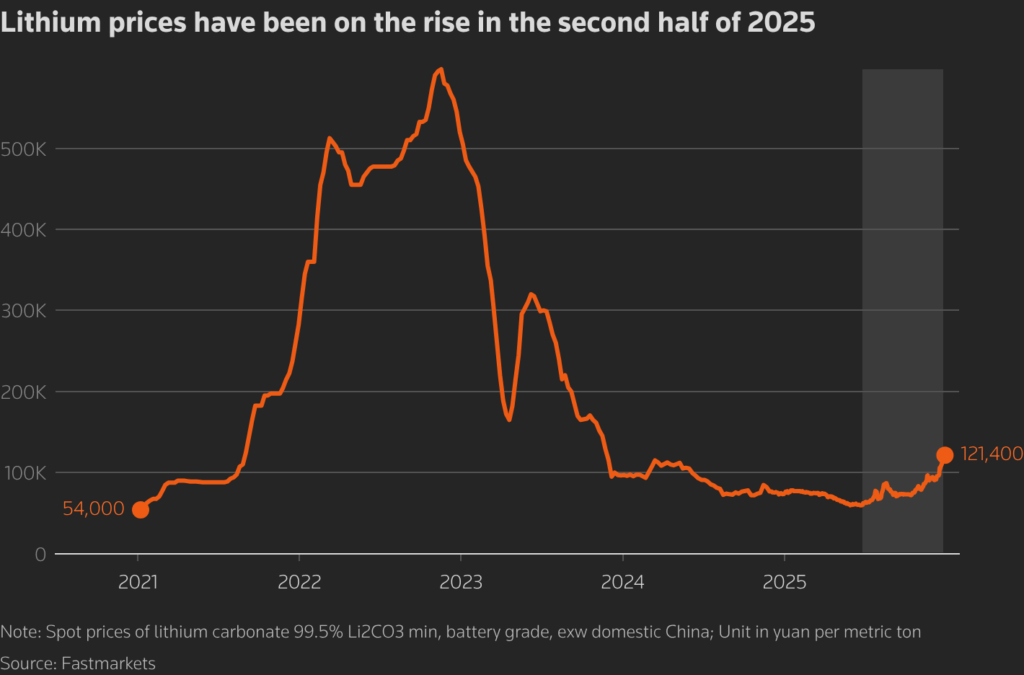
Los precios del litio continuaron cayendo en el primer semestre de 2025, alcanzando un mínimo para 2025 de 58.400 yuanes el 23 de junio, lo que comprimió los márgenes y los precios de las acciones de los mineros a nivel global y obligó a algunos a reducir la producción.
Pero el compromiso de julio de Pekín de frenar el exceso de capacidad en varios sectores, incluido el litio, y la paralización productiva de agosto en la mina Jianxiawo del gigante chino de baterías CATL, que representa alrededor del 3% del suministro mundial, .
Los precios del carbonato de litio en la Bolsa de Futuros de Cantón se dispararon un 130% desde el mínimo de este año, alcanzando su nivel más alto desde noviembre de 2023: 134.500 yuanes por tonelada el 29 de diciembre. Los precios al contado evaluados por el proveedor de información Fastmarkets aumentaron un 108% en el mismo período.
Se espera que la demanda de litio para almacenamiento energético crezca un 55% en 2026, tras un salto del 71% en 2025, según un cálculo de Reuters basado en datos de UBS.
El bróker Guotai Junan proyectó que la demanda equivalente de carbonato de litio para almacenamiento representará el 31% del consumo total en 2026, frente al 23% en 2025, reduciendo la participación de mercado dominada por las baterías de vehículos eléctricos.
Pero una migración potencialmente más rápida de lo previsto a la tecnología de baterías de iones de sodio para sistemas de almacenamiento, junto con la desaceleración de las ventas de vehículos eléctricos, podría reducir la demanda, mientras que el crecimiento de la oferta limitará el alza de precios, señalaron analistas.
En diciembre, el director de la asociación china de automóviles de pasajeros advirtió sobre una caída en la demanda de baterías de litio en el primer trimestre, en parte por una esperada disminución en las ventas de vehículos eléctricos a medida que se eliminan los incentivos fiscales.
(1 dólar = 6,9980 yuanes chinos)
(Por Amy Lv, Tony Munroe y Eric Onstad; editado por Jane Merriman)
Fuente:
![[Análisis SMM] En junio, el elevado coste integral de los materiales de ánodo respaldó el desplazamiento al alza del centro de precios.](https://imgqn.smm.cn/usercenter/jZvMC20251217171729.jpg)
![[SMM Análisis de mercado de mitad de año] Revisión del mercado de materiales de cátodo LFP en el primer semestre de 2026](https://imgqn.smm.cn/usercenter/mzgdV20251217171729.png)
![[Análisis de SMM] El lado de las materias primas bajo presión y con retroceso, los costos de grafitización se dispararon, los costos de los materiales para ánodos de junio se mantuvieron altos](https://imgqn.smm.cn/usercenter/gcOsy20251217171726.jpg)