Low-Priced Supplies Dwindle, Prices Rise Slightly; Supply-Demand Imbalance in Stainless Steel Market Awaits Resolution [[SMM Daily Review of Stainless Steel Spot Cargo]]

Publicado: Apr 30, 2025 16:08
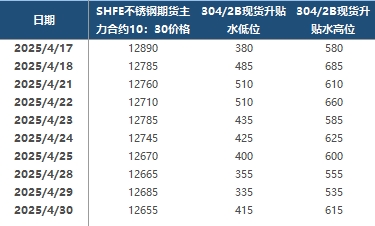
[SMM Daily Review of Stainless Steel Spot Market: Prices Edge Up as Low-Priced Supplies Dwindle, Supply-Demand Imbalance in Stainless Steel Market Awaits Resolution] SMM reported on April 30 that today, SS futures continued their previous fluctuating trend in the doldrums. As the Labour Day holiday approaches, the market did not witness the expected pre-holiday stockpiling frenzy, with all parties maintaining a cautious wait-and-see attitude. Currently, transactions are mainly concentrated on low-priced warrant cargoes, with most other purchases driven by rigid demand. Notably, as stainless steel prices hit a relatively low level, further downward resistance has significantly increased. Coupled with the gradual depletion of low-priced supplies, market prices have shown signs of a slight rebound. In the futures market, the most-traded contract 2506 is operating in a fluctuating trend in the doldrums. At 10:30 a.m., SS2506 was quoted at 12,655 yuan/mt. In the spot market, the cold-rolled 201/2B coils in Wuxi and Foshan were both quoted at 8,100 yuan/mt; the cold-rolled trimmed 304/2B coils had an average price of 13,000 yuan/mt in Wuxi and 13,000 yuan/mt in Foshan. From the perspective of market fundamentals, the current stainless steel prices have led to significant losses in the stainless steel sector. Additionally, the prices of furnace charges such as nickel and chromium have remained relatively firm, highlighting the prominent cost-supporting effect. However, the overall production cuts in the industry have been insufficient, with production being maintained more through adjustments in steel grade structures, resulting in an insignificant contraction effect on the supply side. On the demand side, impacted by the US tariff policies, downstream enterprises hold a pessimistic outlook, leading to increasingly cautious purchasing behavior. Despite prices being at a low level, market transactions have not significantly improved, with weak demand remaining the core contradiction constraining the recovery of the stainless steel market.

SMM reported on April 30 that today, SS futures continued their previous fluctuating trend in the doldrums. As the Labour Day holiday approached, the market did not witness the expected pre-holiday stockpiling frenzy, with all parties maintaining a cautious wait-and-see attitude. Currently, transactions are mainly concentrated on low-priced warrant cargoes, with most other purchases driven by rigid demand. It is worth noting that as stainless steel prices reached relatively low levels, the resistance to further declines significantly increased. Coupled with the gradual depletion of low-priced cargoes, market prices have shown signs of a slight rebound.

In the futures market, the most-traded 2506 contract was trading in a weak and fluctuating manner. At 10:30 a.m., SS2506 was quoted at 12,655 yuan/mt, down 30 yuan/mt from the previous trading day. In the Wuxi region, the spot premiums/discounts for 304/2B stainless steel ranged from 415 to 615 yuan/mt. In the spot market, cold-rolled 201/2B coils in both Wuxi and Foshan were quoted at 8,100 yuan/mt. For cold-rolled trimmed 304/2B coils, the average price in Wuxi was 13,000 yuan/mt, and the same in Foshan. Cold-rolled 316L/2B coils were priced at 23,750 yuan/mt in Wuxi and 23,750 yuan/mt in Foshan. Hot-rolled 316L/NO.1 coils were quoted at 22,975 yuan/mt in both regions. Cold-rolled 430/2B coils were priced at 7,500 yuan/mt in both Wuxi and Foshan.

From the perspective of market fundamentals, the current stainless steel prices have led to significant losses in the stainless steel sector. Additionally, the prices of furnace charges such as nickel and chromium have remained relatively firm, highlighting the prominent cost-supporting effect. However, the overall production cuts in the industry have been insufficient, with production being maintained more through adjustments in steel grade structures, resulting in an insignificant contraction effect on the supply side. On the demand side, impacted by the US tariff policies, downstream enterprises hold pessimistic expectations and are increasingly cautious in their procurement behaviors. Despite prices being at low levels, market transactions have not significantly improved, with weak demand remaining the core imbalance constraining the recovery of the stainless steel market.
Declaración de Fuente de Datos: Excepto la información disponible públicamente, todos los demás datos son procesados por SMM basándose en información pública, comunicación de mercado y confiando en el modelo de base de datos interna de SMM. Son solo para referencia y no constituyen recomendaciones para la toma de decisiones.

Para cualquier consulta o para obtener más información, por favor contacte: lemonzhao@smm.cn
Para más información sobre cómo acceder a nuestros informes de investigación, contacte con:service.en@smm.cn
Noticias relacionadas
[Flash | El Imacec de Chile cae 1,5% interanual en julio, la mayor caída mensual desde 2022, mientras la minería se desploma 9,3%]
hace 4 horas
[Flash | El Imacec de Chile cae 1,5% interanual en julio, la mayor caída mensual desde 2022, mientras la minería se desploma 9,3%]
Leer más
[Flash | El Imacec de Chile cae 1,5% interanual en julio, la mayor caída mensual desde 2022, mientras la minería se desploma 9,3%]
[Flash | El Imacec de Chile cae 1,5% interanual en julio, la mayor caída mensual desde 2022, mientras la minería se desploma 9,3%]
El Banco Central de Chile informó el 1 de septiembre que el Índice Mensual de Actividad Económica (Imacec) de julio cayó un 1,5% interanual en términos no ajustados. En términos desestacionalizados, el índice cayó un 2,1% interanual y un 1,7% mensual, marcando la mayor caída mensual desde 2022. El banco atribuyó el descenso principalmente a la minería, que cayó un significativo 9,3%, debido fundamentalmente a las condiciones climáticas, seguidas de menores leyes de mineral y mantenimiento de equipos que interrumpieron las operaciones normales de producción. Muchas de las minas afectadas son yacimientos asociados de cobre-molibdeno. Dado que el concentrado de molibdeno se recupera como subproducto del proceso de flotación utilizado para tratar el mineral de sulfuro de cobre, la interrupción de las plantas de procesamiento también redujo la producción de molibdeno.
hace 4 horas
Las rígidas restricciones de oferta intensifican el tira y afloja del mercado de molibdeno a principios de septiembre 【Análisis de molibdeno de SMM】
hace 19 horas
Las rígidas restricciones de oferta intensifican el tira y afloja del mercado de molibdeno a principios de septiembre 【Análisis de molibdeno de SMM】
Leer más
Las rígidas restricciones de oferta intensifican el tira y afloja del mercado de molibdeno a principios de septiembre 【Análisis de molibdeno de SMM】
【Análisis de molibdeno de SMM】 Noticias SMM del 3 de septiembre: En agosto, el mercado chino de molibdeno mantuvo un equilibrio ajustado, caracterizado por una oferta relativamente escasa y el respaldo de una demanda rígida. En general, los precios subieron primero y luego se estabilizaron, consolidándose en niveles altos. El concentrado de molibdeno al 45% se disparó hasta 5.455 yuanes/tmu durante el 19 y el 25 de agosto, manteniéndose firmemente en el rango máximo de los últimos tres años; esto impulsó simultáneamente el ferromolibdeno al 60% al contado, que alcanzó un máximo escalonado de 344.000 yuanes/tm el 24 y 25 de agosto.
hace 19 horas
[Flash | El Índice de Producción Minera de Chile cae 7,2% interanual en julio; la minería metálica baja 10,7%]
3 Sep 2026 10:06
[Flash | El Índice de Producción Minera de Chile cae 7,2% interanual en julio; la minería metálica baja 10,7%]
Leer más
[Flash | El Índice de Producción Minera de Chile cae 7,2% interanual en julio; la minería metálica baja 10,7%]
[Flash | El Índice de Producción Minera de Chile cae 7,2% interanual en julio; la minería metálica baja 10,7%]
El 31 de agosto, el Instituto Nacional de Estadísticas (INE) de Chile informó que el índice de producción industrial del país cayó un 5,1% interanual en julio. Dentro de ese indicador, el índice de producción minera (IPMin) retrocedió un 7,2%, con la minería metálica un 10,7% a la baja, lo que restó 9,301 puntos porcentuales al índice, principalmente por la menor extracción y procesamiento de cobre. Datos del USGS muestran que Chile representó aproximadamente el 16% de la producción mundial de molibdeno en 2025. Las recientes pérdidas de producción en las minas de cobre-molibdeno de Chile se han concentrado en la etapa de beneficio, lo que golpea más al molibdeno como subproducto que al cobre; por lo tanto, se espera que el suministro mundial de molibdeno sienta el impacto en 2026.
3 Sep 2026 10:06
Low-Priced Supplies Dwindle, Prices Rise Slightly; Supply-Demand Imbalance in Stainless Steel Market Awaits Resolution [[SMM Daily Review of Stainless Steel Spot Cargo]] - Shanghai Metals Market (SMM)