With a growth rate of 2.6%, what happens when China’s aluminium production peaks?

Published: Apr 28, 2025 11:28
For the past two decades, China has dominated the global aluminium landscape with unparalleled force.

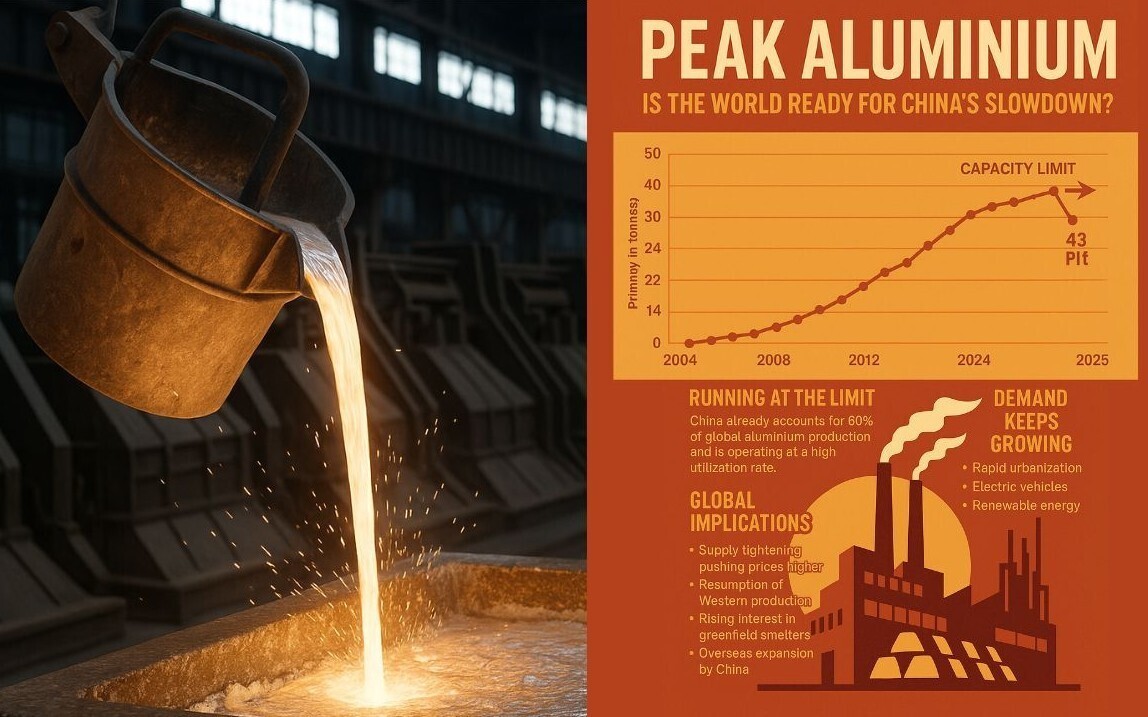
For the past two decades, China has dominated the global aluminium landscape with unparalleled force. From producing just 4 million tonnes in 2004, the country now commands a staggering 43 million tonnes of primary aluminium smelting capacity, accounting for 60 per cent of the world’s total. But now, in 2025, the dragon appears to be nearing its limits. As China approaches its government-imposed production ceiling with a 2.6 per cent growth rate during the first quarter of the calendar year, a monumental shift is on the horizon — one that could recalibrate global supply chains, trade dynamics, and pricing structures.
With a growth rate of 2.6%, what happens when China’s aluminium production peaks?
Image for representational purposes

If China’s aluminium production growth rate progresses in a similar pattern, the national production will reach 44 million tonnes, just one million tonnes away from the set cap. Thus, the aluminium world rightfully asks: What happens when China peaks?

The concept of ‘peak production’ isn’t new. Borrowed from the world of oil economics, it describes the point at which production hits its maximum before an inevitable plateau or decline sets in, not due to lack of demand, but due to constraints like raw material availability, cost pressures, or environmental regulations. For China, all three are now converging.

The country’s bauxite reserves, the cornerstone of aluminium production, are running low. At current rates, domestic resources might only last another 11 years. Compounding this, since 2017, the Chinese government has enforced a hard cap of 45 million tonnes of annual aluminium production to combat overcapacity and reduce the sector’s higher carbon footprint.

Adding to the pressure are rising input costs. Prices for energy and alumina, the key intermediate product, have spiked, with alumina contracts on the Shanghai Stock Exchange recording sharp increases in late 2024. Meanwhile, technological innovation, while ongoing, hasn’t advanced quickly enough to counteract these structural challenges.

Running at the limit

China’s aluminium industry is already operating near full throttle. By February 2025, its smelting capacity had hit 45.81 million tonnes, with operating output at 43.64 million tonnes — a utilisation rate of over 95 per cent. With little room left to grow, analysts now believe the industry is brushing up against its absolute limits.

Log in https://www.alcircle.com/news/with-a-growth-rate-of-2-6-what-happens-when-chinas-aluminium-production-peaks-113915 to read the full story for FREE

Source credit: https://www.alcircle.com/news/with-a-growth-rate-of-2-6-what-happens-when-chinas-aluminium-production-peaks-113915
Data Source Statement: Except for publicly available information, all other data are processed by SMM based on publicly available information, market communication, and relying on SMM‘s internal database model. They are for reference only and do not constitute decision-making recommendations.

For any inquiries or to learn more information, please contact: lemonzhao@smm.cn
For more information on how to access our research reports, please contact:service.en@smm.cn
Related News
Hindalco Boosts Aluminum Exports to Northeast Asia Amid West Asia Crisis
45 mins ago
Hindalco Boosts Aluminum Exports to Northeast Asia Amid West Asia Crisis
Read More
Hindalco Boosts Aluminum Exports to Northeast Asia Amid West Asia Crisis
[SMM Aluminum Express News] Hindalco Industries said aluminum exports to Japan, South Korea, and Taiwan have increased slightly as the company filled supply gaps created by the West Asia crisis. Around 70% of Hindalco’s aluminum is consumed domestically, while 25–30% is exported, with most overseas shipments directed to Northeast Asia. The company is also ramping up its new Aditya FRP rolling mill in Sambalpur, aiming to ease India’s aluminum can supply shortage by end-2026.
45 mins ago
Texmaco Secures $3M Rail Wagon Order from Vedanta for Alumina Transport Expansion
48 mins ago
Texmaco Secures $3M Rail Wagon Order from Vedanta for Alumina Transport Expansion
Read More
Texmaco Secures $3M Rail Wagon Order from Vedanta for Alumina Transport Expansion
[SMM Aluminum Express News] Texmaco Rail & Engineering has secured additional rail wagon orders from Vedanta Aluminium worth INR 285.8 million (US$3 million) for alumina transportation equipment. The latest contract covers one BTAP alumina rake and one brake van, following an earlier INR 571.5 million (US$6 million) order for two BTAP rakes and two BVCM units. Deliveries are scheduled within six to eight months, supporting Vedanta’s alumina logistics expansion.
48 mins ago
THACO Proposes $4.4B Bauxite, Alumina Investments in Vietnam, Aiming for 2030 Commissioning
52 mins ago
THACO Proposes $4.4B Bauxite, Alumina Investments in Vietnam, Aiming for 2030 Commissioning
Read More
THACO Proposes $4.4B Bauxite, Alumina Investments in Vietnam, Aiming for 2030 Commissioning
[SMM Aluminum Express News] THACO has proposed US$4.4 billion in bauxite and alumina investments in Vietnam, including the Lam Dong 2 alumina complex with planned capacity of 2 Mtpa alumina and a separate bauxite mining project targeting 12 Mtpa of ore production. The broader proposal also includes downstream aluminum smelting, titanium processing, chemical plants, and industrial park developments as THACO pursues a vertically integrated aluminum value chain. If approved in 2026, the first 1 Mtpa alumina phase is targeted for commissioning by 2030.
52 mins ago
With a growth rate of 2.6%, what happens when China’s aluminium production peaks? - Shanghai Metals Market (SMM)