Stainless Steel Market Futures-Spot Linkage: Price Fluctuations Amid the Tug-of-War Between Supply and Demand [SMM Stainless Steel Spot Daily Review]

Publicado: Feb 21, 2025 17:28
[SMM Stainless Steel Spot Daily Review: Stainless Steel Market Futures and Spot Linkage, Price Fluctuations Amid the Tug-of-War Between Supply and Demand] On February 21, during the week in the stainless steel market, the electronic May contract saw active trading, with futures prices first declining and then rebounding. This was driven by factors such as disruptions at Indonesian nickel-iron plants, maintenance at Beigang Xincai, and a recovery in macro sentiment, leading to a rise in the closing price on the 21st. In the spot market, prices for different series increased across the board, with the 300 series seeing the largest gains, followed by the 400 series. Although downstream demand was released slowly, the futures market momentum and changes in supply pushed spot prices higher. Market participants need to monitor subsequent supply and demand dynamics to adjust their strategies.

On February 21, the stainless steel market remained highly active. The electronic trading of the SS05 contract continued to be vibrant, with intense competition between long and short positions. On the same day, the SS05 contract fluctuated at highs upon opening, reaching the highest price of the day before trending downward. Its subsequent movements were highly uncertain, influenced by a mix of complex factors.

Reviewing this week's stainless steel futures market, the trend was highly volatile, showing a pattern of initial decline followed by a rebound. At the beginning of the week, the market was dominated by cautious sentiment. On February 17, the closing price of stainless steel futures was 13,045 yuan/mt, down 0.15% from the previous day, with a cumulative decline of 0.95% over the past five days. However, in the latter half of the week, the market sentiment shifted dramatically. On February 21, the closing price rose to 13,230 yuan/mt, with a daily increase of 0.38% and a cumulative five-day gain of 1.07%.

The recent price increase was driven by multiple factors. A major nickel pig iron smelter in Indonesia encountered unexpected issues, with the overall project capacity utilisation rate in February at only 30%, and nickel pig iron production is expected to decrease by approximately 10,000 mt in metal content. Meanwhile, Beigang New Materials plans to conduct equipment maintenance and upgrades from March to June, which is expected to impact the production of the 200 series, reducing output by approximately 300,000 mt. These developments injected marginally positive sentiment into the futures market. Additionally, a recovery in macroeconomic sentiment provided further support for the price increase.

In the spot market, stainless steel prices rose overall. Although the price increases varied across different series, they undoubtedly sent positive market signals. Prices for the 300 series stainless steel saw a broad rise, with the prices of 304/2B coil (mill edge and slit edge) in Wuxi and Foshan markets increasing by 25 yuan/mt, and the nationwide average price rising by 30 yuan/mt. Prices for various specifications of the 316L series also increased by 25 yuan/mt. This price rise was partly driven by the positive sentiment from the futures market and partly by the maintenance plans of some stainless steel producers, which altered market supply expectations and supported the price increase.

Prices for the 400 series stainless steel also rose. In the Wuxi market, the price of 430/2B coil increased by 25 yuan/mt, while in the Foshan market, the increase was relatively smaller at 5 yuan/mt. The nationwide average price rose by 10 yuan/mt. Although the price increase was not as significant as that of the 300 series, it still demonstrated the resilience of demand for this series in the market, with prices following the upward market trend.

Currently, although the release of downstream demand remains slow, spot prices have risen under the dual influence of the futures market and changes in supply. However, market participants should remain highly vigilant, closely monitoring subsequent changes in demand and the actual impact of maintenance on supply, to adjust their business strategies flexibly and better respond to market fluctuations.

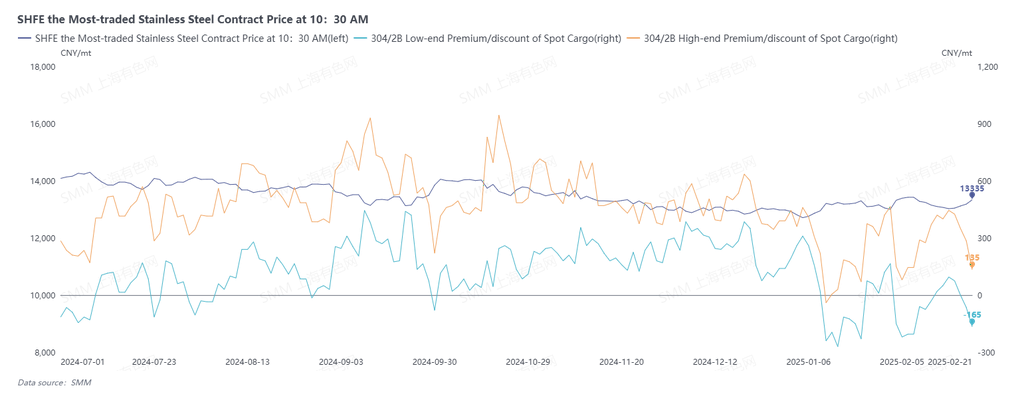
As of 10:30 a.m., the price of the SS2505 contract on the SHFE market was 13,335 yuan/mt. The spot premiums for stainless steel in Wuxi ranged from -165 to -135 yuan/mt. Note: Spot slit edge price = mill edge price + 170 yuan/mt.
》Click to view SMM historical spot metal prices

》Click to view SMM metal industry database

Declaración de Fuente de Datos: Excepto la información disponible públicamente, todos los demás datos son procesados por SMM basándose en información pública, comunicación de mercado y confiando en el modelo de base de datos interna de SMM. Son solo para referencia y no constituyen recomendaciones para la toma de decisiones.

Para cualquier consulta o para obtener más información, por favor contacte: lemonzhao@smm.cn
Para más información sobre cómo acceder a nuestros informes de investigación, contacte con:service.en@smm.cn
Noticias relacionadas
[Flash | El Imacec de Chile cae 1,5% interanual en julio, la mayor caída mensual desde 2022, mientras la minería se desploma 9,3%]
hace 3 horas
[Flash | El Imacec de Chile cae 1,5% interanual en julio, la mayor caída mensual desde 2022, mientras la minería se desploma 9,3%]
Leer más
[Flash | El Imacec de Chile cae 1,5% interanual en julio, la mayor caída mensual desde 2022, mientras la minería se desploma 9,3%]
[Flash | El Imacec de Chile cae 1,5% interanual en julio, la mayor caída mensual desde 2022, mientras la minería se desploma 9,3%]
El Banco Central de Chile informó el 1 de septiembre que el Índice Mensual de Actividad Económica (Imacec) de julio cayó un 1,5% interanual en términos no ajustados. En términos desestacionalizados, el índice cayó un 2,1% interanual y un 1,7% mensual, marcando la mayor caída mensual desde 2022. El banco atribuyó el descenso principalmente a la minería, que cayó un significativo 9,3%, debido fundamentalmente a las condiciones climáticas, seguidas de menores leyes de mineral y mantenimiento de equipos que interrumpieron las operaciones normales de producción. Muchas de las minas afectadas son yacimientos asociados de cobre-molibdeno. Dado que el concentrado de molibdeno se recupera como subproducto del proceso de flotación utilizado para tratar el mineral de sulfuro de cobre, la interrupción de las plantas de procesamiento también redujo la producción de molibdeno.
hace 3 horas
Las rígidas restricciones de oferta intensifican el tira y afloja del mercado de molibdeno a principios de septiembre 【Análisis de molibdeno de SMM】
hace 19 horas
Las rígidas restricciones de oferta intensifican el tira y afloja del mercado de molibdeno a principios de septiembre 【Análisis de molibdeno de SMM】
Leer más
Las rígidas restricciones de oferta intensifican el tira y afloja del mercado de molibdeno a principios de septiembre 【Análisis de molibdeno de SMM】
【Análisis de molibdeno de SMM】 Noticias SMM del 3 de septiembre: En agosto, el mercado chino de molibdeno mantuvo un equilibrio ajustado, caracterizado por una oferta relativamente escasa y el respaldo de una demanda rígida. En general, los precios subieron primero y luego se estabilizaron, consolidándose en niveles altos. El concentrado de molibdeno al 45% se disparó hasta 5.455 yuanes/tmu durante el 19 y el 25 de agosto, manteniéndose firmemente en el rango máximo de los últimos tres años; esto impulsó simultáneamente el ferromolibdeno al 60% al contado, que alcanzó un máximo escalonado de 344.000 yuanes/tm el 24 y 25 de agosto.
hace 19 horas
[Flash | El Índice de Producción Minera de Chile cae 7,2% interanual en julio; la minería metálica baja 10,7%]
3 Sep 2026 10:06
[Flash | El Índice de Producción Minera de Chile cae 7,2% interanual en julio; la minería metálica baja 10,7%]
Leer más
[Flash | El Índice de Producción Minera de Chile cae 7,2% interanual en julio; la minería metálica baja 10,7%]
[Flash | El Índice de Producción Minera de Chile cae 7,2% interanual en julio; la minería metálica baja 10,7%]
El 31 de agosto, el Instituto Nacional de Estadísticas (INE) de Chile informó que el índice de producción industrial del país cayó un 5,1% interanual en julio. Dentro de ese indicador, el índice de producción minera (IPMin) retrocedió un 7,2%, con la minería metálica un 10,7% a la baja, lo que restó 9,301 puntos porcentuales al índice, principalmente por la menor extracción y procesamiento de cobre. Datos del USGS muestran que Chile representó aproximadamente el 16% de la producción mundial de molibdeno en 2025. Las recientes pérdidas de producción en las minas de cobre-molibdeno de Chile se han concentrado en la etapa de beneficio, lo que golpea más al molibdeno como subproducto que al cobre; por lo tanto, se espera que el suministro mundial de molibdeno sienta el impacto en 2026.
3 Sep 2026 10:06