Review of LME Aluminum Trends During the Chinese New Year Holiday: Pre-Holiday Demand Weakens, LME Aluminum Fluctuates and Consolidates [SMM Analysis]

Publicado: Feb 05, 2025 09:20 (GMT+8)
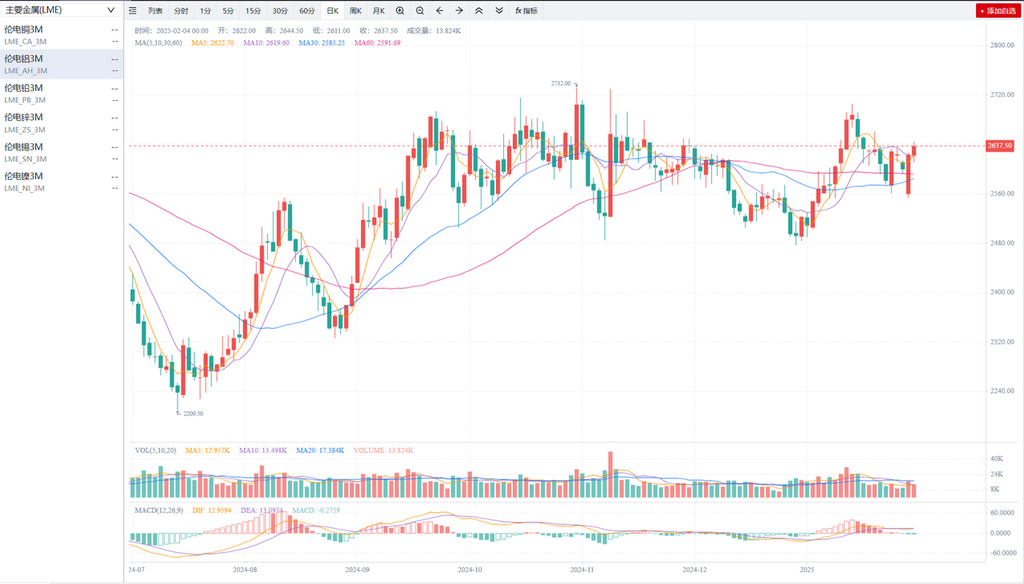
[SMM Analysis: Review of LME Aluminum Trends During the Chinese New Year Holiday: Pre-Holiday Demand Weakens, LME Aluminum Consolidates] Before the Chinese New Year holiday, due to weakening end-use consumption, the price center of SHFE aluminum shifted downward. On January 27, the most-traded SHFE aluminum contract (AL2503) closed at 20,240 yuan/mt, with a daily decline of 0.78%. During the Chinese New Year holiday (January 28 to February 4), the SHFE aluminum market was closed, while LME aluminum prices overall maintained a fluctuating trend, with the highest point reaching $2,634/mt and the lowest at $2,553/mt. On February 4, it closed at $2,637.5/mt, with a range increase of 1.11%.

SMM, February 5:

Before the Chinese New Year holiday, domestic aluminum prices shifted lower as end-use consumption weakened. On January 27, the most-traded SHFE aluminum contract (AL2503) closed at 20,240 yuan/mt, down 0.78% on the day. During the Chinese New Year holiday (January 28 to February 4), the SHFE aluminum market was closed, while LME aluminum prices maintained a fluctuating trend, with a high of $2,634/mt and a low of $2,553/mt. On February 4, LME aluminum closed at $2,637.5/mt, up 1.11% over the period.
Macro Economy: US Fed Maintains Cautious Stance on Rates, US and Eurozone Economies Slow

The US Fed recently stated that there is no urgent need for an interest rate cut until inflation and employment data require further adjustments, keeping the federal funds rate in the 4.25%-4.50% range. Fed official Raphael Bostic noted that while inflation is expected to continue declining, heightened economic uncertainty necessitates cautious policy adjustments to avoid overcorrection. The market remains focused on the timing and scale of future Fed rate cuts.

In Q4 2024, US GDP growth slowed to 2.3%, down from 3.1% in Q3, reflecting weakened growth momentum. Although inflation has significantly eased, the market remains wary of potential upside risks, particularly additional tariff policies that may be implemented by the Trump administration, which could increase cost pressure. Affected by economic data, the US dollar index fell below 107.8 on January 31, weakening the US dollar, while the 10-year US Treasury yield hovered around 4.5%.

In the Eurozone, Q4 2024 economic growth stagnated, recording 0.0% QoQ, with risks of weak demand and sluggish business activity intensifying. To stimulate the economy, the European Central Bank decided to cut the benchmark interest rate by 25 basis points to 2.75%, marking the fifth rate cut in this cycle and underscoring the urgency to boost economic growth.


EU Sanctions Tighten, US Tariffs Add Pressure, Global Aluminum Supply Chain Faces Adjustments

EU Expands Restrictions on Russian Aluminum Imports

On January 16, 2025, the EU announced plans to expand import restrictions on Russian aluminum products in its 16th round of sanctions in response to the ongoing Ukraine crisis. However, as Russia has successfully redirected its aluminum exports to non-sanctioned countries, the global impact of this measure is expected to be limited. Following the announcement, LME aluminum briefly surpassed $2,600/mt, hitting a one-month high before pulling back. The related sanctions are expected to be finalised in February.

Since the outbreak of the Russia-Ukraine conflict, the EU has significantly reduced its imports of Russian aluminum, with Russian aluminum now accounting for approximately 6% of the EU's total primary aluminum imports, a sharp decline from 2022. Supplies from the Middle East, India, and Southeast Asia have gradually filled the gap in the EU market. Meanwhile, Russian aluminum is increasingly flowing into China, with China importing 263,000 mt of Russian aluminum in the first three quarters of 2024, accounting for 33% of Russia's total aluminum exports. Considering China's aluminum production has nearly reached its capacity ceiling of 45 million mt, China's demand for imported aluminum is expected to persist.

US Tariff Hike Impacts Canadian Aluminum Trade

On February 2, Trump announced a 25% tariff on aluminum imports from Canada and Mexico, effective February 4, along with an additional 10% tariff on Chinese imports on top of existing tariffs. For China, the aluminum semis export tax rebate policy canceled in December last year will partially offset the tariff impact. However, Canada faces greater pressure—93.75% of its primary aluminum exports, totaling 1.55 million mt in 2024, were destined for the US, while US domestic primary aluminum supply only meets one-sixth of its consumption. Under these circumstances, the tariff hike will inevitably push up US domestic aluminum prices, ultimately affecting end-use consumers. The Canadian government is negotiating with the US to seek tariff exemptions or other trade compensation measures. On February 4, Mexico and Canada reached an agreement with the US to delay the tariff implementation by 30 days in exchange for enhanced border security measures with the US.

Amid tariff expectations, Canadian aluminum traders have begun arbitrage activities in the European market. According to SMM, the Rotterdam P1020A dp premium has dropped from $370/mt in early January to $320-330/mt, indicating market adjustments to hedge against US tariff policies. If the tariff policy continues, more Canadian aluminum may flow into the European market, further impacting global trade patterns and the European market's price structure.

Summary

Before the Chinese New Year, domestic aluminum market demand weakened, while LME aluminum prices fluctuated during the holiday. From a macro perspective, the US Fed has no immediate plans for rate cuts, US economic growth is slowing, and the Eurozone economy is stagnating with continued rate cuts, posing challenges to global economic recovery. On the supply side, the EU plans to expand sanctions on Russian aluminum, but the global market has partially absorbed the impact, with supplies from the Middle East and Southeast Asia filling the gap, while Russian aluminum flows to China have increased. The US's 25% tariff on Canadian aluminum may raise costs in the North American aluminum market, with Canada seeking countermeasures and arbitrage activities emerging in the European market. Overall, the global aluminum market is expected to undergo structural adjustments in the short term due to policy impacts, requiring close attention to US and European trade policies and changes in major consumer market demand.


Source: SMM Click on the SMM Industry Database for More Information

 

Declaración de Fuente de Datos: Excepto la información disponible públicamente, todos los demás datos son procesados por SMM basándose en información pública, comunicación de mercado y confiando en el modelo de base de datos interna de SMM. Son solo para referencia y no constituyen recomendaciones para la toma de decisiones.

Para cualquier consulta o para obtener más información, por favor contacte: lemonzhao@smm.cn
Para más información sobre cómo acceder a nuestros informes de investigación, contacte con:service.en@smm.cn
Noticias relacionadas
Alba avanza en la adquisición de Aluminium Dunkerque y aspira a la expansión mundial del aluminio bajo en carbono
hace 3 horas
Alba avanza en la adquisición de Aluminium Dunkerque y aspira a la expansión mundial del aluminio bajo en carbono
Leer más
Alba avanza en la adquisición de Aluminium Dunkerque y aspira a la expansión mundial del aluminio bajo en carbono
[SMM Noticias Exprés de Aluminio] Aluminium Bahrain (Alba) informó que su propuesta de adquisición de Aluminium Dunkerque avanza, y la empresa trabaja para obtener las aprobaciones regulatorias restantes necesarias para cerrar la operación. En la reunión del Consejo del tercer trimestre celebrada el 22 de septiembre, el presidente Khalid Al Rumaihi describió el acuerdo como un paso importante en la expansión internacional de Alba y en su ambición de construir una plataforma global de aluminio bajo en carbono. Alba firmó el acuerdo para adquirir Aluminium Dunkerque en mayo de 2026, y la operación se valoró posteriormente en unos 2.200 millones de dólares. Aluminium Dunkerque es la mayor fundición de aluminio primario de la UE, mientras que Alba opera la mayor fundición de aluminio de un solo emplazamiento del mundo en Baréin. La adquisición sigue sujeta a aprobaciones regulatorias pendientes y aún no se ha cerrado. El Consejo también aprobó el Plan de Comercialización preliminar de Alba para 2027, al tiempo que revisó asuntos operativos, comerciales y de gobernanza. En cuanto al suministro de aluminio, la principal conclusión es que Alba mantiene su compromiso de completar la adquisición de Dunkerque a pesar de las interrupciones regionales del suministro que afectaron a sus operaciones en Baréin a principios de este año.
hace 3 horas
Guinea busca financiación estadounidense para el proyecto de refinería de alúmina de CBG
hace 3 horas
Guinea busca financiación estadounidense para el proyecto de refinería de alúmina de CBG
Leer más
Guinea busca financiación estadounidense para el proyecto de refinería de alúmina de CBG
[SMM Noticias Exprés del Aluminio] Guinea busca financiación estadounidense para la refinería de alúmina prevista por Compagnie des Bauxites de Guinée (CBG), mientras el país acelera sus esfuerzos por procesar más bauxita a nivel nacional. El Ministerio de Minas de Guinea informó que el 18 de septiembre se mantuvieron conversaciones con la Corporación Financiera de Desarrollo Internacional de Estados Unidos (DFC) y el Banco de Exportaciones e Importaciones de Estados Unidos sobre una posible participación en la financiación del proyecto. CBG tiene como objetivo iniciar la construcción a finales de 2026, aunque aún no se han revelado los requisitos de financiación de la refinería ni la posible contribución estadounidense.
hace 3 horas
El Parlamento Europeo respalda la ampliación del CBAM a productos transformados de aluminio y acero a partir de 2028
hace 3 horas
El Parlamento Europeo respalda la ampliación del CBAM a productos transformados de aluminio y acero a partir de 2028
Leer más
El Parlamento Europeo respalda la ampliación del CBAM a productos transformados de aluminio y acero a partir de 2028
[SMM Noticias exprés del aluminio] El Parlamento Europeo ha respaldado una ampliación más extensa del Mecanismo de Ajuste en Frontera por Carbono (CBAM) de la UE a los productos transformados de aluminio y acero a partir de 2028. El Parlamento adoptó su posición negociadora el 15 de septiembre por 464 votos a favor, 50 en contra y 159 abstenciones, apoyando una cobertura que va más allá de la propuesta original de la Comisión Europea para 180 productos transformados adicionales, incluidos productos con uso intensivo de aluminio como alambres, elementos de fijación, resortes y ciertos productos acabados. En el caso del aluminio, el Parlamento también propone reducir el umbral de exención del CBAM de 50 toneladas a solo 5 toneladas, lo que significa que los importadores de menores volúmenes podrían quedar sujetos a los requisitos del CBAM. Asimismo, apoya normas más estrictas contra la elusión, incluido el uso de valores por defecto de emisiones basados en el país de origen real cuando las autoridades sospechen intentos de eludir las obligaciones del CBAM. Los cambios aún no son definitivos, ya que todavía se requieren negociaciones con el Consejo de la UE. De adoptarse, la ampliación aumentaría la obligación de declarar las emisiones de carbono y, potencialmente, la exposición a los costes del carbono para los exportadores de productos transformados de aluminio a la UE, extendiendo el CBAM más allá del aluminio primario y semielaborado.
hace 3 horas