Chinese New Year Break Plan for 2025 Released, Solar Cell Production Cuts by 13.3% [SMM Survey]

Publicado: Jan 2, 2025 14:53
The 2025 Chinese New Year break plan has been announced. Except for battery manufacturers that will halt production, most battery facilities are expected to rotate shifts during the holiday, with production lines continuing operation without shutdown. A few battery manufacturers will suspend production and take a three-week break, during which they will carry out line repairs, production line maintenance, and upgrades. However, the overall impact on supply is relatively small. The more significant impact comes from the production cut plans of leading semi-integrated and integrated battery companies. In January 2025, battery production cuts amounted to 7.36 GW, with the top three companies accounting for nearly 80% of the reduction.

The 2025 Chinese New Year break schedule has been released. Except for battery manufacturers that have ceased production, most battery bases plan to rotate shifts during the holiday, with production lines continuing operation without shutdowns. A few battery manufacturers will halt production for three weeks for line repairs, maintenance, and upgrades during the holiday, but the overall impact on supply is relatively small. The more significant impact comes from the production cut plans of leading semi-integrated and integrated battery enterprises. In January 2025, battery production cuts amounted to 7.36 GW, with the top three companies accounting for nearly 80% of the reductions.

According to the SMM survey, the planned production of solar cells in January 2025 was 48.13 GW, including 3.42 GW of P-type cells and 44.74 GW of N-type cells, down 13.3% MoM. The decline in January production was mainly due to the Chinese New Year holiday, compounded by labour shortages and logistics constraints, leading to a downturn in both upstream and downstream demand.
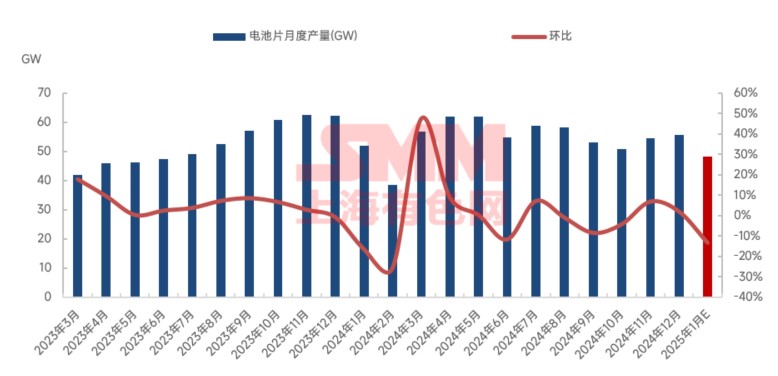
Among the 60 companies that had achieved large-scale production in January, 13 remained in a state of shutdown. During December 2024-January 2025, 1-2 companies resumed production after shutdowns, and 1-2 battery manufacturers are expected to resume production after the Chinese New Year. Battery production in February 2025 is expected to remain largely stable.

By manufacturer type, the January production schedule for integrated and semi-integrated manufacturers totaled 34.06 GW, including 2.12 GW of P-type cells and 31.93 GW of N-type cells, down 15.69% MoM. Specialized battery manufacturers scheduled 14.07 GW, including 1.30 GW of P-type cells and 12.7 GW of N-type cells, down 6.94% MoM.

By technology type, domestic PERC cell production in January decreased by 15.57%, Topcon cell production decreased by 14.35%, HJT cell production decreased by 11.36%, while BC cell production remained largely stable.

By size, the reduction in PERC cell production was mainly in the 182 size, with other PERC sizes already discontinued. Topcon cell production cuts were primarily in the 210R size and other non-mainstream sizes (proprietary sizes of integrated manufacturers were gradually discontinued). The 183-series cells saw slight production cuts, while the 210N cell production increased against the trend. HJT cells were predominantly in the 210 half-cut size.

It is well known that the recent solar cell market has been on the rise, with prices increasing. This is partly driven by the rising silicon wafer prices, which strengthened cost support, and partly influenced by market sentiment. In December, industry self-discipline sentiment surged, module prices rose, and manufacturers voluntarily initiated production cut plans, effectively managing inventory on the supply side. In 2025, leading battery manufacturers spearheaded production cuts and price hikes, with orders showing signs of spillover. Other first- and second-tier battery manufacturers experienced sufficient demand, jointly refraining from price cuts, and prices of all types of solar cells increased. At the end of December and early January, downstream module manufacturers stockpiled batteries, further supporting solar cell demand.
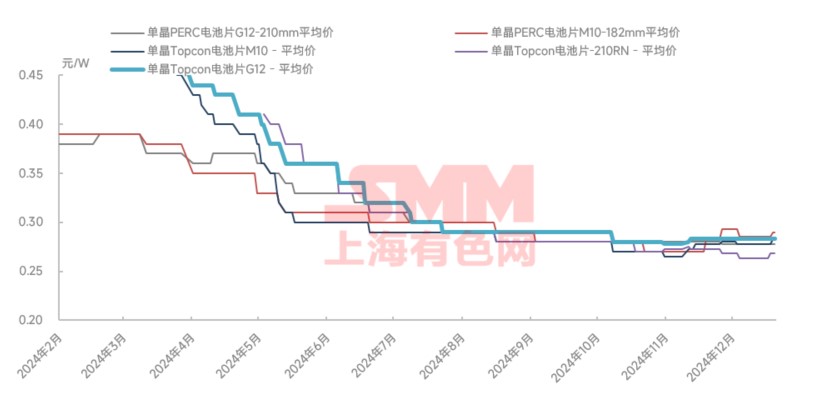
We expect the likelihood of solar cell production cuts in February 2025 to be relatively low, with production levels likely to remain largely stable. On the price side, strong cost support is expected. Although no demand increase is anticipated in February, the strong cost support for batteries suggests prices may remain stable with an upward trend.

Declaración de Fuente de Datos: Excepto la información disponible públicamente, todos los demás datos son procesados por SMM basándose en información pública, comunicación de mercado y confiando en el modelo de base de datos interna de SMM. Son solo para referencia y no constituyen recomendaciones para la toma de decisiones.

Para cualquier consulta o para obtener más información, por favor contacte: lemonzhao@smm.cn
Para más información sobre cómo acceder a nuestros informes de investigación, contacte con:service.en@smm.cn
Noticias relacionadas
[Solar: Bangladés introduce una tarifa de 0,086 dólares/kWh para la energía solar en tejados con medición neta y un objetivo de 5 GW]
hace 1 hora
[Solar: Bangladés introduce una tarifa de 0,086 dólares/kWh para la energía solar en tejados con medición neta y un objetivo de 5 GW]
Leer más
[Solar: Bangladés introduce una tarifa de 0,086 dólares/kWh para la energía solar en tejados con medición neta y un objetivo de 5 GW]
[Solar: Bangladés introduce una tarifa de 0,086 dólares/kWh para la energía solar en tejados con medición neta y un objetivo de 5 GW]
La División de Energía de Bangladesh anunció una tarifa de 10,50 BDT (0,086 dólares)/kWh para la electricidad excedente de sistemas solares en tejados elegibles bajo el régimen de medición neta del país, válida por tres años hasta el 28 de febrero de 2030. El costo máximo de generación para sistemas solares en tejados con almacenamiento en baterías se ha fijado en 8 BDT/kWh, con el gobierno añadiendo un margen de beneficio del 20% y una prima del 11,25%. Los sistemas instalados antes del 28 de febrero de 2027, que cumplan con las Directrices de Medición Neta 2025, son elegibles para la tarifa de incentivo. El gobierno pretende instalar al menos 5 GW de capacidad solar mediante medición neta para el próximo verano, con el fin de ayudar a resolver los déficits diarios de electricidad que superan los 3 GW durante la demanda máxima estival.
hace 1 hora
[Solar: Frontier Energy de Australia firma contratos para el proyecto híbrido solar-batería Waroona en Australia Occidental]
hace 1 hora
[Solar: Frontier Energy de Australia firma contratos para el proyecto híbrido solar-batería Waroona en Australia Occidental]
Leer más
[Solar: Frontier Energy de Australia firma contratos para el proyecto híbrido solar-batería Waroona en Australia Occidental]
[Solar: Frontier Energy de Australia firma contratos para el proyecto híbrido solar-batería Waroona en Australia Occidental]
Frontier Energy anunció que ha firmado todos los contratos principales para la primera etapa de su Proyecto de Energía Renovable Waroona, en el suroeste de Australia Occidental, que comprende una instalación solar de 132 MW y un sistema de almacenamiento de energía en baterías de 81,5 MW/565 MWh. Longi suministrará más de 200.000 paneles fotovoltaicos de 650 W y 655 W, Trinasolar suministrará las unidades de batería con una garantía de 20 años y un acuerdo de servicios a largo plazo, y SMA proporcionará los inversores. El presupuesto del proyecto es de aproximadamente 310 millones de dólares estadounidenses, con inicio de la construcción este mes y primera generación prevista para 2028, con planes de ampliación a 1 GW de energía solar y 660 MW de capacidad de almacenamiento.
hace 1 hora
[Solar: Malasia lanza el programa solar nacional LSS6 con 2,5 GW de energía solar y 1,25 GW de almacenamiento]
hace 1 hora
[Solar: Malasia lanza el programa solar nacional LSS6 con 2,5 GW de energía solar y 1,25 GW de almacenamiento]
Leer más
[Solar: Malasia lanza el programa solar nacional LSS6 con 2,5 GW de energía solar y 1,25 GW de almacenamiento]
[Solar: Malasia lanza el programa solar nacional LSS6 con 2,5 GW de energía solar y 1,25 GW de almacenamiento]
El Ministerio de Transición Energética y Transformación del Agua de Malasia lanzó en julio la licitación solar a gran escala LSS6, con un cupo total de 2.500 MW de capacidad solar combinada con 1.250 MW de almacenamiento de energía en baterías, más 150 MW reservados para empresas bumiputera. Se trata de la mayor licitación solar a escala de servicio público en la historia de Malasia y la primera ronda LSS que exige el desarrollo híbrido solar-BESS. Se espera que el programa atraiga entre 13.000 y 15.000 millones de ringgit (aproximadamente 3.200-3.700 millones de dólares estadounidenses) en inversión privada, con proyectos puestos en marcha por fases y con el objetivo de alcanzar la plena operación comercial antes del 31 de diciembre de 2029.
hace 1 hora