Since H2 2023, the PV market has experienced a sharp downturn, with the industry deeply mired in a capacity surplus and facing a wave of brutal eliminations. Against this backdrop, PV companies have had to reassess the market environment, rationally adjust their strategies, and slow down or even terminate investment projects lacking competitive advantages.
According to Polaris statistics, since 2023, 47 PV projects have been announced as delayed or terminated. These projects span the entire industry chain, including polysilicon, wafers, solar cells, auxiliary materials, and power stations. Among them are projects involving 320,000 mt of polysilicon, 37 GW of wafers/slices/ingots, 101.5 GW of solar cells and modules, and over 850 million m² of PV film.
"84 GW Solar Cell Projects Abruptly Halted"
Among the aforementioned projects, 12 PV projects have been terminated, primarily focusing on the TOPCon and HJT solar cell segments, with a total scale reaching 84 GW.
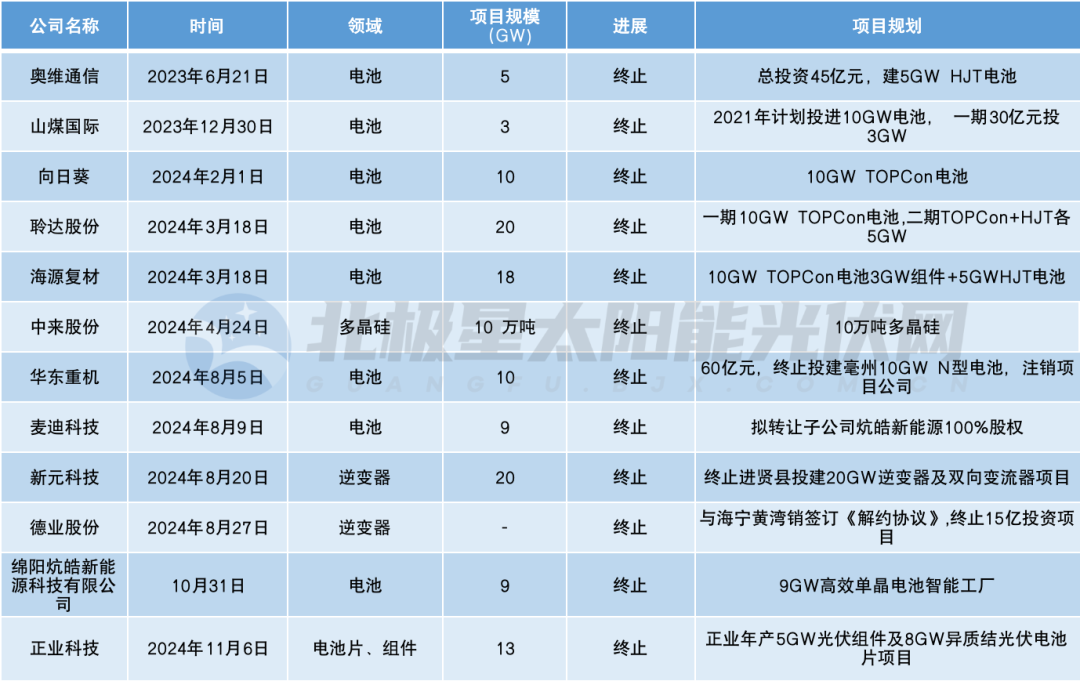
Notably, since H2 2023, the PV industry has undergone an iteration wave from P-type to N-type technologies, with solar cells being the core battleground of this transition, experiencing the most dramatic changes.
According to InfoLink data, by the end of 2024, TOPCon solar cell capacity is expected to reach approximately 920 GW, sufficient to meet most or even all market demand for the next five years. With new capacity already ample and even approaching surplus, an intense "price war" has become inevitable, and TOPCon module prices are quickly aligning with P-type prices. For investing companies, this significantly compresses profit margins compared to initial investment expectations, leaving many in a dilemma.
As "cut-throat competition" in the industry intensifies, an increasing number of cross-sector entrants are exiting this brutal competition. Companies like Lingda Co., Meditech, and Haiyuan Composite Materials have successively pressed the termination button. Even Sunflower, which had re-entered the PV field with high confidence, terminated its 10 GW TOPCon solar cell project under the severe circumstances. Similarly, East China Heavy Machinery took only a year to go from deciding to invest 6 billion yuan in a high-profile cross-sector PV venture to terminating its 10 GW N-type solar cell project. Shanxi Coal International Energy Group, one of the earliest publicly listed firms to venture into HJT, also succumbed, ultimately announcing the termination of its 3 GW HJT solar cell project.
Beyond the solar cell segment, PV backsheet leader Zhonglai Co. terminated its 100,000 mt high-purity polycrystalline silicon project; inverter company Xinyuan Technology terminated its 20 GW inverter and bidirectional converter project, while Deye Co. announced the termination of its 1.5 billion yuan inverter investment project. Additionally, Meditech, whose performance was dragged down, announced the termination of its 9 GW high-efficiency monocrystalline solar cell smart factory project and began divesting PV assets. Jiaojian Co., after reassessing market risks, decided to terminate its plan to acquire a 70% stake in Boda New Energy.
35 PV Projects Delayed
Amid this overwhelming "PV winter," for ongoing projects, blind expansion would only plunge companies deeper into financial crises, making project delays a rational choice after careful consideration.
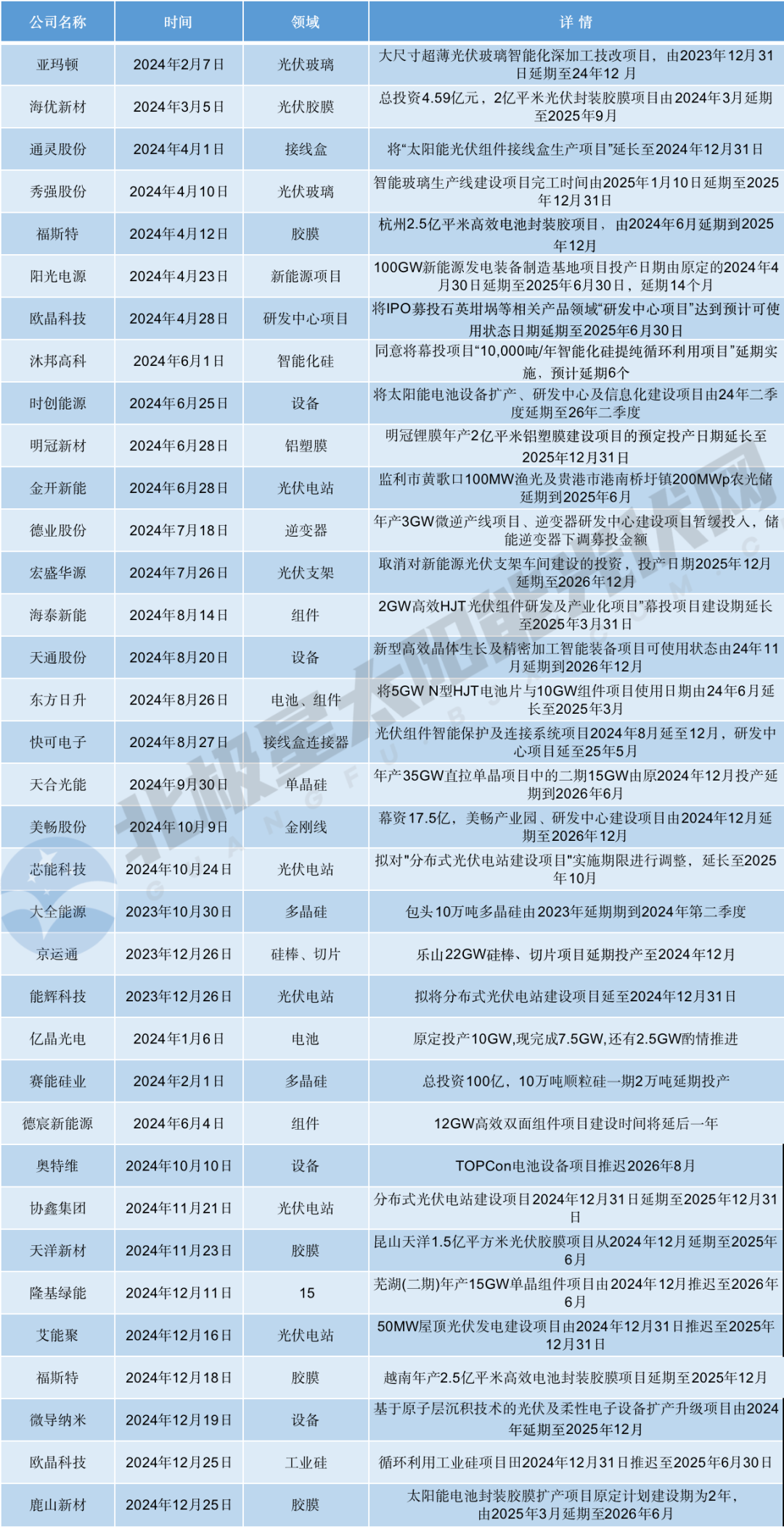
According to incomplete statistics, 35 PV projects have been announced as delayed in 2024, covering the entire industry chain from polysilicon, wafers, solar cells and modules, auxiliary materials, to power stations. Although some project completion timelines have been pushed to 2025 or even 2026, this move also reflects a glimmer of hope among companies for a market recovery in the future.
Among these, Daqo New Energy's 100,000 mt polysilicon investment and Saineng Silicon's 100,000 mt granular silicon Phase I 20,000 mt project have been delayed; Jingyuntong's Leshan 22 GW ingot and slicing project has been postponed to the end of 2024 for commissioning; and solar cell and module projects totaling 46.5 GW, invested by companies like Dechen New Energy and Eging PV, have been delayed by over six months.
In the auxiliary material segment, delays in PV film projects are relatively concentrated. "Main players" such as First, Crown, Tianyang New Materials, and Lushan New Materials have successively postponed their project investments by over a year, with each project scale ranging from 150-250 million m².
On the equipment side, equipment companies like Shichuang Energy, Tiantong Co., Autowell, and Micro Guide Nano have delayed their projects by at least a year. Among them, Autowell's TOPCon solar cell equipment project has been postponed to August 2026; Tiantong Co. has delayed the "large-size RF piezoelectric wafer project" and the "new-type high-efficiency crystal growth and precision processing intelligent equipment project" to December 2026 for reaching their intended usable state. Shichuang Energy has postponed the intended usable state timelines for its high-efficiency solar cell equipment expansion project, new material expansion and automation upgrade project, and R&D center and information construction project by 1-2 years. Micro Guide Nano has delayed the intended usable state timeline for its "PV and flexible electronics equipment expansion and upgrade project based on atomic layer deposition technology" to December 2025.
Notably, as downstream end-user PV power stations, project delays have started to increase. This year, as distributed PV installation scales continuously set new records, the associated investment risks have also grown. The implementation of time-of-use electricity prices and distributed PV market trading policies have introduced fluctuations in electricity price returns, making investments increasingly cautious. For instance, distributed PV projects invested by companies like Shanghai Nenghui, Xinneng Technology, GCL Energy Technology, and Ainuo Energy, spanning multiple provinces and cities, have seen significant delays in overall project progress due to policy impacts and adjustments in resource planning by owners.
Additionally, changes in the nature of PV land use have also become a reason for implementation delays. Jinkai New Energy announced that due to changes in land use nature, the 100 MW fishery-PV hybrid project in Huangxiekou, Jianli City, and the 200 MWp agrivoltaic-storage hybrid project in Gangnanqiaoxu Town, Guigang City, had to be postponed to June 2025.
Details are shown in the table below:

![[SMM PV News] Withstanding the Extreme "Heat" Test: APsystems APstorage 261L Successfully Passes UL 9540A Test!](https://imgqn.smm.cn/usercenter/oytJq20251217171740.jpg)
![Los precios de las obleas y las células solares siguen bajando, mientras que los recortes de producción de vidrio respaldan las subidas de precios [Reseña semanal de SMM]](https://imgqn.smm.cn/usercenter/JPzPS20251217171723.jpeg)
![[Los precios de los módulos fotovoltaicos distribuidos siguen divergiendo]](https://imgqn.smm.cn/usercenter/CaHKo20251217171738.jpg)