The global aluminium market faced significant challenges in 2024. Alumina shortages drove price increases, while geopolitical tensions, trade barriers, and sanctions reshaped global trade flows, leading to a trend of deglobalization. Shipping disruptions caused by conflicts further pushed up transportation costs and delays. On the macro economic front, interest rate cuts in major economies and China’s a set of stimulus added volatility to aluminium prices. As we enter 2025, what risks and opportunities lie ahead for the market?
Alumina shortages expected to ease in 2025
In 2024, alumina prices surged due to widespread supply constraints, making it one of the tightest years in preceding and following. China’s limited domestic bauxite availability capped alumina production growth, while international markets suffered from reduced alumina output in Australia. Accidents at Rio Tinto's Gladstone operations, environmental approval issues at South32, and the closure of Alcoa's Kwinana refinery caused a 1.16 million tonne alumina output decline in Australia this year, compared to 2023.
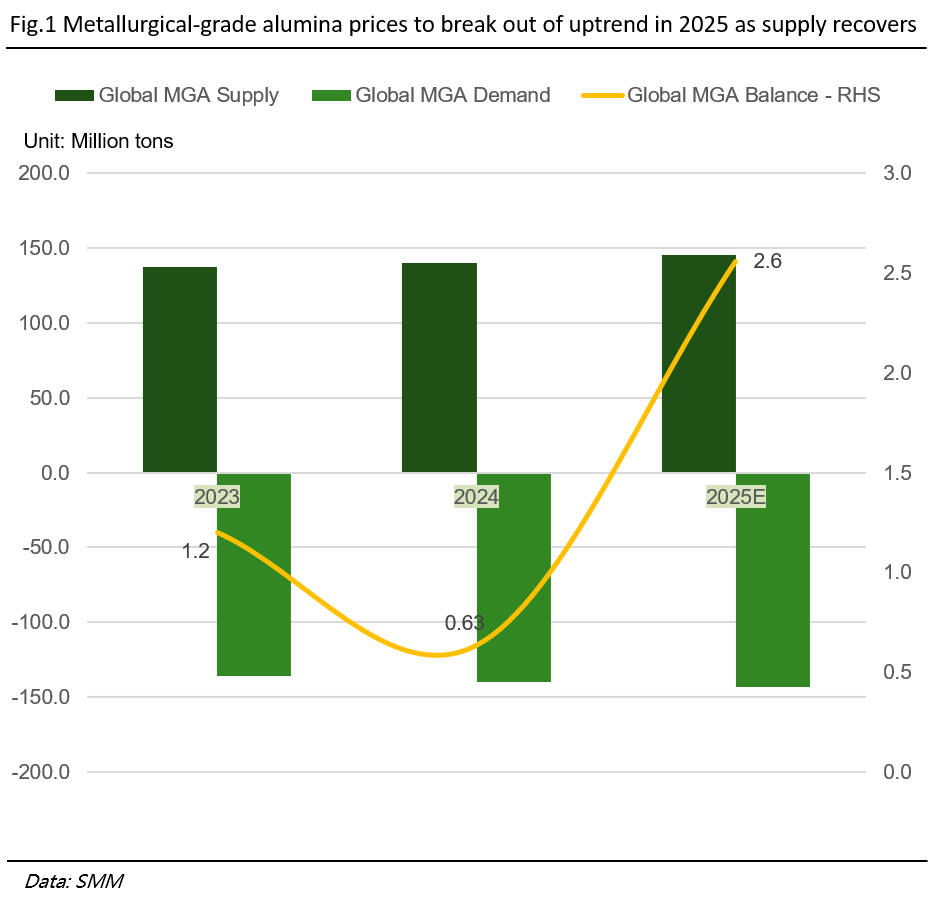
This imbalance was exacerbated by continued growth in global aluminium production, which drove alumina demand faster than supply could expand. By the end of 2024, global alumina supply reached 140.3 million tonnes, a 2.3% year-over-year increase, while demand rose 2.76% to 139.7 million tonnes, leaving a slim surplus of 0.6 million tonnes, which is the lowest since 2020.
However, Rio Tinto’s resolution of its production disruptions late in the year helped stabilize alumina prices, the South 32's environmental approval also were confirmed in December. In 2025, new capacity additions in Indonesia and India are expected to boost global alumina output. Two alumina refineries in Indonesia, Mempawah SGAR project and Jinjiang project, each with a capacity of 1 million tonnes, are scheduled to begin production between 2024 Q4 and early 2025. India’s Vedanta also constructed 1.5 million tonne expansion, will get full production as long as sufficient bauxite supply.
In 2025, alumina supply growth is likely to outpace demand, creating a surplus that could reduce pressure on aluminium operating costs. Based on our analysis, global metallurgical-grade alumina (MGA) surplus is expected to reach approximately 2.6 million tonnes in 2025, an increase of about 2 million tonnes year-over-year.
Primary aluminium deficit in 2024 is turning to a narrow surplus in 2025
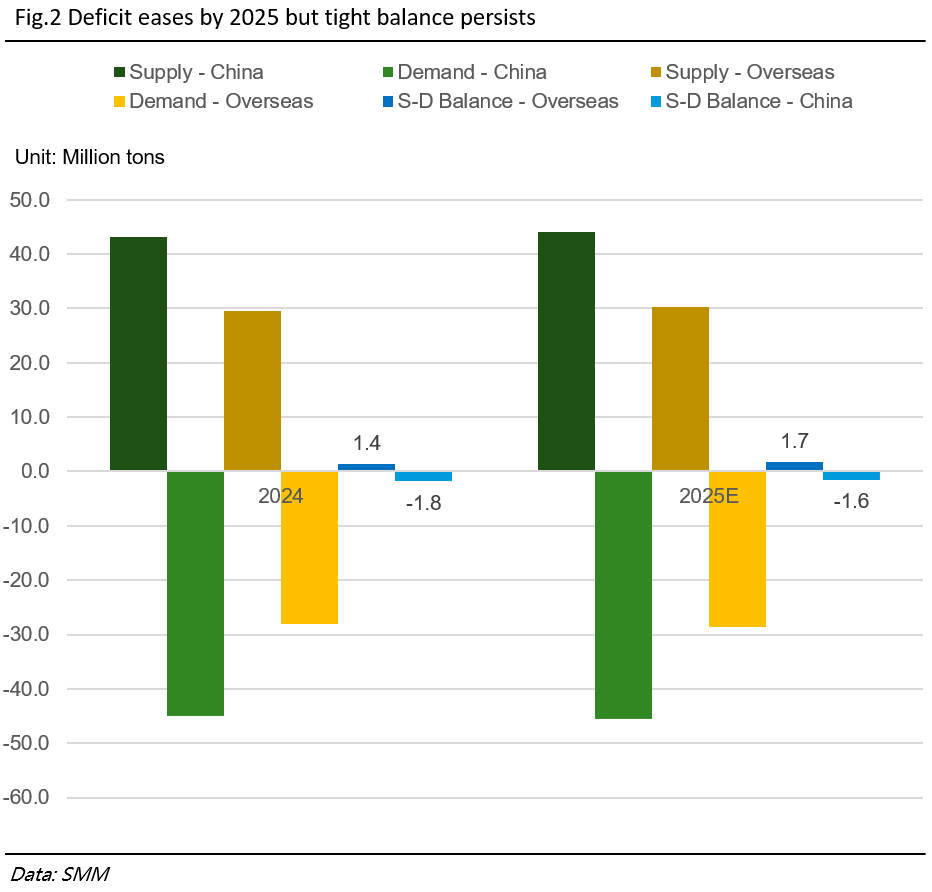
On the supply side, China’s aluminium production is capped at 45.5 million tonnes. High production costs elsewhere overseas have limited capacity expansions, with most new projects located in India and Indonesia. As our understanding, Balco's expansion project of Vedanta with 435kt capacity in India is under construction and likely to be finished next year, while the other 220kt new capacity from Indonesia Huatsing aluminium is expected to come on stream, which ramping-up was paused in the end of 2024 due to the high cost. Restarting idle capacity remains challenging, especially in high-cost regions like the U.S. and Europe.
On the demand side, the global major economies’ interest rate cuts and stimulus in China are expected to drive economic recovery, which will also benefit aluminium demand. These measures are likely to show their initial effects by 2025.
In that case, the global aluminium balance is likely to turn to a tight balance with only 0.1 million tons of surplus.
Regional markets vary: The U.S. keeps solid while Europe remains a concern
The U.S. aluminium market is expected to remain resilient in 2025, underpinned by stable industrial activity. With most imports sourced from Canada, the supply chain is anticipated to stay reliable, ensuring elevated premiums in the region.
In Europe, aluminium demand is likely to stay subdued due to modest economic growth. However, supply-side challenges are increasing as stricter environmental regulations and geopolitical risks, including potential broader sanctions on Russian aluminium, are expected to tighten supply further and drive premiums upward.
Japan’s aluminium market is expected to remain stable. However, higher premiums in North American and European markets and health demand growth in East and Southeast Asian market continue driving the regional premium upward. As a result, Japanese premiums have risen, reaching $228 per tonne in Q1 2025, a $30 increase from Q4 2024, with further gains expected.
In China, aluminium demand is projected to grow moderately by around 2%, despite the ongoing sluggishness in the real estate sector. Expanding production of photovoltaic profiles and electric vehicles is fueling demand in the transportation and power electronics sectors. With domestic aluminium production nearing its regulatory ceiling, aluminium prices are expected to remain well-supported under the anticipated stimulus policies in 2025.
In the Middle East, supply and demand appear to keep in strong level. As a key global supplier of primary aluminium, the region's output remains robust in 2025. On the consumption side, rapid infrastructure development, particularly in large-scale projects across the Gulf Cooperation Council (GCC) countries, is driving strong growth in aluminium demand.
Prices expected to be supported while remain volatile amid uncertainties
Starting in 2025, while declining alumina prices are expected to ease cost pressures, aluminium prices are unlikely to decline sharply in the short term. The realization of anticipated supply growth remains uncertain, depending on factors such as project timelines, raw material availability, and logistical stability. On the demand side, the pace of recovery still requires validation, particularly in regions with slower economic momentum. In other words, the minor surplus in the global aluminium market is likely to persist amid uncertainties.
In 2025, limited supply growth in the global aluminium market, high operating costs, fragile supply chains, and healthy demand could support aluminium prices. Additionally, factors such as the value of the US dollar, geopolitics, trade policies, and monetary policies from authorities could introduce further uncertainty and volatility to the global aluminium market.
![[SMM Noticias breves] South32 revisó la oferta de prima CIF MJP del cuarto trimestre de 2026 a 265 USD/tm](https://imgqn.smm.cn/usercenter/tkWbz20251217171654.jpg)