On October 18, a new central state-owned enterprise enterprise, China Resources Recycling Group Co., Ltd., was officially established in Tianjin.
China Resources Recycling Group Composition and Key Focus
China Resources Recycling Group Co., Ltd. has a registered capital of 10 billion yuan, with the State-owned Assets Supervision and Administration Commission of the State Council (SASAC) representing the State Council in performing the duties of the investor. Shareholders include several central state-owned enterprises such as Sinopec, China Baowu, Minmetals, China Resources Group, and Chalco.
China Resources Recycling Group Co., Ltd. will be dedicated to resource recycling and will undertake the important task of creating a national, functional resource recycling and reuse platform. After its establishment, the group will also expand into the recycling business of scrapped motor vehicles, home appliances, and electronic products, as well as major equipment products such as decommissioned wind power and PV modules. China Resources Recycling Group will recycle and reuse steel scrap, waste power batteries, waste plastics, and waste non-ferrous metals, which will help improve energy and mineral self-sufficiency.
New Opportunities in the Steel Scrap Industry
The establishment of China Resource Recycling Group will further consolidate the important position of the steel scrap industry in the national economy. It is not only a strong boost to the current steel scrap market but also a powerful driver for the future large-scale and standardized development of the steel scrap industry. Industry insiders indicate that the future steel scrap industry needs to continuously focus on technological innovation, cost control, and market expansion. The establishment of China Resource Recycling Group is expected to address many of the current pain points faced by the steel scrap industry. On one hand, by integrating industry resources, optimizing industrial layout, and improving the efficiency of steel scrap recycling and processing; on the other hand, leveraging the strong capabilities and brand influence of central enterprises to promote the standardization and large-scale development of the steel scrap industry, further reducing production costs.
There is still a significant gap in achieving the target for steel scrap utilization.
Steel scrap is currently the only raw material that can significantly replace iron ore and is a green renewable resource. Within the industry, the use of steel scrap is widely recognized for its strong competitiveness in both energy conservation and emission reduction, as well as reducing dependence on imported ore.
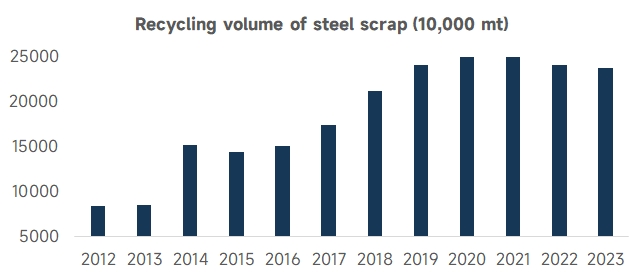
According to market statistics, producing 1 mt of steel using steel scrap can save 1.6 mt of iron ore, 0.4 mt of coke, and approximately 1 mt of raw coal, while also significantly reducing emissions of carbon dioxide and solid waste. In recent years, the importance of steel scrap as a major substitute for iron ore has become increasingly prominent. The national and local governments have formulated a series of regulations and policies related to "steel scrap" to support the standardized development of the steel scrap industry in various aspects, aiming to improve the recycling rate of steel scrap and promote the green transformation of the steel industry. However, due to the decline in profits in the steel industry in recent years, the proportion of steel scrap added has remained low, and the recycling volume of steel scrap has not been ideal.
Based on the recycling volume of steel scrap from major steel enterprises nationwide, SMM estimates that the recycling volume of steel scrap in 2023 was about 238 million mt. In February 2024, the State Council issued the "Opinions on Accelerating the Construction of a Waste Recycling System," proposing that by 2025, the annual utilization of major renewable resources such as steel scrap, copper scrap, aluminum scrap, lead scrap, zinc scrap, waste paper, waste plastic, waste rubber, and waste glass should reach 450 million mt, and the annual output value of the resource recycling industry should reach 5 trillion yuan. There is still some distance to go to achieve the target for steel scrap utilization set for the 14th Five-Year Plan.
Expand the number of "white list" enterprises for steel scrap processing to promote recycling volume
In recent years, the country has introduced numerous policies related to steel scrap to promote the recycling volume and enhance the production of steel scrap processing enterprises. These policies actively advance the construction of steel scrap processing bases. As of now, 31 provinces have issued policies related to steel scrap, optimizing the construction of steel scrap processing and increasing the entry list for the steel scrap processing industry. On November 6, the Ministry of Industry and Information Technology (MIIT) Department of Energy Conservation and Comprehensive Utilisation issued an announcement. According to the "Steel Scrap Processing Industry Access Conditions" and other regulatory conditions and relevant announcement management methods, the list of enterprises that meet the "Steel Scrap Processing Industry Access Conditions" (the twelfth batch) was announced, and the list of enterprises proposed to be removed from the "Steel Scrap Processing Industry Access Conditions" was also published. This time, a total of 111 enterprises met the "Steel Scrap Processing Industry Access Conditions" (the twelfth batch), and a total of 26 enterprises were proposed to be removed from the list. According to SMM statistics, as of November 2024, a total of 1,013 enterprises have been included in the "Steel Scrap Processing Industry Access Conditions" in twelve rounds, and a total of 104 enterprises have been removed, leaving 909 enterprises currently in the list.
The number of enterprises included in "Steel Scrap Processing Industry Access Conditions" over the years and the list of enterprises included in the twelfth batch of "Steel Scrap Processing Industry Access Conditions" , as well as the list of revoked enterprises, are as follows:
![[SMM Steel] Los cuellos de botella en el transporte marítimo y los riesgos geopolíticos tensan el comercio de exportación de acero semielaborado iraní](https://imgqn.smm.cn/usercenter/VhIgs20251217171719.jpg)
![[SMM Steel] El mercado europeo de bobinas laminadas en caliente se muestra mixto ante la resistencia de los compradores a las subidas de precios de las acerías](https://imgqn.smm.cn/usercenter/ntiFA20251217171719.jpg)