Can India Replace Europe and the United States and Become a Major Export Market of Chinese Stainless Steel? [SMM analysis]

Publicado: Sep 09, 2022 11:10 (GMT+8)
Fuente: SMM
At the same time, the structure of major exporting countries of Chinese stainless steel has gradually changed since the second half of this year. China’s stainless steel exports did not fall steeply though China's main export destination, Europe, has suffered hefty from energy crisis and inflation. Why is that?

SHANGHAI, Sep 9 (SMM) - Stainless steel futures stopped falling and rebounded recently, exceeding the market expectations. The rally was partly boosted by the forced shutdown or production cuts by many steel mills in light of serious losses under the energy crisis, and overseas supplies also dropped palpably. At the same time, the structure of major exporting countries of Chinese stainless steel has gradually changed since the second half of this year. China’s stainless steel exports did not fall steeply though China's main export destination, Europe, has suffered hefty from energy crisis and inflation. Why is that?

The reasons are listed as follows:

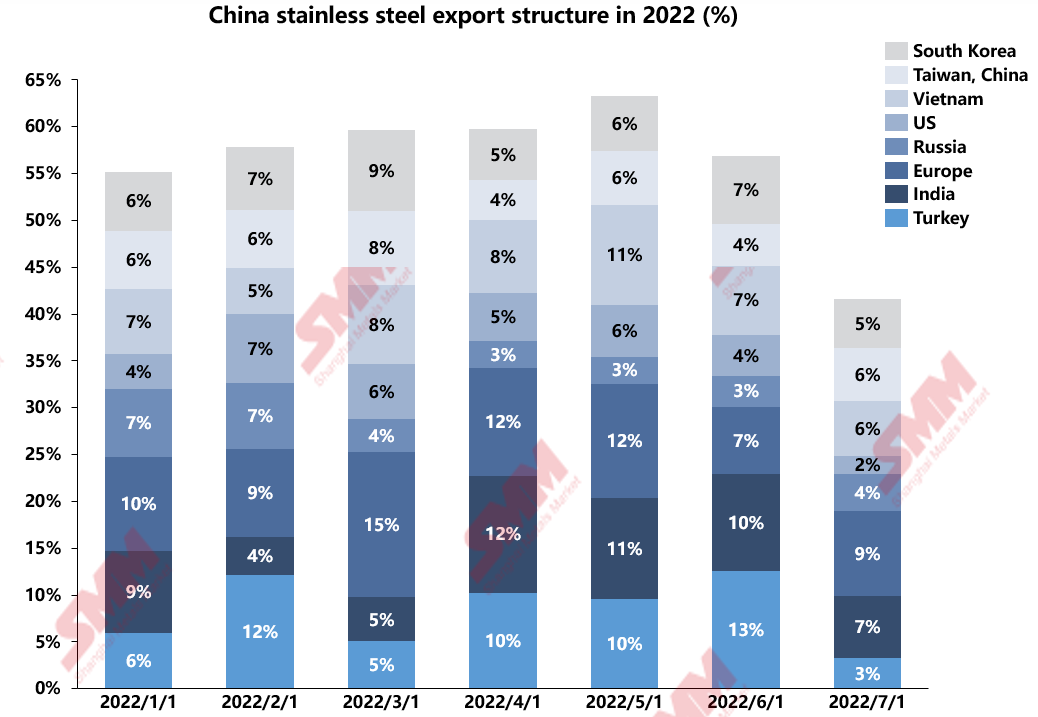
First of all, the total export volume to the Europe has indeed decreased since June and July from a proportion of over 10% in the early stage.  On the contrary, the proportion of exports to India has boomed since this April. According to SMM research, India is now the second largest export market in addition to the European and American markets, and its development prospects are very promising. Therefore, it is evidenced by the actual export data that India has indeed become one of the main destinations for future exports.
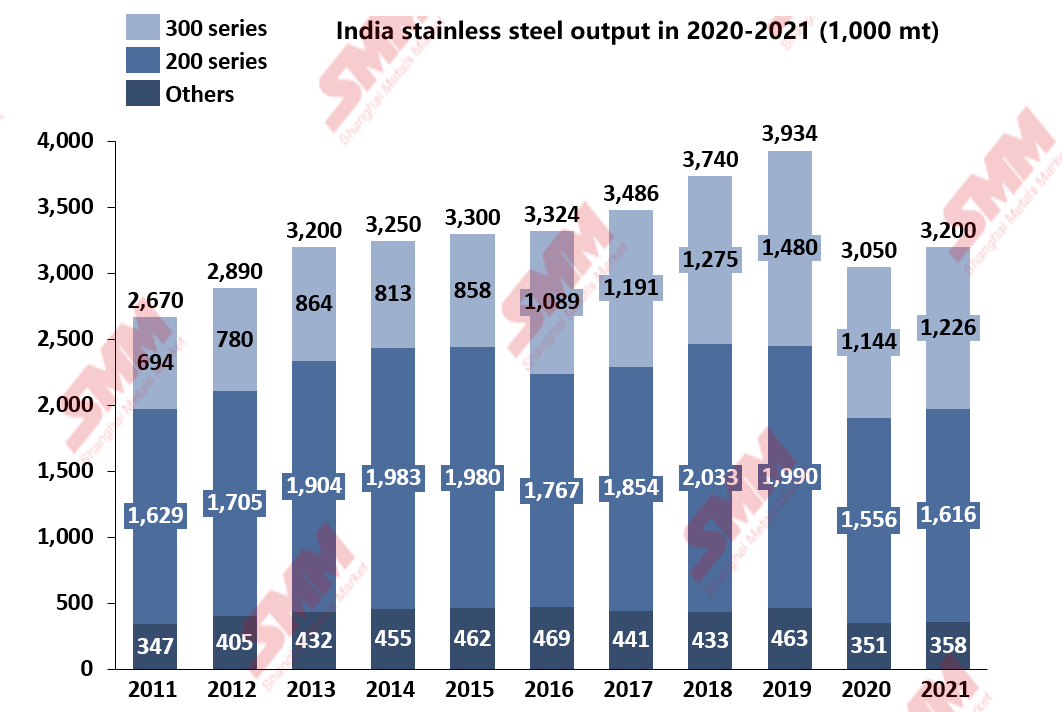
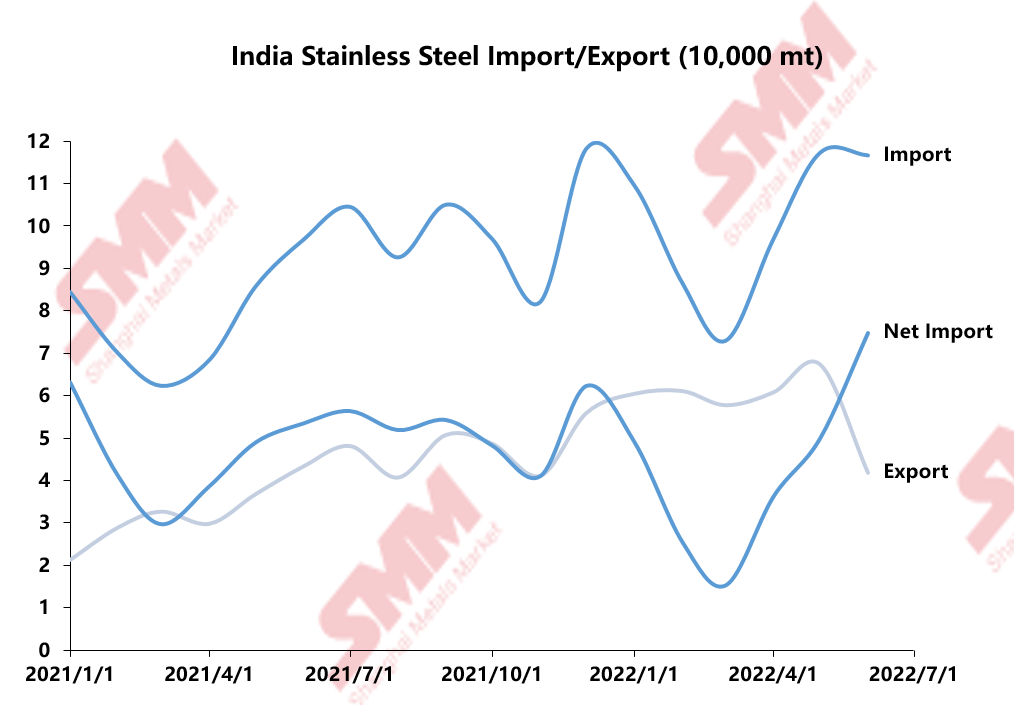
Secondly, from the perspective of India itself, if it only acts as an OEM, its demand may not be able to be maintained a high level. Then, it is nonsense that China's export growth could compensate for part of the contracting domestic demand. But it can be seen from the net import data of India that the country’s net import has been increasing since April, which shows that a large part of the stainless steel imported from China is indeed consumed domestically in India. As India's main exporter, China may continue to benefit from the rapid development of India's stainless steel consumption. On the other hand, India's total capacity has reached 5.87 million mt, accounting for about 7% of the global stainless steel capacity.
In addition, European orders have been weakening since June due to the energy crisis, high costs and serious losses. A number of large European stainless steel mills have recently stopped the production, while some have decided to further raise stainless steel prices. Under this background, the operating rates of fabricators in Europe are still likely to rise in August and September amid existing rigid demand, which will serve as an opportunity for Chinese export market. In addition, South Korean steel giant Posco was shut down due to unexpected conditions. As is mentioned earlier, it may affect the production when the typhoon hovers in the country. But according to the follow-up study of SMM, Posco may have power and production equipment damages caused by the typhoon, and the impact on its production may have been extended, and this will become one of the important factors that will benefit the Chinese stainless steel export market in the short term.

In addition, since the end of August, China's domestic demand has improved as well along with the export market. Although steel mills have been resuming the production in September, it will take time for the output to gradually enter the market. Therefore, SMM believes that the supply and demand mismatch will dominate the first half of September with supply tightening and demand growing strongly. On the whole, although the export demand has improved, it is not enough to fully compensate for the impact of the increase in steel production in the domestic market that is likely to lead to an oversupply. Furthermore, it remains to be seen whether the consumption is smoothly transmitted to the terminal and even the consumer end. As such, SMM believes that short-term stainless steel prices will remain rangebound.


Declaración de Fuente de Datos: Excepto la información disponible públicamente, todos los demás datos son procesados por SMM basándose en información pública, comunicación de mercado y confiando en el modelo de base de datos interna de SMM. Son solo para referencia y no constituyen recomendaciones para la toma de decisiones.

Para cualquier consulta o para obtener más información, por favor contacte: lemonzhao@smm.cn
Para más información sobre cómo acceder a nuestros informes de investigación, contacte con:service.en@smm.cn
Noticias relacionadas
Subsidiaria de Western Mining recibe licencia de 17 años para mina polimetálica en Qinghai
22 Sep 2026 16:11 (GMT+8)
Subsidiaria de Western Mining recibe licencia de 17 años para mina polimetálica en Qinghai
Leer más
Subsidiaria de Western Mining recibe licencia de 17 años para mina polimetálica en Qinghai
El 22 de septiembre, Western Mining anunció que su subsidiaria de propiedad total, Qinghai Ganxin Mining Development Co., Ltd. ("Ganxin Mining"), obtuvo recientemente una Licencia de Minería emitida por el Departamento de Recursos Naturales de la Provincia de Qinghai. La mina, denominada Mina Polimetálica de Hierro Geermu Tuwenchahan de Qinghai Ganxin Mining Development Co., Ltd., incluye hierro, cobre, oro, molibdeno, zinc, plomo y plata como minerales autorizados para su explotación. La licencia de minería tiene una validez desde el 3 de agosto de 2026 hasta el 30 de agosto de 2043.
22 Sep 2026 16:11 (GMT+8)
El proyecto estadounidense de Korea Zinc por 7.400 millones de dólares supera la evaluación ambiental y comenzará operaciones de prueba en 2029
21 Sep 2026 17:02 (GMT+8)
El proyecto estadounidense de Korea Zinc por 7.400 millones de dólares supera la evaluación ambiental y comenzará operaciones de prueba en 2029
Leer más
El proyecto estadounidense de Korea Zinc por 7.400 millones de dólares supera la evaluación ambiental y comenzará operaciones de prueba en 2029
El 21 de septiembre, Korea Zinc anunció que su proyecto de manufactura en Estados Unidos, valorado en 7.400 millones de dólares, había superado la evaluación de impacto ambiental. Está previsto que la planta comience sus operaciones de prueba en 2029 y la producción comercial al año siguiente, con la fabricación de 11 minerales críticos, 12 metales no ferrosos y ácido sulfúrico de grado semiconductor. En abril, Korea Zinc informó de que había completado la adquisición de una fundición de zinc local y otras empresas relacionadas. La compañía planea ejecutar el proyecto mediante la ampliación y modernización de las instalaciones existentes.
21 Sep 2026 17:02 (GMT+8)
Australia revisa los derechos antidumping sobre el acero galvanizado de India, Malasia y Vietnam ante la preocupación por el zinc
11 Sep 2026 18:30 (GMT+8)
Australia revisa los derechos antidumping sobre el acero galvanizado de India, Malasia y Vietnam ante la preocupación por el zinc
Leer más
Australia revisa los derechos antidumping sobre el acero galvanizado de India, Malasia y Vietnam ante la preocupación por el zinc
El 9 de septiembre de 2026, Australia inició su segunda revisión por extinción de las medidas antidumping sobre la chapa de acero galvanizado procedente de India, Malasia y Vietnam, y abrió por separado una revisión por extinción de las medidas compensatorias sobre las importaciones procedentes de India. La revisión abarca el período de julio de 2025 a junio de 2026, y se prevé que el informe final se publique antes del 11 de febrero de 2027. Dado que el acero galvanizado es el principal sector de uso final del zinc, las medidas afectan directamente a los costes de exportación y a la competitividad, lo que podría repercutir en la demanda interna de zinc de Australia y en su cadena de suministro. El mantenimiento de los derechos ofrecería cierta protección a la capacidad nacional de producción de acero y de recubrimiento, mientras que su supresión podría aumentar las importaciones a bajo precio y afectar al consumo regional de zinc. El resultado final sigue sujeto a la determinación de las autoridades.
11 Sep 2026 18:30 (GMT+8)