SHANGHAI, Jun 27 (SMM) - As the most advantageous raw material for the production of nickel sulphate, why does the price of nickel hydrometallurgy intermediate products keep falling? What are the actual operating rates of nickel sulphate smelters who use high-grade nickel matte? Which will be the most elastic raw material for the production of nickel sulphate in the second half of the year? What does the market concern the most amid the downward trend of nickel prices?
For answers to the above-mentioned questions, please check SMM’s detailed analysis as below.
According to the current cost of raw materials, the rankings of cost performances of different raw materials are as below: MHP > crude nickel sulphate > black powder > high-grade nickel matte > nickel briquette. Nickel sulphate produced with MHP, crude nickel sulphate and black powder is more cost efficient. Although the cost of nickel sulphate produced with high-grade nickel matte is relatively high, the production losses have turned into profits recently. Nickel sulphate smelters who use nickel briquette or nickel powder still struggle in losses. Affected by bearish macro market and poor fundamentals, the price of nickel has kept falling recently, so has the price of nickel briquette. Even so, nickel briquette is still more expensive than nickel sulphate, making it uneconomical to dissolve the former to produce the latter. However, according to SMM survey, the use ratio of nickel briquette still cannot be reduced to zero even when the supply of MHP and high-grade nickel matte is relatively ample, and it is expected that a certain amount of nickel briquette will continue to be used in the second half of the year. Thus, the question comes as to why nickel briquette can maintain a certain market share in 2022 and its use may even increase in the future despite its lack of cost efficiency? The SMM analysis is as follows:
Some end users provide nickel briquette or powder to nickel sulphate smelters under tolling agreement, involving 2,500 mt in nickel content per month, and this situation will last in the short term.
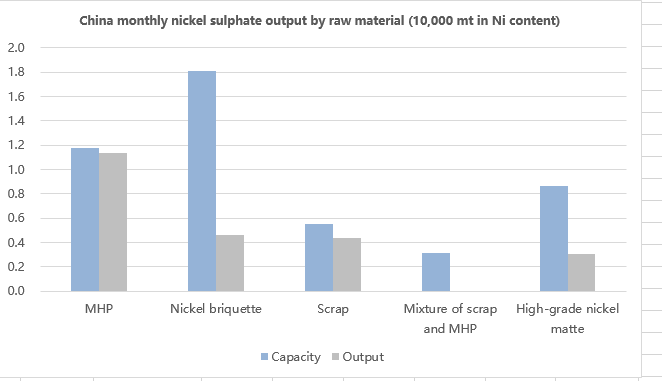
The monthly output of high-grade nickel matte in Indonesia has basically remained at 8,000-10,000 mt (Ni content) over the past three months. China imports more than 6,000 mt of high-grade nickel matte (Ni content) per month from Indonesia, and the import volume in April was nearly 9,000 mt in nickel content. According to SMM survey in May, the use of imported high-grade nickel matte in nickel sulphate production was less than 4,000 mt in nickel content. The mismatch of upstream and downstream production capacity has resulted in a large amount of high-grade nickel matte currently existing in the form of inventory. In the next quarter, whether the production capacity of nickel sulphate smelters who use high-grade nickel matte as raw materials can reach full capacity or whether they can rapidly increase their production will become one of the key factors for determining whether the use of nickel briquette will continue to be slightly squeezed or increase.
Another key factor is the increase in MHP-based nickel salt production capacity. According to SMM survey in June, the domestic monthly production capacity of nickel sulphate using MHP is 12,000 mt in nickel content per month. Similar to high-grade nickel matte, although there are large factories planning to build new MHP-based nickel salt capacity, the production of nickel salt with MHP will face capacity bottlenecks before new MHP capacity is released.
Although the capacity of nickel sulphate smelters who use MHP is slightly higher than the output, the actual operating rate has exceeded 100% due to the switch of some production lines to refined nickel. In addition, some production lines that use scrap as raw materials can theoretically mix MHP with scrap, but the capacity of such production lines is small and has not yet been put into operation. SMM suggests that some nickel salt companies who have access to MHP can increase their production by cooperating by taking outsourcing orders.
If high-grade nickel matte-based nickel salt production capacity cannot be released quickly and if new MHP-based nickel salt production lines are not put into production in the short term, the operating rates of MHP-based nickel salt production lines may be raised to the upper limit and production lines that use a mixture of scrap and MHP are expected to be put into operation in the case of the recovery of nickel salt demand. The use of nickel briquette (powder) may rise again to meet downstream demand.
Nickel sulphate production costs using different raw materials ($/mt in Ni content)
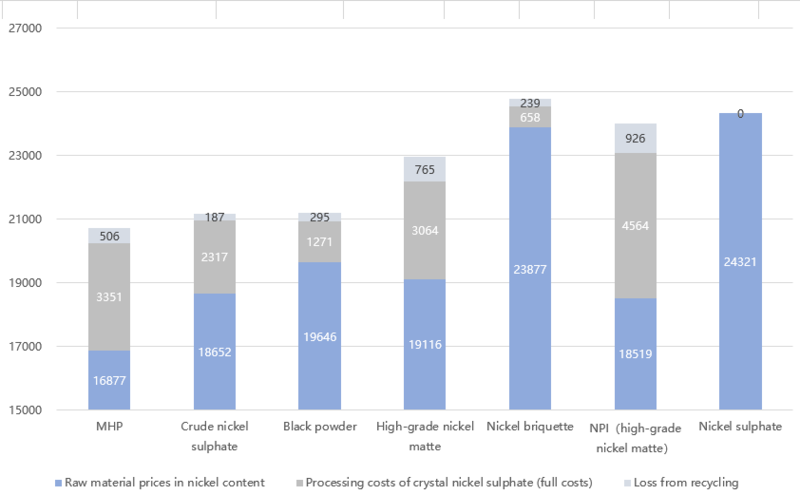
Notes: NPI (high-grade nickel matte) in the above chart refers to the process under which NPI is used to produce high-grade nickel matte, which is then used to produce nickel sulphate.
![[SMM Noticias del Mercado de Níquel] Una acería del sur de China compra 7.000 toneladas de NPI de alta ley a 1.050 yuanes/mtu](https://imgqn.smm.cn/usercenter/PFIti20251217171734.jpg)
![[SMM Noticias del acero inoxidable] India rechaza las cuotas de acero del TLC con la UE por debajo de los derechos actuales](https://imgqn.smm.cn/usercenter/GmHLU20251217171733.jpg)