A Brief Look into the Steel and Energy Industries in Ukraine

Publicado: Mar 02, 2022 13:56 (GMT+8)
In the then-Soviet Union, Ukraine was a highly developed region in both industry and agriculture.

SHANGHAI, Mar 2 - In the then-Soviet Union, Ukraine was a highly developed region in both industry and agriculture. It was known as the "breadbasket of Europe", and the military industry accounted for about a quarter of the Soviet Union's scientific and technological strength; the main industrial sectors were aviation, aerospace, military industry, metallurgy, machine building, shipbuilding and chemicals.

When it gained independence from the Soviet Union in August 1991, Ukraine was quite rich and superior in terms of resources. It had more than 600,000 square kilometres of territory that covere vast plains and endless black land. The nation was very rich in coal, iron and manganese reserves and had more than 70 types of mineral resources. And what was even more dazzling was its strong heavy industrial infrastructure and a relatively complete and advanced military industrial system.

However, after 30 years of development, Ukrainian industry shrunk significantly for a variety of reasons, such as the severance of the Soviet-era supply chain package following the partition, the fall out with Russia, the siege by the West, the failure of economic reforms, etc.

Nonetheless, Ukraine is still the world's second largest exporter of grain, its steel and military industries are still relatively well developed, and large quantities of gas are still transported from Russia to the EU via Ukrainian pipelines.

As the conflicts between Russia and Ukraine escalate, commodities traders are keeping a close eye on Ukraine's vast infrastructure network, which is key to supplying gas, crops and steel to Europe and beyond. Among these is Donetsk, a port for exporting grains and metals and home to giant steel mills.

Stainless Steel

Ukraine is one of the world's largest producers of iron ore and steel and is rich in iron ore and coal resources. Donbass is the largest coal field in Ukraine with proven reserves of 42 billion mt. Krivoy Rog has iron ore reserves of 26 billion mt.

According to UKRFelightprom (Ukrainian Steelmaking Industry Association), in 2021, Ukrainian crude steel output rose 3.6% to 21.4 million mt; pig iron output added 3.6% to 21.2 million mt; rolled steel output grew 3.5% to 19.1 million mt; while steel pipe output fell by 15% to 980,000 mt.

Ukraine steel accounts for about a tenth of Europe's steel imports and any disruption to steel mills’ production or shipments would tighten the already tight market supply on the continent and could support steel prices at the current high level after hitting a record last year.

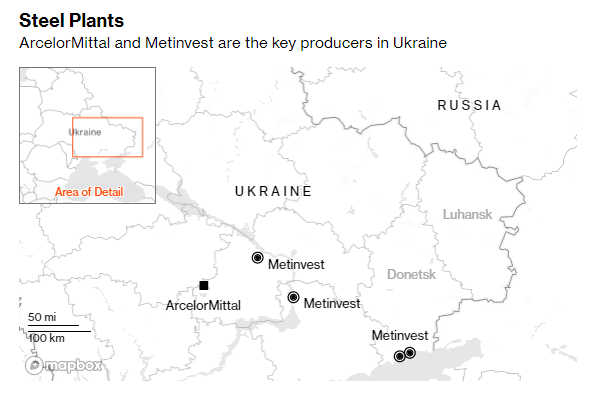
Major Ukrainian steel producers include Metinvest BV, which has plants in the industrial heartland of eastern Ukraine, including a plant next to the Dnieper River, and two large plants in Mariupol.

ArcelorMittal , the world's number one steel producer, has the largest steel plant in Ukraine, located in central Ukraine of Kryvyi Rih. Ferrexpo, the world's third largest iron ore producer, has all its operations in Ukraine and is located about 350 kilometres (about 220 miles) southeast of Kiev. Seamless pipe manufacturer Interpipe also has a plant in Dnipro in the east.
Energy

Ukraine has an extensive gas transportation network that was designed in Soviet Union times to transport fuel from the large gas fields of Siberia to Europe. Over the past decade, Russia has spent billions of dollars bypassing Ukraine to build the new Nord Stream gas pipeline, but Ukraine remains key to Europe's energy security.

A quarter of the EU's gas comes from Russia, and while about a third is delivered via Ukraine.
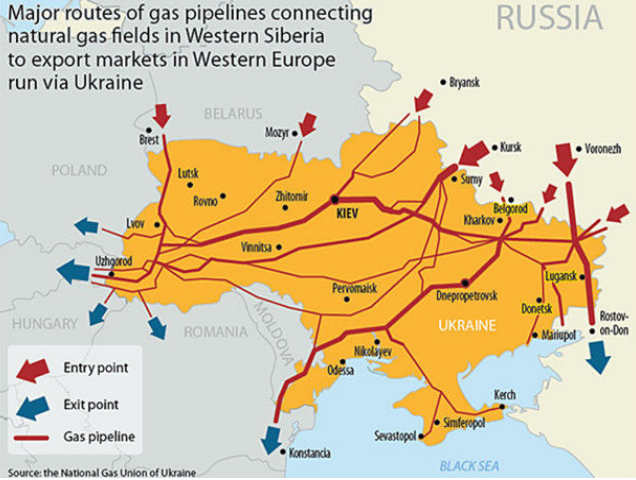
The pipeline through Ukraine also transports some Russia oil to Europe. In the power sector, Ukraine's largest private power company, DTEK, has a number of power plants in Donetsk and Luhansk.
Declaración de Fuente de Datos: Excepto la información disponible públicamente, todos los demás datos son procesados por SMM basándose en información pública, comunicación de mercado y confiando en el modelo de base de datos interna de SMM. Son solo para referencia y no constituyen recomendaciones para la toma de decisiones.

Para cualquier consulta o para obtener más información, por favor contacte: lemonzhao@smm.cn
Para más información sobre cómo acceder a nuestros informes de investigación, contacte con:service.en@smm.cn
Noticias relacionadas
Exportaciones de neumáticos semirradiales de China caen un 0,92% interanual acumulado en enero-agosto de 2026
08 Oct 2026 16:26 (GMT+8)
Exportaciones de neumáticos semirradiales de China caen un 0,92% interanual acumulado en enero-agosto de 2026
Leer más
Exportaciones de neumáticos semirradiales de China caen un 0,92% interanual acumulado en enero-agosto de 2026
[SMM Flash] Según datos de aduanas, en agosto de 2026, China exportó 29,696 millones de neumáticos semirradiales (incluidos los neumáticos recauchutados), con exportaciones acumuladas de enero a agosto por un total de 235,7676 millones de unidades, un 0,92% menos interanual.
08 Oct 2026 16:26 (GMT+8)
Heyuan emite regulaciones estrictas y multas por la gestión no autorizada de baterías de plomo-ácido usadas
28 Sep 2026 17:34 (GMT+8)
Heyuan emite regulaciones estrictas y multas por la gestión no autorizada de baterías de plomo-ácido usadas
Leer más
Heyuan emite regulaciones estrictas y multas por la gestión no autorizada de baterías de plomo-ácido usadas
[Actualización del mercado de baterías de plomo-ácido de desecho] Recientemente, la Oficina de Ecología y Medio Ambiente del municipio de Heyuan emitió el «Aviso sobre la regulación de la gestión de baterías de plomo-ácido de desecho». Según el Código de Ecología y Medio Ambiente de la República Popular China, las empresas e instituciones públicas que realicen actividades de recolección y almacenamiento de residuos sin permiso podrán ser multadas con entre 200.000 y 1 millón de yuanes; quienes realicen operaciones de utilización y eliminación sin permiso podrán ser multados con entre 1 y 5 millones de yuanes y se les ordenará suspender sus operaciones o cerrar, con multas de entre 100.000 y 1 millón de yuanes para los responsables; si el acto constituye un delito, se perseguirá la responsabilidad penal conforme a la ley.
28 Sep 2026 17:34 (GMT+8)
"Guangzhou refuerza la gestión de baterías de plomo-ácido de desecho de bicicletas eléctricas y aclara las normas sobre residuos peligrosos"
28 Sep 2026 17:33 (GMT+8)
"Guangzhou refuerza la gestión de baterías de plomo-ácido de desecho de bicicletas eléctricas y aclara las normas sobre residuos peligrosos"
Leer más
"Guangzhou refuerza la gestión de baterías de plomo-ácido de desecho de bicicletas eléctricas y aclara las normas sobre residuos peligrosos"
[Dinámica del mercado de baterías de plomo-ácido usadas de bicicletas eléctricas] Recientemente, la Oficina de Ecología y Medio Ambiente del Municipio de Cantón emitió un aviso sobre los puntos clave para la gestión ambiental de las baterías de plomo-ácido usadas de bicicletas eléctricas en Cantón. El documento aclara que las baterías de plomo-ácido usadas son residuos peligrosos (HW31, 900-52), y las baterías de desecho generadas por el reciclaje en tiendas, el canje y la reparación deben transferirse a unidades autorizadas. Las unidades que poseen un permiso de recolección de residuos peligrosos (incluido el 900-52) están exentas de manifiestos de transferencia electrónicos durante el proceso de recolección en el marco del programa piloto de recolección centralizada.
28 Sep 2026 17:33 (GMT+8)