SHANGHAI, Feb 11 (SMM) - This is a roundup of China's metals weekly inventory as of February 11.
Copper Inventory in Major Chinese markets Added 27,800 mt from Monday
As of Friday February 11, the copper inventories in major domestic markets rose 27,800 mt from Monday February 7, and up 86,600 mt from pre-CNY holiday level of 98,700 mt, to 185,300 mt. The five-day increment of inventory during the CNY holiday in 2022 was 11,500 mt higher than that in the same period in 2021, which recorded a gain of 75,100 mt in five days. The main cause is that the downstream participants took longer holidays than in 2021.
In details, the inventories added 10,900 mt to 112,000 mt in Shanghai, rose 13,600 mt to 46,800 mt in Guangdong, climbed 1,900 mt to 18,200 mt in Jiangsu, up 900 mt to 3,000 mt in Chongqing, and advanced 500 mt to 3,500 mt in Tianjin.
Looking into next week, with the accelerated recovery of production, more demand will be created. It is expected that inventory will keep rising next week, but at a slower speed.
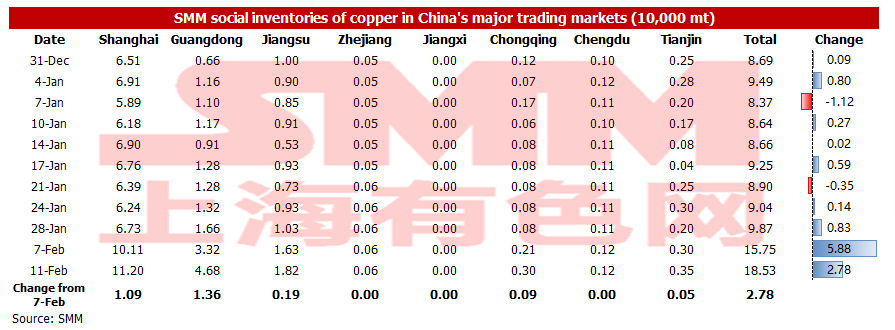
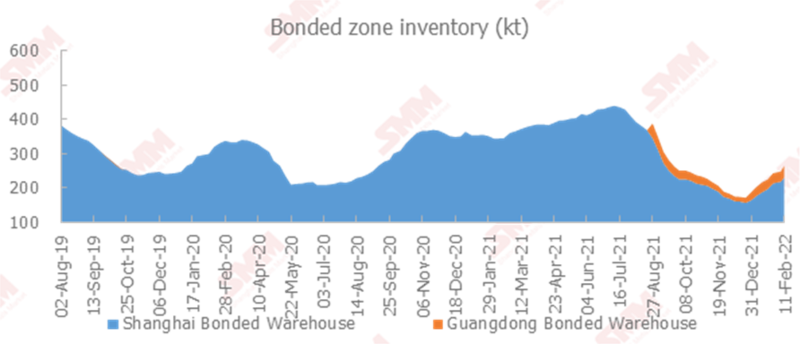
Copper Inventory in Domestic Bonded Zone Up 17,150 mt from Monday
The copper inventories in domestic bonded zones rose 17,150 mt from Monday February 7 to 265,250 mt as of February 11, according to SMM survey.
The inventory in the Shanghai bonded zone rose 12,400 mt to 231,000 mt, while that in Guangdong added 4,750 mt to 34,250 mt on the week.
The foreign trade market was extremely quiet as the import losses remained at around 1,000 yuan/mt in the first trading week post the CNY holiday. The cargos under B/L kept arriving at the ports, and the domestic smelters actively exported to bonded zones. The total inventories were still on the rise.
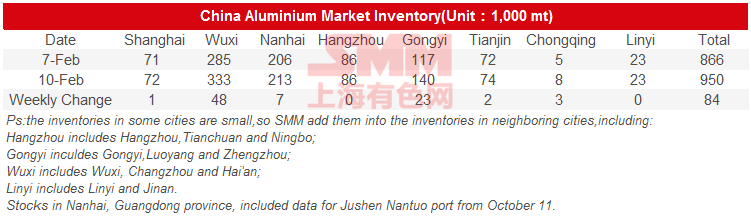
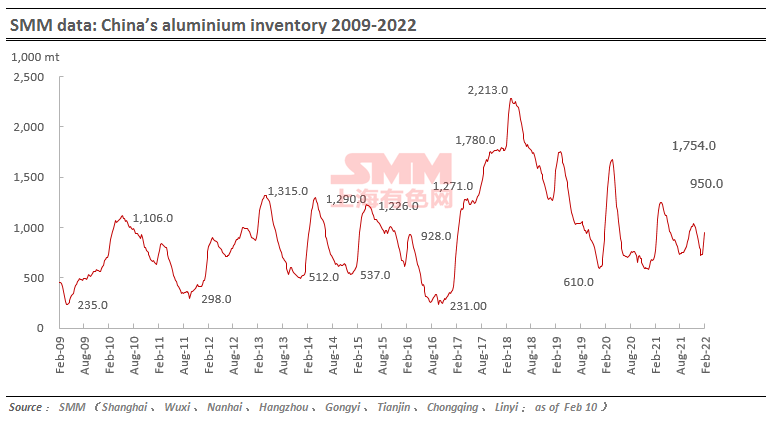
Aluminium Ingot Social Inventory in China Increased by 84,000 mt after the Chinese New Year
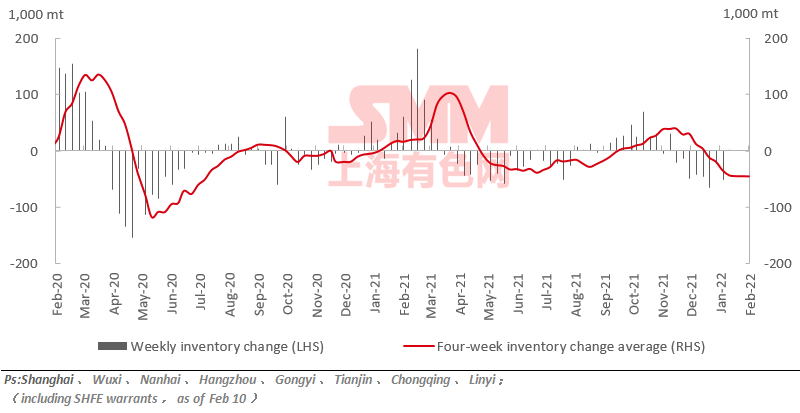
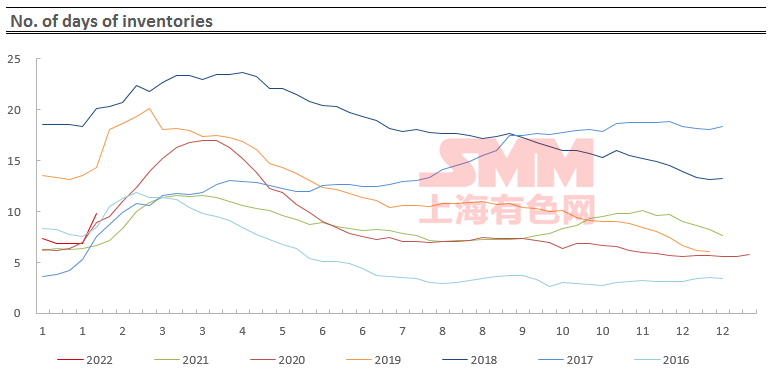
SMM data showed that the aluminium ingot social inventory in China totalled 950,000 mt on February 10, 2022, up 84,000 mt from Monday, with Wuxi, Gongyi, Nanhai, and Chongqing being the major contributors to the overall increase.
Aluminium Billet Inventories in China Increased by 17,600 mt after the Chinese New Year
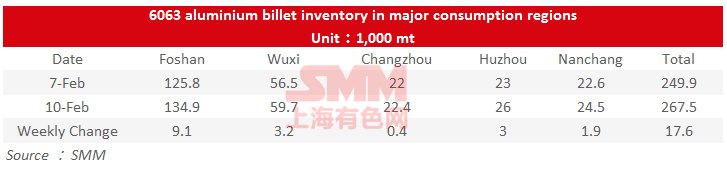
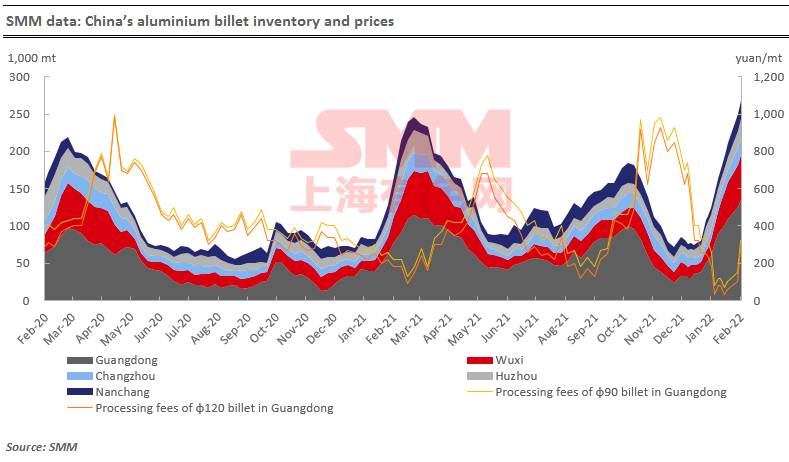
The domestic aluminium billet inventory stood at 267,500 mt on February 10, an increase of 17,600 nt or 7.04% from Monday. The inventory increased across each of the five regions. Foshan was the biggest contributor, with an increase of 9,100 mt or 7.23%, followed by Wuxi, with an increase of 3,200 mt or 5.66%. The inventory in Huzhou rose 3,000 mt or 13.04%. SMM survey showed that most aluminium extruders plan to resume their work from the tenth or the twelfth day of the first lunar month. The overall demand for aluminium billets was sluggish.
Given the poor demand from aluminium extruders, the inventory will continue to accumulate next week.
Zinc Ingot Social Inventory in Seven Major Regions Rose 82,200 mt from Pre-CNY Level
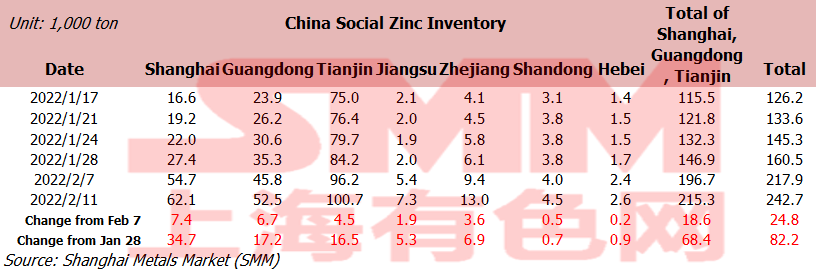
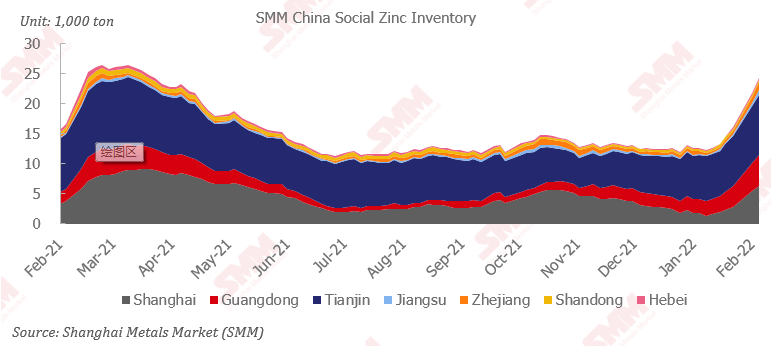
As of February 11, the zinc ingot inventory across the seven major regions in China totalled 242,700 mt, up 24,800 mt from February 7 and up 82,200 mt from January 28, according to SMM data. The domestic inventories continued to accumulate this week. Shanghai continued to attract zinc ingots from smelters as the local zinc prices were higher than in other parts of China, while the inflows of imported zinc were limited, and the inventory in the region increased significantly. Although downstream producers in Guangdong resumed their operations one after another, the local inventory continued to increase as high zinc prices affected the purchases. In Tianjin, the storage capacity of SHFE-approved warehouses was insufficient, while the market demand did not improve significantly, causing the local inventory to continue to rise. The total inventories across Shanghai, Guangdong, and Tianjin rose by 68,400 mt from January 28.
Lead Ingot Social Inventory Increased 7,600 on Week
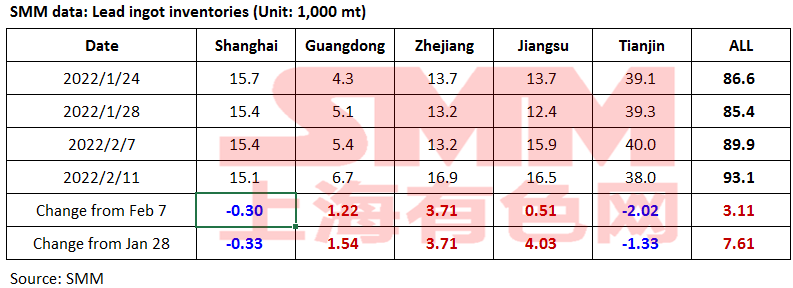
The social inventory of lead ingots across Shanghai, Guangdong, Zhejiang, Jiangsu and Tianjin increased 7,600 mt from last Friday January 28 and rose 3,100 mt from Monday February 7 to 93,100 mt as of February 11.
According to SMM survey, the enterprises from the lead industry chain started to resume the production this week after the Chinese New Year holiday. Many lead smelters stocked the lead ingots during the holiday, and they sent the stocks to the social warehouses this week. While the procurements by some lead-acid battery enterprises delayed, especially in Jiangsu, Zhejiang, and Guangdong where the return of non-local workers was later than expected, which hindered the production resumption.
The secondary lead and lead-acid battery enterprises will resume their production further next week, and the downstream users will restock the raw materials on rigid demand. The social inventory of lead ingots may increase more slowly.
Silicon Metal Social Inventory Fell 2,000 mt on Week
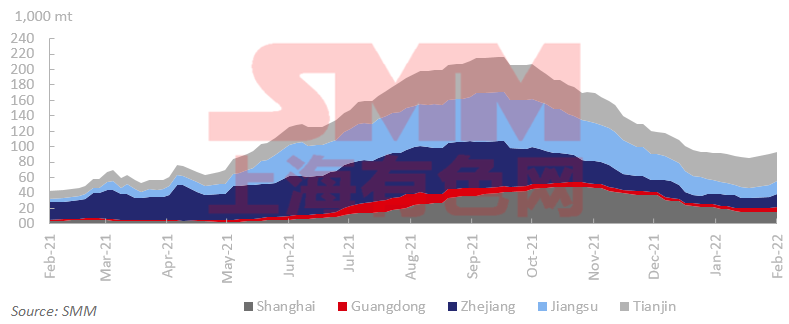
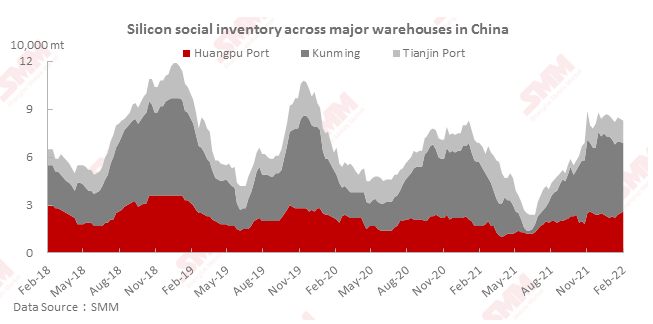
The social inventory of silicon metal across Huangpu port, Kunming city and Tianjin port decreased by 2,000 mt from January 28 to 83,000 mt as of Friday February 11.
The stocks in Kunming city declined as the shipments to other regions stood high during the Chinese New Year holiday, while the local automobile has not recovered. The stocks in Tianjin dropped as well amid low arrivals. The inventory at Huangpu port increased slightly on the high arrivals.

Nickel Ore Inventories at Chinese Ports Fell 10,000 wmt from Pre-Holiday Level
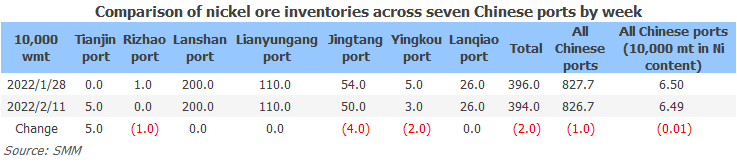
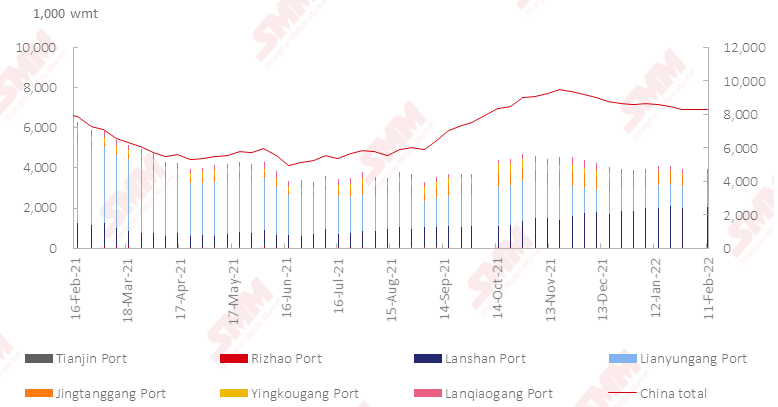
The nickel ore inventory at Chinese ports dipped 10,000 wmt from pre-holiday level to 8.27 million wmt as of February 11. Total Ni content stood at 64,900 mt. The total inventory at seven major ports stood at around 3.94 million wmt, 20,000 wmt lower than Friday January 28.
Domestic NPI output dropped owing to environmental protection-related restrictions, hence the inventory of nickel ore dropped more slowly. Meanwhile, the logistics services stalled in some places during the CNY holiday. The total inventories stood largely unchanged.
![Magnesium Market Downtrend Continues, Cautious Sentiment Prevails with Widespread Wait-and-See [SMM Magnesium Ingot Spot Report]](https://imgqn.smm.cn/usercenter/znXdm20251217171724.jpeg)

![[SMM Flash de Cromo] El precio medio del cromo de Tharisa cae a 285 $/t en el cuarto trimestre, mientras la guía para el año fiscal 2027 se mantiene en 1,50-1,65 Mt](https://imgqn.smm.cn/usercenter/EutUV20251217171724.jpeg)