China Weekly Inventory Summary and Data Wrap (Dec 31)

Publicado: Dec 31, 2021 20:00
This is a roundup of China's metals weekly inventory as of December 31.

SHANGHAI, Dec 31 (SMM) - This is a roundup of China's metals weekly inventory as of December 31.

Aluminium Social Inventories Dropped 65,000 mt on Week

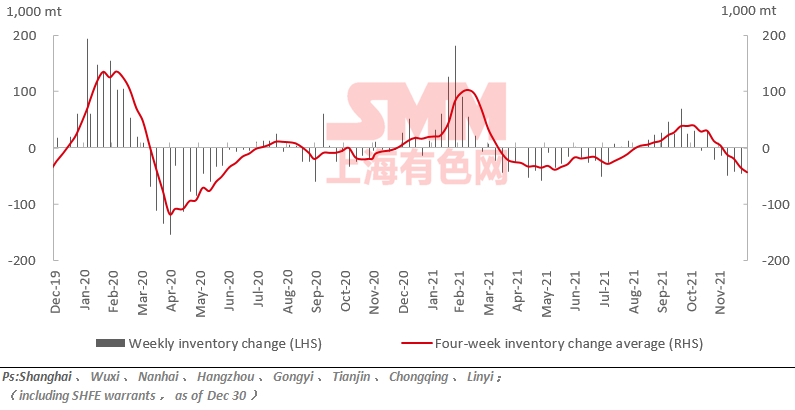
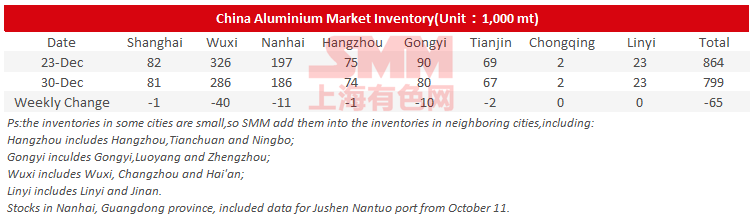
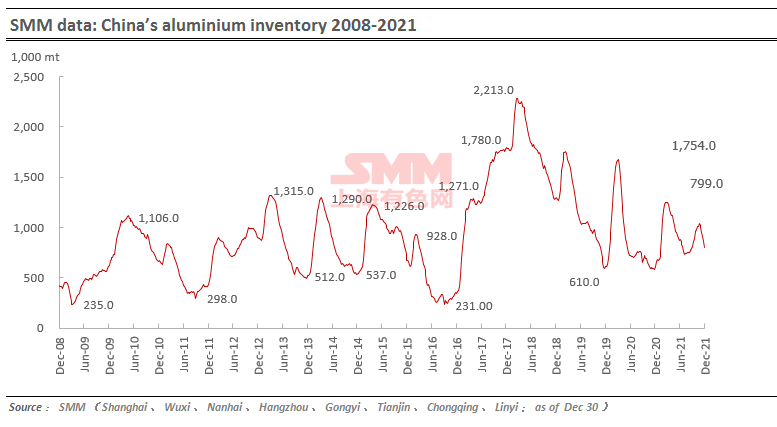
SMM data showed that China's social inventories of aluminium across eight consumption areas dropped 65,000 mt on the week to 799,000 mt as of December 30, mainly contributed by Wuxi, Nanhai and Gongyi. The social inventories dropped 40,000 mt from Monday December 27 largely because the arrivals in Wuxi declined significantly.
Aluminium Billet Inventories Up 5,700 mt on Week

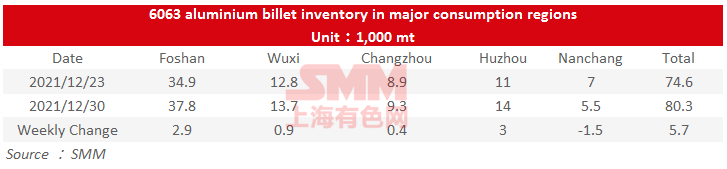
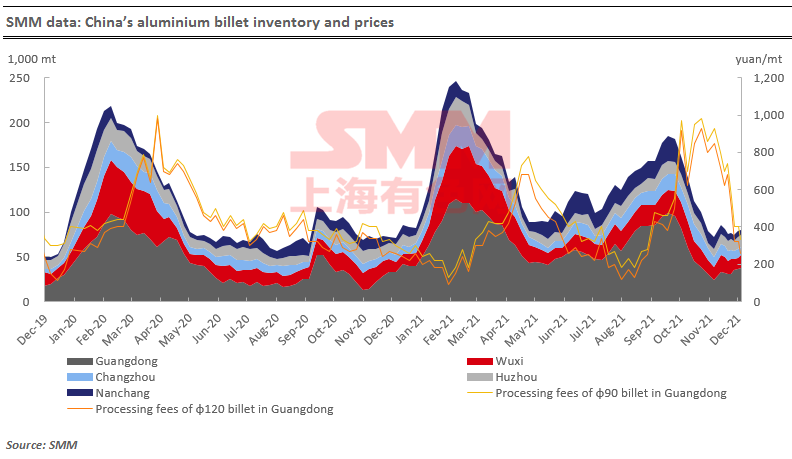
The stocks of aluminium billet in five major consumption areas added 5,700 mt to 80,300 mt on December 30 from a week ago, an increase of 7.64%.

The inventories across four major markets rose on the week except for Nanchang. Among them, the inventory in Huzhou rose 3,000 mt or 27.27% from last Thursday, and that in Foshan added 2,900 mt or 8.31%, both of which contributed most of the weekly gains. The aluminium billet market was subdued by the year-end as most companies were busy with managing cash flows and reduced the orders taken, resulting in a quiet market.  

Looking into next week, the downstream market was sluggish in demand, coupled with the upcoming New Year’s Day holiday. It is expected that the weekly inventory of aluminium billet will continue to rise.
Zinc Social Inventories Down 4,100 mt On Week

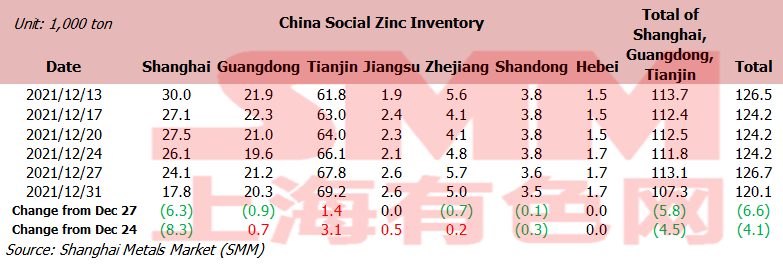
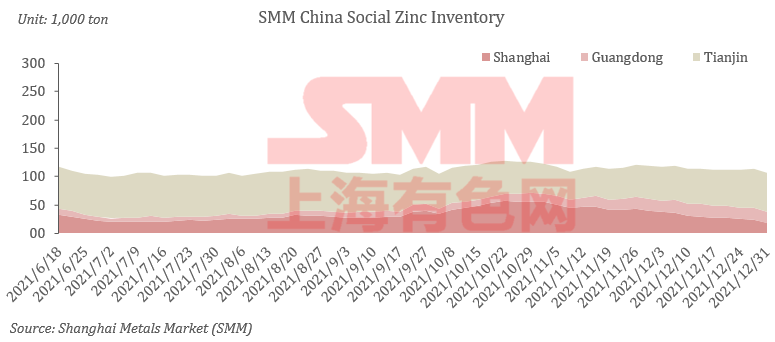
SHANGHAI, Dec 31 (SMM)—Total zinc inventories across seven Chinese markets stood at 120,100 mt as of December 31, down 6,600 mt from December 27 and 4,100 mt from December 24.

Shanghai saw a decrease in the stocks as the inflows of imported zinc thinned, some domestic zinc brands were still in transit and the arrivals of goods in the market declined sharply, and downstream producers properly restocked before the holiday. The inventory in Guangdong rose slightly amid muted arrivals of goods in the market and falling demand from downstream producers. The stocks in Tianjin continued to increase as the arrivals of goods stabilised, downstream demand was sluggish and traders have demand of delivering futures goods. Inventories in Shanghai, Guangdong and Tianjin fell 4,500 mt, and inventories across seven Chinese markets decreased 4,100 mt.
Silicon Metal Social Inventory Increased 1,000 mt on Week

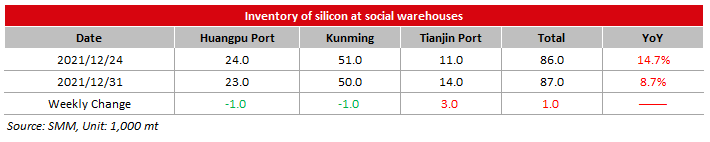
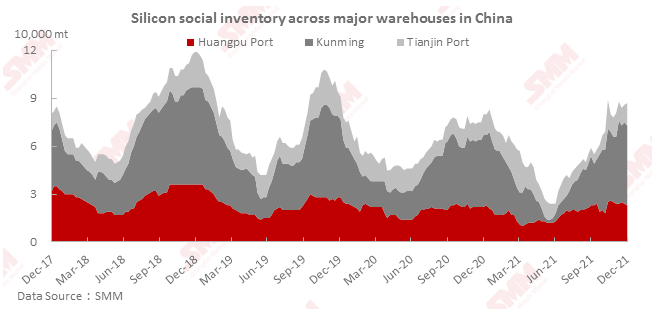
The social inventory of silicon metal across Huangpu port, Kunming city and Tianjin port increased 1,000 mt from the previous week to 87,000 mt as of Friday December 31.

The inventory in north China increased, while the inventory in south China declined.

The arrivals at Tianjin port increased significantly as all people from other cities will have to obtain a COVID-19 negative certification within 48 hours to enter Tianjin from January 1 to March 15, 2022. At the same time, the shipments from Tianjin port remained sluggish. The inventory at Tianjin port rose.

The shipments in south China were high this week, and the arrivals at Kunming and Huangpu port declined. Therefore, the inventory in south China decreased.
Lead Ingot Social Inventory Fell 13,400 mt on Week

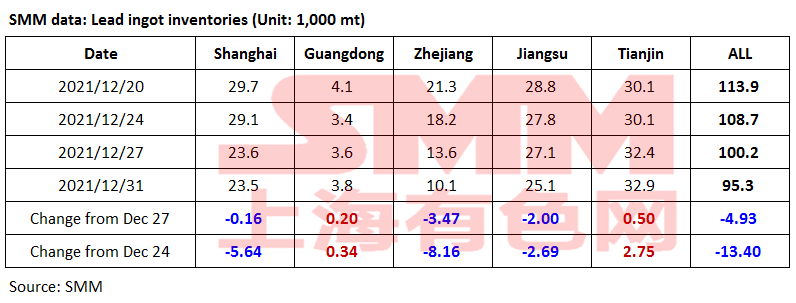
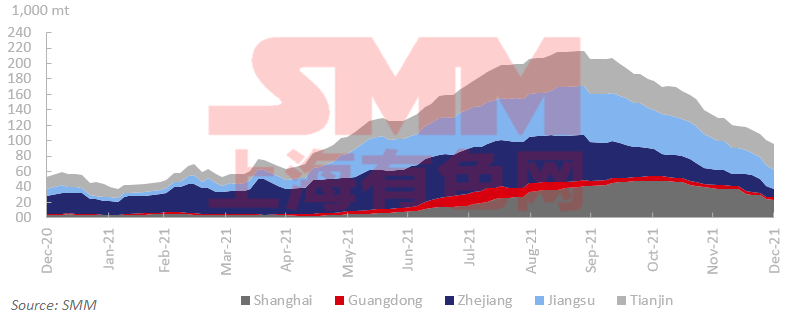
The social inventory of lead ingots across Shanghai, Guangdong, Zhejiang, Jiangsu and Tianjin decreased 13,400 mt from December 24 and 4,900 mt from December 27 to 95,300 mt as of December 31.

The supply of secondary lead shrank in Jiangxi, Anhui, and other major consuming markets due to environmental protection inspections and maintenance. However, the lead prices declined during the week, and the primary lead smelters’ shipments were modest, mainly shipping the goods under long-term orders. The downstream users restocks raw materials on demand approaching the New Year's Day, so they increased the purchases from traders. As such, the social inventory continued to decline.

The smelters will gradually resume the supply after the New Year's Day holiday next week, and the downstream users will keep restocking for the CNY. The social inventory of lead ingots is expected to keep falling.
Copper Inventory in Major Chinese Markets Added 900 mt over Weekend

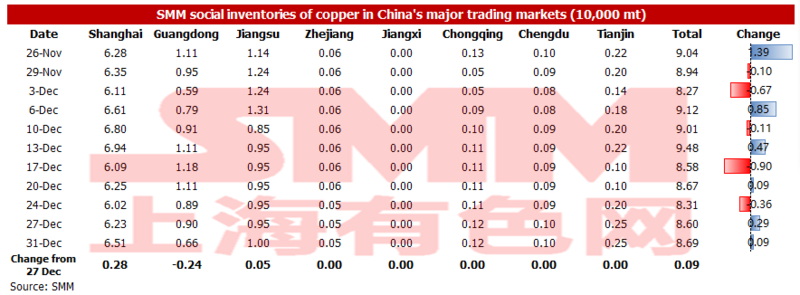
As of Friday December 31, the copper inventory across major Chinese markets increased 900 mt from Monday December 27 to 86,900 mt. The increase in the inventory this week was mainly seen in Shanghai and Jiangsu. The inventories in Guangdong declined, and there has been little change in the inventories across other regions.

Specifically, the inventory in Shanghai increased by 2,800 mt to 65,100 mt, the inventory in Jiangsu added 500 mt to 10,000 mt, and the inventory in Guangdong fell 2,400 mt to 6,600 mt. The consumption in various regions was poor this week. The arriving shipments in east China increased due to the influx of imported copper and the cargoes from north China. On the other hand, the lower efficiency of transportation in Guangxi due to the COVID-19 pandemic and the maintenance at smelters reduced the shipments arrivals in Guangdong.

The consumption is expected to be weak next week. The supply will grow. The inventories are expected to increase further.
Copper Inventory in China Bonded Zone Grew 15,600 mt on Week

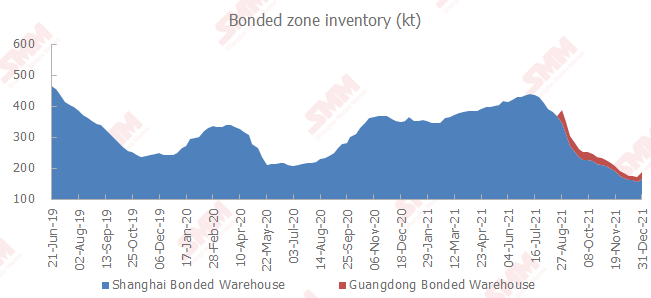
The copper inventories in the domestic bonded zones grew 15,600 mt from December 24 to 187,300 mt as of Friday December 31, the first increase after 11 consecutive weeks of decline, according to the most recent SMM survey.

The inventory in the Shanghai bonded zone increased 7,700 mt to 164,500 mt, and the inventory in the Guangdong bonded zone increased 7,900 mt to 22,800 mt.

The trades in the import market was subdued at the end of the year. The severe import losses also depressed the import demand, reducing the shipments from bonded zone inventories. The concentrated arriving shipments over the past two weeks went to the bonded warehouses. Therefore, the inventory in China’s bonded zones stopped falling and rebounded.
Nickel Ore Inventories at Chinese Ports Fell 65,000 wmt

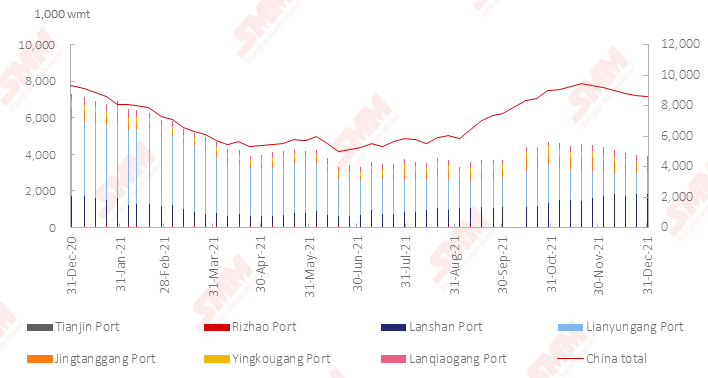
The nickel ore inventory at Chinese ports dipped 65,000 wmt from a week earlier to 8.59 million wmt as of December 31. Total Ni content stood at 67,500 mt. The total inventory at seven major ports stood at around 3.89 million wmt, a drop of 65,000 wmt from a week earlier.

The port inventory continued its downward trend, but the decline was relatively slow. The arriving shipments and loading both slowed down. The port unloading pressure has weakened compared with the previous period. Some NPI plants may have plans to undertake maintenance in January. The port inventory may rebound slightly.

Imports of Spot Nickel Saw Slight Profits


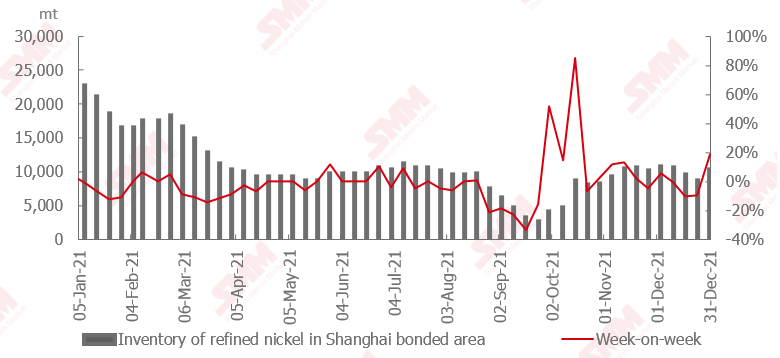
The SHFE/LME nickel price ratio hovered at highs this week, rising to 7.49 before falling, and then stabilising at 7.44. The import saw small profits of 250 yuan/mt.

As the long-term contracts of pure nickel for 2021 were completed, most of the traders were busy with annual settlements and stopped business operations. Therefore, the import volume of pure nickel from bonded zone inventories was small even as the import window opened. There were 2,000 mt of shipments arrivals of nickel plate this week. It is expected that those shipments will be offered for sale in the domestic market next week. But the SHFE/LME nickel price ratio is expected to remain profitable for the import due to the low domestic inventories.



Declaración de Fuente de Datos: Excepto la información disponible públicamente, todos los demás datos son procesados por SMM basándose en información pública, comunicación de mercado y confiando en el modelo de base de datos interna de SMM. Son solo para referencia y no constituyen recomendaciones para la toma de decisiones.

Para cualquier consulta o para obtener más información, por favor contacte: lemonzhao@smm.cn
Para más información sobre cómo acceder a nuestros informes de investigación, contacte con:service.en@smm.cn
Noticias relacionadas
La expansión minera de Zambia enfrenta desafíos de infraestructura en medio de una mayor inversión
hace 5 horas
La expansión minera de Zambia enfrenta desafíos de infraestructura en medio de una mayor inversión
Leer más
La expansión minera de Zambia enfrenta desafíos de infraestructura en medio de una mayor inversión
El sector minero de Zambia inicia una importante fase de expansión a medida que los grandes productores internacionales aumentan el gasto de capital para alinearse con las ambiciones del gobierno de incrementar la producción nacional de cobre hacia 1 millón de toneladas métricas al año. Sin embargo, según informes de prensa extranjera, los analistas del sector advierten que los objetivos de producción a largo plazo del país dependen en gran medida de que la infraestructura de red y transporte pueda expandirse al mismo ritmo que la capacidad minera. La principal limitación operativa sigue siendo la disponibilidad de electricidad en el Copperbelt. Con más del 83 % de los 3 985 MW de potencia nacional de Zambia dependiendo de activos hidroeléctricos como Kafue Gorge y Kariba North, las recientes caídas del nivel de agua provocadas por la sequía han expuesto graves vulnerabilidades energéticas en todo el sector minero. Las fluctuaciones imprevistas de la red y los cortes de carga de emergencia plantean agudos riesgos operativos para los procesos de transformación de alto consumo energético, donde las interrupciones del suministro causan un fuerte choque térmico en los revestimientos de ladrillo de los hornos de fundición de cobre, lo que provoca daños físicos en los equipos y paradas operativas prolongadas. Para mitigar estas perturbaciones, las empresas mineras invierten cada vez más en proyectos de energías renovables aislados de la red, capacidad solar fotovoltaica a escala de servicio público e importaciones regionales de energía. Más allá de la energía, un crecimiento sostenido de la producción requerirá inversiones de capital en redes de logística ferroviaria, infraestructura hídrica y la capacidad técnica de los proveedores locales.
hace 5 horas
Elecciones en Zambia: Inversores observan el crecimiento minero y la continuidad de políticas en medio de reformas económicas
hace 7 horas
Elecciones en Zambia: Inversores observan el crecimiento minero y la continuidad de políticas en medio de reformas económicas
Leer más
Elecciones en Zambia: Inversores observan el crecimiento minero y la continuidad de políticas en medio de reformas económicas
Mientras Zambia se prepara para sus elecciones generales, los inversores internacionales y los analistas de metales se centran en si la continuidad de las políticas macroeconómicas puede traducirse en un crecimiento minero tangible, según informes de prensa extranjera. La atención principal del mercado está puesta en la ejecución de la inversión extranjera directa, la fiabilidad del sector eléctrico y las reformas económicas estructurales necesarias para respaldar los objetivos de producción a largo plazo. Como columna vertebral de la economía nacional —genera el 70 % de los ingresos por exportaciones y más del 10 % del PIB—, el sector del cobre sigue siendo el principal referente para los inversores institucionales. Los agentes del mercado observan de cerca si los proyectos en cartera, incluidas las ampliaciones en curso de First Quantum, la inversión continuada de Barrick y el regreso de Vedanta, pueden traducirse en aumentos reales de producción de cara al objetivo a largo plazo de triplicar la producción nacional de cobre, que parte de aproximadamente 1 millón de toneladas. Aunque el gobierno se ha comprometido a mantener estables los tipos de regalías mineras, los operadores extranjeros se enfrentan a posibles ajustes en la cadena de suministro en virtud de un marco de contenido local que exige a las mineras aumentar las compras nacionales del 20 % a cerca del 40 % en un plazo de tres a cuatro años. Dado que los proveedores locales a menudo carecen del capital y la capacidad técnica necesarios, los operadores extranjeros podrían toparse con cuellos de botella operativos o con incertidumbre en la aplicación de la normativa. Además, el aumento de la producción depende de resolver la vulnerabilidad de una red eléctrica muy dependiente de la energía hidroeléctrica, mediante inversiones en energía solar y reformas de la red, tras los graves cortes de suministro provocados por la sequía. Los inversores también siguen de cerca las negociaciones para un programa sucesor del FMI, después de que el anterior mecanismo de 1.700 millones de dólares finalizara en enero, así como los riesgos de déficit fiscal vinculados a las compras estatales de reservas estratégicas de maíz.
hace 7 horas
Panamá considera una empresa estatal para reiniciar las operaciones de la mina de cobre Cobre Panamá.
hace 7 horas
Panamá considera una empresa estatal para reiniciar las operaciones de la mina de cobre Cobre Panamá.
Leer más
Panamá considera una empresa estatal para reiniciar las operaciones de la mina de cobre Cobre Panamá.
Según informes de medios extranjeros, el gobierno de Panamá evalúa crear una empresa estatal para allanar el camino hacia la reapertura de la mina de cobre Cobre Panamá, de First Quantum Minerals. Bajo la asociación público-privada propuesta, el Estado panameño tendría una participación accionaria del 35 % al 40 %, mientras que First Quantum conservaría el control operativo con el 60 % al 65 % restante. Como alternativa, las autoridades estudian un esquema de arrendamiento directo en el que el Estado mantiene la propiedad exclusiva de la concesión subyacente a cambio de regalías e ingresos fiscales. Cobre Panamá permanece inactiva desde finales de 2023, luego de que un fallo de la Corte Suprema invalidara su contrato de operación, sumado a una legislación posterior que prohíbe nuevas concesiones mineras privadas. La creación de una empresa estatal ofrece un mecanismo constitucional para que el gobierno del presidente José Raúl Mulino reanude las operaciones mineras sin emitir nuevos permisos privados. Las diferencias se han atenuado después de que First Quantum suspendiera su demanda de arbitraje internacional por 20.000 millones de dólares y obtuviera autorización para vender los concentrados de cobre almacenados, reiniciar su central eléctrica y realizar una auditoría ambiental que obtuvo una calificación de cumplimiento del 88 %. Se espera una decisión definitiva del gobierno antes de fin de año.
hace 7 horas