SMM survey: what kind of metal do you like most in 2022?
December 10, China Automotive Power Battery Industry Innovation Alliance's domestic power battery installed capacity data for November and January-November were released.
Domestic power battery installed capacity TOP10 in November
In terms of production, in November 2021, China's power battery production totaled 28.2 GWH, an increase of 121.8 percent over the same period last year and 12.4 percent month-on-month growth.
Among them, the output of ternary batteries was 10.4 GWH, accounting for 36.8% of the total output, up 42.6% from the same period last year and 12.9% from the previous year; and the output of lithium iron phosphate batteries was 17.8 GWH, accounting for 63.0% of the total output, up 229.2% from the same period last year and 12.0% from the previous year.
In terms of installed capacity, in November, the installed capacity of power batteries in China was 20.8 GWH, up 96.2% from the same period last year and 35.1% from the previous month.
Among them, the total installed capacity of ternary batteries was 9.2%, up 57.7% from the same period last year and 32.5% from the previous year; and the total installed capacity of lithium iron phosphate batteries was 11.6%, up 145.3% from the same period last year and 37.2% from the previous year.
This is the fifth month in a row that the installed capacity of lithium iron phosphate batteries has exceeded that of ternary batteries.
A total of 43 domestic power battery enterprises were installed in November. Among them, the top 10 enterprises are: Ningde era, BYD, China New Airlines (AVIC Lithium), Guoxuan Hi-Tech, Honeycomb Energy, Tafel, Yiwei Lithium Energy, Fu Energy Technology, Xin Wanda, LG New Energy.
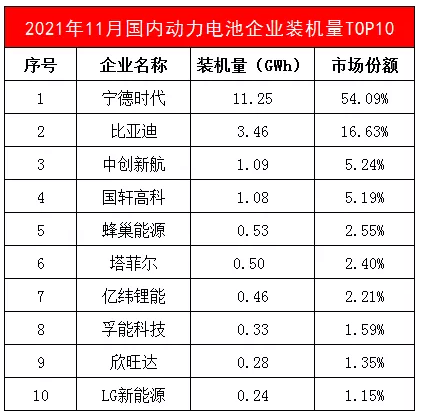
As can be seen from the picture above, Ningde Times, BYD and China New Airlines, which ranked in the top three, won a total market share of 76.59%. The market share of the top five is 83.70%, and that of the top ten is 92.40%.
The other 33 companies have a market share of 7.60%.
Installed capacity of domestic power batteries from January to November
In terms of production, from January to November 2021, China's power battery output totaled 188.1 GWH, an increase of 175.5% over the same period last year.
Among them, the output of ternary batteries totaled 82.4 GWH, accounting for 43.8 percent of the total output, an increase of 106.1 percent over the same period last year; and lithium iron phosphate battery output totaled 105.3 GWH, accounting for 56.0 percent of the total output, an increase of 275.7 percent over the same period last year.
This is the output of lithium iron phosphate battery has exceeded that of ternary battery for seven months in a row, and it has completely laid the foundation for an annual output of more than ternary battery.
In terms of installed capacity, from January to November, the installed capacity of power batteries in China totaled 128.3 GWH, an increase of 153.1% over the same period last year.
Among them, the total installed capacity of ternary batteries was 63.3 GWH, accounting for 49.3% of the total installed capacity, up 92.5% over the same period last year; and the installed capacity of lithium iron phosphate batteries was 64.8 GWH, accounting for 50.5% of the total installed capacity, up 270.3% over the same period last year.
In annual terms, this is the first time this year that the installed capacity of lithium iron phosphate batteries has exceeded that of ternary batteries.
A total of 55 domestic power battery enterprises were installed from January to November, 13 fewer than the same period last year. The top ten enterprises are: Ningde Times, BYD, China New Airlines (AVIC Lithium), Guoxuan Hi-Tech, LG New Energy, Yiwei Lithium Energy, Tafel, Honeycomb Energy, Funeng Technology, Xinwanda.
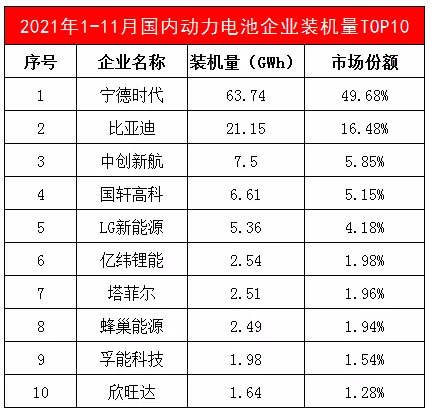
As can be seen from the above figure, the power battery installed capacity of the top 3, the top 5 and the top 10 power battery companies are 94.8GWh, 106.7GWh and 118.1 GWH respectively, accounting for 73.9%, 83.2% and 92.0% of the total installed capacity, respectively.
"monopolize" the domestic market in the Ningde era
Ningde era installed 11.25GWH in November, with a market share of more than 54%, reaching 54.09%. From January to November, the installed capacity of power batteries was 65.93GWH, with a market share of 51.4%.
In 2018, there was a description of the market as follows: article 19 of China's Anti-monopoly Law stipulates that an operator may be presumed to have a dominant position in the market under any of the following circumstances:
An operator whose market share in the relevant market reaches 1/2;
The combined market share of the two operators in the relevant market reaches 2/3;
The total market share of the three operators in the relevant markets reached 3/4.
According to the above statement, it is easy for the relevant companies in the power battery market to sit in the right seat.
More importantly, the top companies, whether in November or January-November, have won "a dozen of 54" while continuing to expand:
In terms of customers, Ford recently confirmed for the first time that Ningde Times has become a Ford power battery supplier; in mid-November, media reported that Ningde Times had set up a branch in South Korea to supply batteries for Hyundai cars, including ternary batteries and iron-lithium batteries.
In terms of supply chain cooperation, Ningde Times signed a cooperation agreement with Lithium Battery Copper foil leader Jiayuan Technology on December 8, under which the two sides will set up a joint venture company and build a high-performance electrolytic copper foil project with an annual output of 100000 tons. The initial registered capital of the joint venture company is 500 million yuan, of which Ningde era contributed 100 million yuan, accounting for 20% of the shareholding, and the capital can be increased to 2 billion yuan by stages according to the needs of the project construction.
On November 19th, Ningde Times also signed an equity transfer and joint venture agreement with the original shareholders of Litai Lithium Phosphate Co., Ltd. Ningde Times will invest a total of 413 million yuan in Litai LiNeng, which is expected to become its largest shareholder.
On November 14, Yongtai Technology announced that Ningde Times plans to buy 25% of Yongtai Hi-Tech held by Pacific Century Pacific Century Hengtong for 500 million yuan. After the completion of the transfer, Ningde Times will become the second largest shareholder of Yongtai High-tech. Yongtaigao's new main products include lithium hexafluorophosphate and difluorosulfonimide lithium (LIFSI).
In the field of energy storage, Ningde Times signed a strategic cooperation agreement with Ates Sunshine Power Group on November 23rd. The two sides will cooperate in energy storage system, lithium battery module supply, energy storage project operation and maintenance services, new energy technology, etc.
BYD benefits from sales of new energy vehicles
BYD has seen a big increase in sales of its new energy vehicles since October. In the same month, BYD sold 80003 new energy passenger cars, an increase of 262.9% over the same period last year.
As a result, BYD achieved "one hit ten" in October: in October, the sales of new energy passenger cars of Xilai, Nezha, Zero, Polar Krypton, GAC Eian, ideal, Volkswagen I.D series, Xiaopeng, Weimar and Lantu added up to only 65370. BYD's new energy passenger car sales are 1.22 times that of the 10 car companies combined!
In November, BYD sold 90121 new energy passenger cars, up 252.7% from a year earlier. This is also the new record of monthly sales of new energy passenger cars in China so far, so far, BYD has sold a total of 500922 vehicles in 2021.
As we all know, the battery of BYD's new energy vehicle is self-supplied, and its excellent performance of power battery is to be expected.
The latest development of BYD battery is that Chuzhou Fudi Battery Co., Ltd. was officially established on December 3. This is another company mainly engaged in battery business after BYD established Jinan Fudi, Yancheng Fudi and Wuwei Fudi in August.
![[SMM Análisis] Ánodo de grafito artificial ligeramente elevado antes del feriado, en general estable durante el feriado](https://imgqn.smm.cn/usercenter/MjfPv20251217171728.jpg)