Dismantling of Motor Scrap Will Become A New Growth Engine amid Slow Increase in Ore Supply

Publicado: Nov 29, 2021 14:38 (GMT+8)
As the supply of thermal coal is always tight in winter, the Ministry of Industry and Information Technology recently issued the Motor Energy Efficiency Improvement Plan to encourage the development of energy-saving rare-earth motors to replace traditional industrial motors, in response to the call for energy conservation and emission reduction. And it also plans to improve the recycling system of motor scrap.

SHANGHAI, Nov 29 (SMM) - As the supply of thermal coal is always tight in winter, the Ministry of Industry and Information Technology recently issued the Motor Energy Efficiency Improvement Plan to encourage the development of energy-saving rare-earth motors to replace traditional industrial motors, in response to the call for energy conservation and emission reduction. And it also plans to improve the recycling system of motor scrap.

The upstream supply of the rare earth industry chain consist of three parts, naming the domestic mining of light and heavy rare earth ore, ore import and recycling of NdFeB scrap.

In 2021, domestic mining of light and heavy rare earth ore accounts for 44% of the total upstream supply of PrNd oxide. The mining quota for light rare earth is 149,000 mt in the same year, an increase of 20% year-on-year; and the quota for medium and heavy rare earth ore totals 19,000 mt. As the mining of rare earth ore brings greater pressure on environmental protection, the annual mining quota of medium and heavy rare earth ore has not increased in the past few years.

In 2021, China’s ore imports stood at 80,000 mt, including 56,000 mt of rare earth metal ore from the United States, and 24,000 mt of mixed rare earth carbonate and unlisted rare earth oxide from Myanmar. Currently, the production of the MP mine in the United States is close to full capacity, thus there is limited room for growth in imports. Meanwhile, the imports from Myanmar in 2021 dropped by 30% year-on-year, and domestic supply was also unable to meet market demand. In the second half of the year, some manufacturers have reduced their operating rates due to short ore supply.

In other words, there is unlikely to be significant growth from the mine side, which is difficult to match the increasing downstream demand for rare earth products.

The NdFeB scrap recycling market accounts for 30%-40% of the upstream PrNd oxide supply, and the supply will amount to 24,000 mt throughout 2021. However, magnetic material companies reduced their production in autumn and winter, and the NdFeB scrap inventory decreased as well. The prices have then rose to 740,000-750,000 yuan/mt. Furthermore, the costs of auxiliary materials such as hydrochloric acid, oxalic acid, and liquid caustic soda remained high. The NdFeB scrap recycling market is still facing Problems such as difficult in collecting scrap and high cost.

The dismantling and recycling domestic motor scrap seems to be more advantageous in terms of techniques and costs by comparison. The recycling of motor scrap has an additional course of dismantling and smashing when compared to NdFeB scrap recycling. Therefore, the technical barriers to be overcome by domestic recycling companies to transform and upgrade to a motor scrap recycler are relatively low. Due to the immature scrap recycling technology and strict environmental protection supervision in foreign countries, motor scrap is mostly treated as waste, and the prices are low. The recycling of imported motor scrap is more cost efficient.

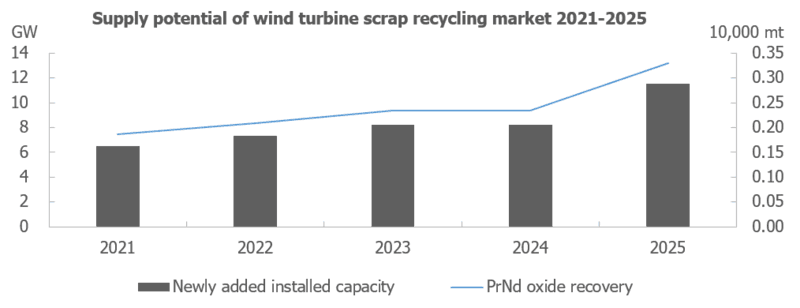
The service life of wind turbines is usually 15-20 years. The first batch of wind turbines installed around the world in 2001 is about to be dismantled and recycled. It is expected that the scrap dismantling market will produce at least 29,000 mt of high-performance NdFeB in 2021-2025, which is equal to 11,900 mt of PrNd oxide. According to the supply and demand balance of PrNd oxide in the next five years, if the wind turbine scraps are fully utilised, it will make up for the supply shortage in the next two to three years. The recycling of permanent magnet motor scrap is mainly found in China. At present, the amount of NdFeB recovered from imported wind turbine scrap stands at 2,000 mt per month, which is equivalent to 732 mt of PrNd oxide. The recycling market for imported motor scrap is still a blue ocean with broad prospects as only a few large recyclers are planning to expand their business to this sector.
Declaración de Fuente de Datos: Excepto la información disponible públicamente, todos los demás datos son procesados por SMM basándose en información pública, comunicación de mercado y confiando en el modelo de base de datos interna de SMM. Son solo para referencia y no constituyen recomendaciones para la toma de decisiones.

Para cualquier consulta o para obtener más información, por favor contacte: lemonzhao@smm.cn
Para más información sobre cómo acceder a nuestros informes de investigación, contacte con:service.en@smm.cn
Noticias relacionadas
Comentario de la tarde sobre tierras raras de SMM del 30 de septiembre
30 Sep 2026 17:18 (GMT+8)
Comentario de la tarde sobre tierras raras de SMM del 30 de septiembre
Leer más
Comentario de la tarde sobre tierras raras de SMM del 30 de septiembre
30 Sep 2026 17:18 (GMT+8)
Los precios de la chatarra se mantienen estables y el comercio en el mercado se reduce durante las vacaciones [Revisión semanal de tierras raras recicladas de SMM]
30 Sep 2026 15:26 (GMT+8)
Los precios de la chatarra se mantienen estables y el comercio en el mercado se reduce durante las vacaciones [Revisión semanal de tierras raras recicladas de SMM]
Leer más
Los precios de la chatarra se mantienen estables y el comercio en el mercado se reduce durante las vacaciones [Revisión semanal de tierras raras recicladas de SMM]
[Reseña semanal de SMM sobre tierras raras recicladas: precios de chatarra estables, actividad del mercado se desacelera antes del feriado] En general, los precios de la chatarra de Pr-Nd se mantuvieron estables esta semana, con un ligero ajuste al alza cerca del fin de semana. Las empresas de reciclaje se mostraron cautelosas a la hora de perseguir precios más altos tras concluir el acopio previo al feriado, mientras que los proveedores mostraron poca disposición a vender. La actividad del mercado se enfrió gradualmente a medida que se acercaba el feriado. A corto plazo, se espera que el mercado permanezca tranquilo durante el feriado con escasa mejora en la negociación, y es probable que los precios de la chatarra de Pr-Nd mantengan un patrón estable.
30 Sep 2026 15:26 (GMT+8)
Los precios de Pr-Nd se mantienen firmes con un aumento constante, y la negociación tiende a ser escasa antes del feriado [SMM Revisión semanal de tierras raras]
30 Sep 2026 15:21 (GMT+8)
Los precios de Pr-Nd se mantienen firmes con un aumento constante, y la negociación tiende a ser escasa antes del feriado [SMM Revisión semanal de tierras raras]
Leer más
Los precios de Pr-Nd se mantienen firmes con un aumento constante, y la negociación tiende a ser escasa antes del feriado [SMM Revisión semanal de tierras raras]
[SMM Revista Semanal de Tierras Raras: Los precios de Pr-Nd se mantienen firmes con ligeras ganancias; la actividad comercial se desacelera antes del feriado] El óxido de terbio se situó en 6,52-6,55 millones de yuanes/tm, con una aceptación débil de los precios altos por parte de los compradores, centros de negociación a la baja y una actividad de oferta general mediocre con escaso volumen de operaciones. El óxido de gadolinio se situó en 190.000-192.000 yuanes/tm, con consultas de los compradores persistentemente débiles y poca disposición de los proveedores a ajustar los precios, manteniéndolos en su mayoría estables a la espera. El óxido de holmio se situó en 635.000-637.500 yuanes/tm, en consolidación, con cambios limitados en los fundamentos de oferta y demanda. El óxido de erbio se situó en 670.000-675.000 yuanes/tm, con consultas débiles de los compradores y un seguimiento comercial insuficiente. El óxido de itrio (5N) se situó en 58.000-60.000 yuanes/tm, y el óxido de itrio (3N) en 28.000-30.000 yuanes/tm, con una demanda mediocre, un seguimiento insuficiente de los compradores y precios sin impulso alcista.
30 Sep 2026 15:21 (GMT+8)