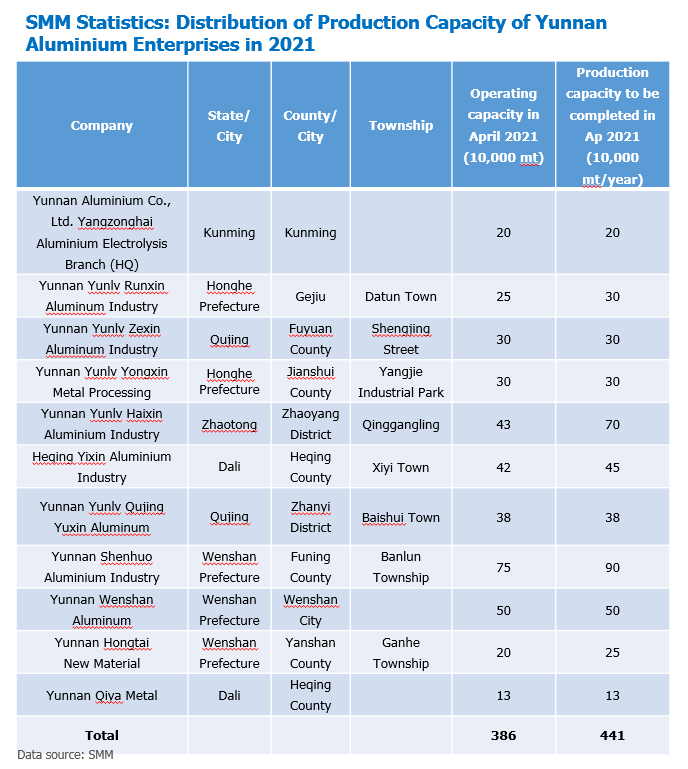
SHANGHAI, May 19 (SMM) — China aluminium industry is carrying out a huge relocation plan to pursue green energy, which is unprecedented in the history of the global aluminium industry. According to the public announcement, Yunnan Hongtai New Materials, a subsidiary of China Hongqiao Group in Yunnan Province, will gradually install 1,048 pots with 440kA technology and 468 pots with 600kA technology, with an annual aluminium production capacity of 2.03 million mt. If other aluminium smelting projects, such as Yunnan Wenshan's production capacity of 1 million mt, Yunnan Shenhuo's 900,000 mt, Yunnan Qiya's 350,000 mt, and Yunnan Aluminium Zhaotong's 700,000 mt, can also be put into production on time, Yunnan's annual production capacity of aluminium will reach nearly 6.9 million mt, up 5 million mt from 2018, and China Hongqiao Group has registered another subsidiary in Yunnan, which may transfer more aluminium production capacity to Yunnan from Shandong in the future. Although Yunnan is a province with rich hydropower resources in China, the rapid growth in electricity demand will put tremendous pressure on power supply, especially during the dry season.
Recently, due to the low rainfall, the Yunnan government has implemented measures to reduce the electricity load of aluminium smelters in the province. According to the statistics of Shanghai Metals Market (SMM), Yunnan's aluminium production capacity stood at 3.86 million mt at the end of April 2021. The curtailment is expected to be about 76,000-380,000 mt of production capacity (reducing the load by about 2%-10%), and the impact period is expected to be about one month. If aluminium plants are forced to reduce the electricity load by shutting down the pots, the impact period is expected to exceed one month due to the time required for restart.
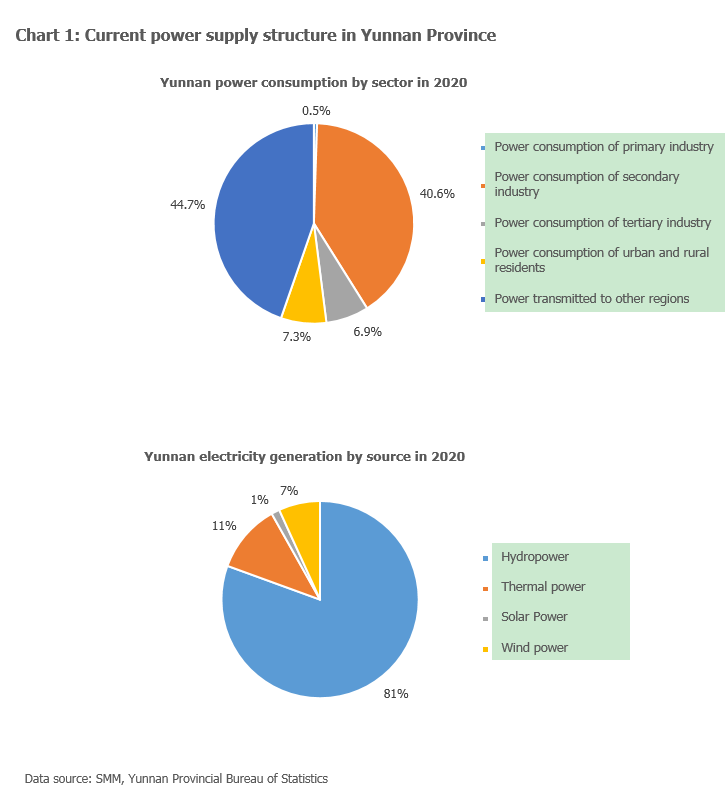
Yunnan is one of the provinces with abundant hydropower resources in China. The province has six major river basins: Jinsha River, Lancang(Mekong) River, Nujiang(Salween) River, Yuanjiang(Hong) River, Nanpan River, and Irrawaddy River. The theoretical reserves of hydropower resources in the province stand at 104GW, accounting for 15% of the country and less than Tibet and Sichuan. By the end of 2020, total installed power generation capacities in Yunnan stood at 103.4GW, of which hydroelectric power stood at 77.6GW, thermal power, wind power and solar power stood at 15.1GW, 8.8GW, and 3.9GW, respectively. The renewable energy, mainly hydropower, totalled at 88.9GW, accounting for 85.4%. The thermal power installed capacity accounted for 14.6%.
Yunnan’s power generation stood at 367.4 billion kWh in 2020, up 6.1% year on year, of which hydropower, wind energy and solar power came in at 296 billion kWh, 25 billion kWh, and 5 billion kWh respectively. Clean energy has generated about 88.7% of total electricity. The electricity consumption of the whole society in Yunnan came in at about 202.6 billion kWh in 2020, up 11.8% year on year, of which the consumption of the nonferrous metal smelting and rolling industry stood at 51.461 billion kWh, up 38% year on year, accounting for 34.6% of the consumption of the secondary industry. Consumption and growth rate are ranked first place among all of industries. The province also 166.4 billion kWh electricity to other regions during the same period, flat from the last year.
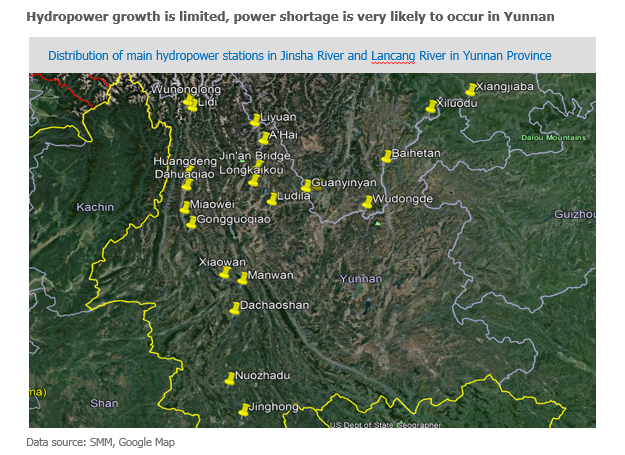
Yunnan's important hydropower resources are concentrated in the Jinsha River and Lancang River, as shown in the figure. At present, the Wudongde Hydropower Station (10.2GW) and the Baihetan Hydropower Station (16GW) constructed on the lower reaches of the Jinsha River at the junction of Yunnan and Sichuan are progressing smoothly. So far, 10 of the 12 generators planned for the Wudongde Hydropower Station have been put into operation. It is expected that all units will be put into operation before July 1 this year. The first unit of Baihetan Hydropower Station is also expected to be put into operation in July this year, and all units will be put into operation in July 2022. If these two hydropower stations and the Toba hydropower station (1400MW) built on the upper reaches of the Lancang River are included, the installed hydropower capacity of the Jinsha River and the Lancang River in Yunnan province will reach 58.07GW, which has basically been developed. Given that the water resources of the Nu River cannot be exploited and utilised at present due to the ecological environment. And also, most of the electricity generated by the Wudongde Hydropower Station and the Baihetan Hydropower Station under construction will be transmitted to Guangdong, Guangxi and Eastern China. Since these two hydropower stations are located at the junction of Yunnan and Sichuan, Sichuan will also have some retained electricity.
The recent commissioning of new aluminium smelting capacity has significantly improved the phenomenon of water abandonment in Yunnan. Yunnan abandoned 31.4 billion kWh of water in 2016, and the amount of water discarded in the province was controlled at 2.5 billion kWh by 2020. Given that there is still a large amount of aluminium production capacity that has not yet been put into production, SMM expects that local electricity consumption in Yunnan will increase significantly in the next few years.
While Yunnan hydropower maintains power transmission from west China to east China, the increase in local retained electricity is limited. Electricity from hydropower stations in the rainy season usually accounts for 65% of Yunnan’s annual total hydropower, so the power supply will become tight in the dry season from December to May of the following year.
Since the smelting industry needs a stable power supply, it is very likely to see a shortage of hydropower during the dry season in Yunnan, which will require more renewable energy or coal-fired power. Although the Yunnan Provincial Government has promised lower electricity prices for primary aluminium investors, this will likely increase the electricity cost of these aluminium plants during the dry season.
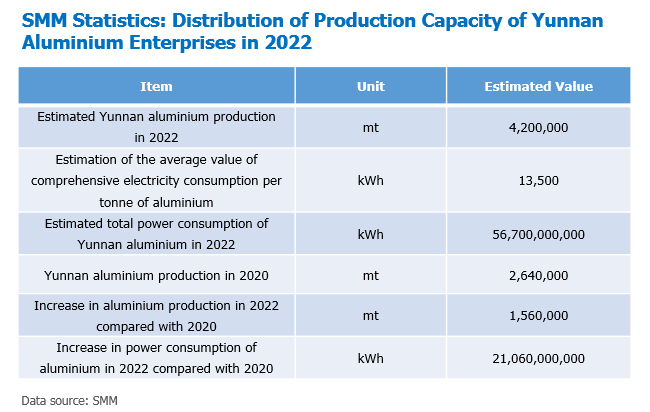
According to statistics from SMM, Yunnan's primary aluminium output in 2020 stood at 2.64 million mt, up 44% year on year. SMM expect that if all the aluminium projects under construction are fully put into operation, Yunnan's primary aluminium output will increase to 4.2 million mt by 2022, the demand for electricity will increase 21 billion kWh from 2020.
Based on the national average utilisation hours of hydropower, wind power and photovoltaic in 2020, Yunnan needs to add 5.5 GW of hydropower, or 10.16 GW of wind power or 18.16 GW of photovoltaic installed capacity to meet the demand, which does not include the growth of power demand in other fields. Although Yunnan is strengthening investment in photovoltaic and wind power, it will still pose a serious challenge to local power supply capacity at that time.
In summary, the Yunnan Provincial Government hopes to attract more investors to develop the local economy. At the same time, China's aluminium companies also hope to use cheap green hydropower to reduce their carbon emission intensity, and have transferred a large amount of aluminium production capacities to Yunnan. However, limited hydropower resources will likely make local power shortages become normal, especially in the dry season.
![El precio de la alúmina retrocede tras un rápido ascenso con una consolidación de volumen decreciente; el índice spot deja de caer y repunta ligeramente; el patrón de oferta fuerte y demanda débil se mantiene sin cambios [Comentario matutino de SMM sobre la alúmina]](https://imgqn.smm.cn/usercenter/SBQYr20251217171651.jpg)