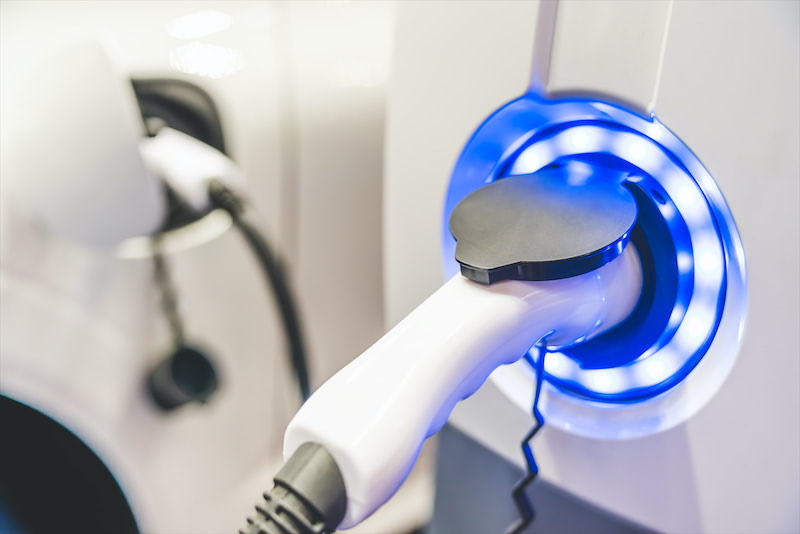
According to reports, researchers at (Queensland University of Technology) of Queensland University of Technology in Australia recently designed a hybrid supercapacitor and promised that the supercapacitor can be charged and discharged almost instantly, and its energy storage capacity is greatly improved, which is on a par with the Ni-MH battery (NiMH).
First of all, the key concepts that need to be understood here are energy density (Wh/kg) and power density (W/kg). Specifically, energy density refers to the total energy that can be stored per weight of the device, while power density refers to the speed at which energy flows in and out of the device while charging and Discharge.
Lithium batteries store energy chemically and are widely used because of their relatively high energy density, but users of smartphones or electric vehicles know that lithium batteries charge very slowly. Supercapacitors, on the other hand, store energy statically rather than chemically, which means they can charge and discharge faster without damaging the internal structure. As a result, they have a very high power density, but they are unable to show their edge because their energy density is much lower than that of chemical batteries.
However, there is one device whose properties fall somewhere between the two-hybrid supercapacitors, which are in the middle on both indicators, store much more energy than ordinary supercapacitors and charge almost as fast. Through it, the battery life of a car or mobile phone will not be extended, but the charging speed will become very fast, and the mileage may no longer be a problem.
In a recent study, the research team at Queensland University of Science and Technology used a capacitive titanium carbide negative electrode and a battery graphene hybrid positive electrode. The result is a hybrid capacitor with about 10 times the power density (charging capacity) of a lithium battery and an energy density close to that of a nickel metal hydride battery, the researchers said.
After a series of tests, the data are also staggering: its energy density can reach 73 Wh/kg, about 28% of today's most advanced electric vehicle batteries, and up to 1600 W/kg of ultra-high power density, while the average lithium battery has a power density of only 250-340 W/kg.
The researchers used an analogy: suppose Tesla Model S Plaid+ comes out with an optional battery pack that doesn't have a range of 520km (837km), but 145mph (233km), but is it more attractive for you to charge at least fivefold faster?
However, to achieve such charging efficiency, infrastructure will be the biggest challenge in the future. You know, ultra-high-speed charging stations will enter the megawatt range, and unless they have a huge energy storage capacity on the site, they will put great pressure on the energy grid.
Not only that, those "acceleration maniacs" who are crazy about pushing their backs may also note with delight that the power density is two-way, which means that the battery pack will not hinder the really huge power output. With today's Plaid + Tesla with an astonishing 1100 horsepower, the battery pack of a hybrid vehicle based on supercapacitors will provide five times as much power for the engine.
In addition, the team was pleasantly surprised to find that the hybrid battery lasts twice as long as the lithium battery and retains 90% of its initial storage capacity after 10,000 charge-discharge cycles.

![[Lithium Battery: Wanrun New Energy Adjusts Repurchase Plan For 100,000-Ton Cathode Material Project]](https://imgqn.smm.cn/usercenter/JSjkr20251217171728.jpg)