The main point of the "special inventory" of the opening results of the US general election (this article): the recount occurred again in "Wisconsin". The invoice map has become more complicated: what does the slash of dark blue, crimson, medium blue, light blue, light red and red and blue represent respectively? Will the result of the US election be "difficult"?
The state is under the spell of "recount" again.
In the 2016 US election, both Trump and Hillary Clinton wanted to "recount" their disadvantaged states, when Wisconsin conducted a recount. In the 2020 election, this "Wisconsin" has once again had a recount. The "WI" on the map (to the right on the map), Wisconsin (Wisconsin,10 electoral votes), had already announced that Biden had "won" the state this morning. But then decided to recount the votes. Because Biden has a lead of only 0.7 percentage points (Biden 49.6% VS 48.9% Trump), the Trump campaign filed a lawsuit demanding a "recount", while Wisconsin law allows candidates with a gap of less than 1% to recount votes after paying the relevant counting fees.
The invoice map is complicated: dark blue, crimson, light blue, light red, red and blue slashes
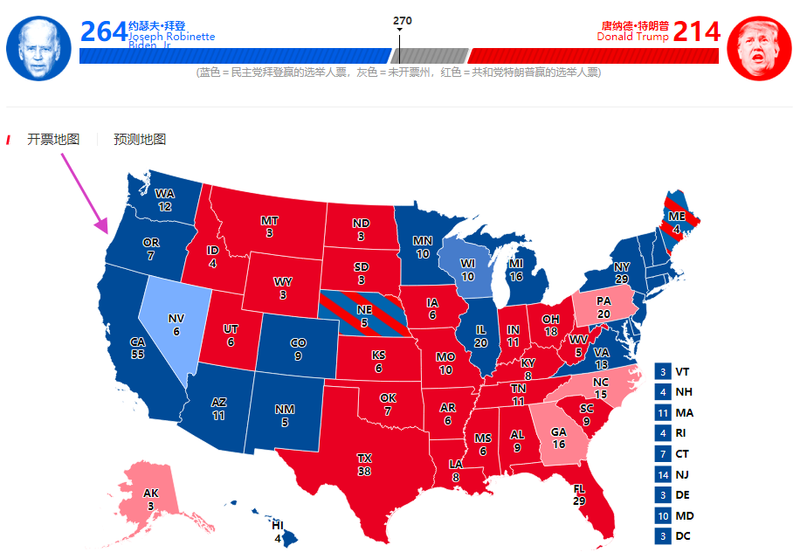
The picture above is the progress bar + colorful map of the special topic of the US election.
Above, progress bar Biden 264 VS 214Trump, how do you calculate it?
"Biden 264 votes = the sum of" dark blue "states in the invoice map + 10 votes in medium blue" WI "Wisconsin (originally won by Biden but decided to recount) + 3 votes in slash ME (4 votes in ME) + 1 vote in slash area NE (5 votes in NE);
Trump 214votes = 209 votes for all "crimson" states on the invoice map + 1 vote for slash ME (4 votes for ME) + 4 votes for slash area NE (5 votes for NE).
The "invoice map" of the special topic of the US election, with various color meanings:
Medium blue = "WI" Wisconsin recounted (back right on map)
Dark Blue = the state that Biden "won" (Biden = Democratic Party),
Crimson = the state Trump "won" (Trump = Republican),
Light blue = states where Biden is temporarily in the lead but is "not declared to have won",
Light red = states where Trump has a temporary lead but is "not declared to have won",
The slash ME (upper right corner of the map / Maine) and NE (middle of the map / Nebraska) involve small constituencies, resulting in state constituencies and small constituencies voting for different people. So it is represented by a red and blue slash.
[specifically: ME Maine, Biden "won" two electoral votes in a state constituency + one electoral vote in a small constituency. Trump "won" an electoral vote in small constituency 2. [NE Nebraska, Trump "won" 2 electoral votes in state constituencies + 1 electoral vote in small constituencies 3, and Biden "won" 1 electoral votes in small constituencies 2. ]
The "lopsided" results of the US election have also drawn more attention from investors and the media around the world to states that are "temporarily ahead but have not yet decided who will win" in the counting process. Therefore, in the "invoice Map" of Huitong net's special topic on the US election, there is a special mark on these "states that are temporarily ahead but have not yet decided who will win". Special marks are also given to states with recounts and two states with small constituencies. In this way, the total number of invoiced maps is: dark blue, crimson, medium blue, light blue, light red, red and blue slashes.
Is the "winning" state 100% safe and accurate?
The above so-called "win", the specific rules are more complex, generally we quote the data of the mainstream media in the United States to update the invoice map (for example, Fox, Associated Press). But in most of these "winning" states, 100% of the votes have not been counted. What potential problems will this bring? Here are two examples to get a glimpse of the leopard:
1) some states have no chance of a turnaround-for example, Trump's "won" KS, Kansas, has completed 99 per cent of the vote count, with Trump leading by 15.3 percentage points (Trump 56.5 per cent VS 41.2 per cent Biden). In other words, even if all those who have not counted votes support Biden, they are still far behind Trump's share of the vote.
2) but some states that "win" are not based on complete data but with artificial predictions-for example, the TX Trump "won" is Texas, and the progress of the vote is 85%, that is, 85% of the "straight votes" are counted. The result of the 85% of the direct election votes is: Trump 52.3% VS 46.3% Biden, that is, Trump has a 6-point lead, but don't forget that 15% of the votes have not yet been counted. In theory, it is impossible to confirm that Trump will win, but given that Trump's support for the oil industry is significantly stronger than that of Biden (because Biden is clean energy), people acquiesce in Trump's victory in Texas, but the formal counting will continue. If there is a discrepancy between the official vote count and the "win" result, it will be a dramatic story again.
(the following picture is a picture of the mainstream media in the United States, which can be used for comparison. Click on the picture to see the larger picture.)
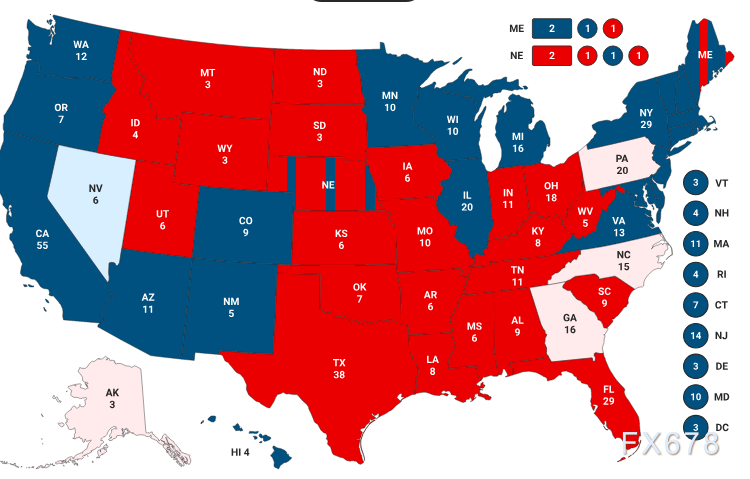
The procrastination of four major factors and the procrastination of the results of the US election
If you follow the rapid results of previous years, see blue is the Democratic Party's Biden won the district, see red is the Republican Trump won the district. The election results of some constituencies have not yet been announced and are usually marked in gray. Whoever first exceeds 270 votes will lock in the new president, and the other will stop. In the 2016 US election, Trump was certain to win the election in about six hours.
However, the counting time for 2020 is now more than 28 hours, and it is still neck and neck. Why is it so procrastinating this time? During the opening process of the US election in 2020, the proportion of votes cast on the spot was affected by the novel coronavirus epidemic in the United States. many people switched to mailing ballots, which may bring about four problems:
1) lengthen the deadline for receiving mailed ballots, and if the counting process is stuck, you may have to wait for more votes to arrive before you can see the results.
2) since mailing ballots do not have to wait in line to cast on the spot, more people may participate in the voting, which will increase the total number and slow down the final counting results.
3) for mailing ballots, it is necessary to verify the documents before counting votes in order to prevent fraud. And a large number of postal ballots, which also brings a lot of extra work to the counting of votes.
4) during the epidemic, the related work efficiency of the staff who may be involved in the counting of votes will also be reduced.
Will the result of the US election be "difficult"?
Will the result of the US election be "difficult"? Compared with about six hours in 2016, in 2020, the preliminary results of the first general election were released at around 8 o'clock on November 4, and now it has been about 29 hours. To some extent, this is a difficult birth. Several undecided states are also key swing states, and the votes of the two are very close, and there is a recount, saying that "dystocia" is not an exaggeration. As for the extent of dystocia, it depends on the actual progress of the following states.
As of 13:00 in Beijing, the states that have not yet been declared "won" are the swing states Pennsylvania (PA,20 electoral votes), North Carolina (NC,15 electoral votes), Georgia (GA,16 electoral votes), Alaska (AK,3 electoral votes) and Nevada (NV,6 electoral votes). Plus a recount of Wisconsin (WI,10 electoral votes).
Trump's leading states are Pennsylvania (PA,20 electoral votes), North Carolina (NC,15 electoral votes), Georgia (GA,16 electoral votes) and Alaska (AK,3 electoral votes). Among them, Trump in the first three states is only slightly ahead, and there is still a large proportion of votes uncounted, which means that the variables are still high. While Alaska (AK,3 electoral votes) is currently 50% of the votes, Trump has a clear lead, but the map color (light red) is still in the category of temporary lead, although Trump has a good chance of winning.
Biden has a good chance of winning in Nevada (NV,6 electoral votes).
If, in Wisconsin (Wisconsin,10 electoral votes), the recount still shows that Biden wins, and at the same time, assuming Biden successfully "wins" Nevada (NV,6 electoral votes), then Biden "won" a total of 270 electoral votes. In this way, in theory, Biden won the US election.
But even if Biden wins 270 votes, it is not certain that the US election will be over, because according to the result of "Biden 270 VS 268 Trump", it is bound to cause the Trump side to continue to take chances and may have to sue for a recount. Then this farce may last for a while.
From a market psychological point of view, if the results of the US election are not clear before the end of Friday's trading day, there should be a big wave of volatility in global financial markets, as investors or speculators adjust their positions to prepare for the uncertainty that may arise over the weekend. Long sellers may close their positions and lead to declines, while short sellers may close their positions and lead to gains. In short, gains and declines depend on the original bets in specific financial markets and widespread speculative expectations by the end of Friday. Look forward to investors looking forward to a good result.
"[live US election] Biden is temporarily in the lead (updating)
![Platinum Prices Stop Falling and Rebound, Spot Market Discounts Widen Slightly, Trading Muted [SMM Daily Review]](https://imgqn.smm.cn/usercenter/wDeWQ20251217171734.jpeg)
![Silver Price Corrective Rebound, Spot Parity Transactions Quietly Await Guidance [SMM Daily Review]](https://imgqn.smm.cn/usercenter/nQsOk20251217171736.jpg)