Do a good job in risk control as the long holiday approaches! Three major exchanges

Publicado: Sep 25, 2020 09:16 (GMT+8)
Fuente: Futures daily
"National Day holiday" is approaching, please do a good risk control! The limit range of the three futures exchanges and the adjustment of margin standards are all here.

As the National Day and Mid-Autumn Festival are approaching, in order to do a good job in market prevention during the long holiday, the last period of Energy, Zheng Shang and Da Shang respectively announced market risk control measures during the long holiday.

In terms of trading time, according to the announcements of the three futures exchanges, night trading will not be held on the evening of September 30, and the market will be closed from October 1 to October 8, and all futures and options contracts will be auctioned together on October 9, and night trading will resume that night.

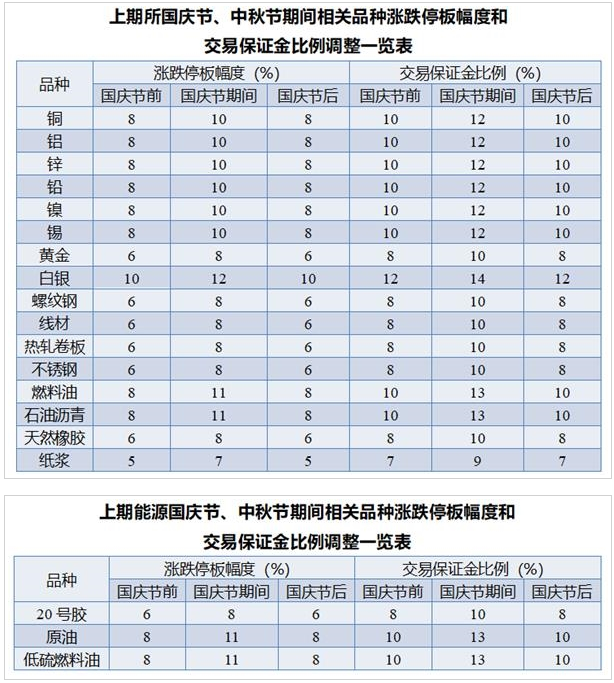
With regard to the last stock exchange and the previous period of energy, at the close of the first trading day when there was no unilateral market since Tuesday, September 29 (Tuesday), the margin ratio of pulp futures contracts was adjusted to 9%, and the limit range was adjusted to 7%. The margin ratio of gold, rebar, wire rod, hot-rolled coil, stainless steel and natural rubber futures contracts was adjusted to 10%, and the range of the limit was adjusted to 8%, and the margin ratio for gold, rebar, wire rod, hot-rolled coil, stainless steel and natural rubber futures contracts was adjusted to 10%, and the limit range was adjusted to 8%. The margin ratio for copper, aluminum, zinc, lead, nickel and tin futures contracts was adjusted to 12%, and the limit range was adjusted to 10%; the margin ratio for fuel oil and petroleum asphalt futures contracts was adjusted to 13%, and the limit range was adjusted to 11%; the margin ratio for silver futures contracts was adjusted to 14%, and the limit range was adjusted to 12%. The margin ratio of the No. 20 glue futures contract was adjusted to 10%, the limit range was adjusted to 8%, and the margin ratio of crude oil and low-sulfur fuel oil futures contracts was adjusted to 13%, and the limit range was adjusted to 11%. After trading on Friday, October 9, the margin ratio and limit range of all futures varieties and contracts returned to their original levels at the close of the first trading day when there was no unilateral market.
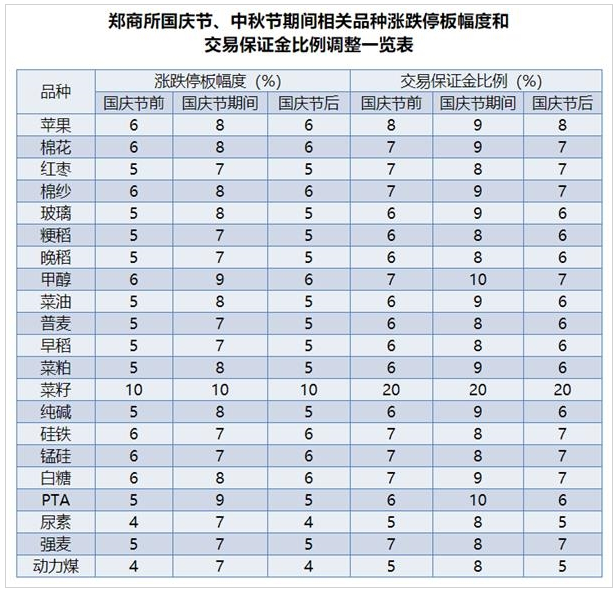
In terms of Zheng Shang Institute, since the settlement on September 29, the margin standard for PTA and methanol variety trading has been adjusted to 10%, and the limit range has been adjusted to 9%; for sugar, cotton, rapeseed meal, rapeseed oil, cotton yarn, apple, glass and soda ash varieties, the margin standard has been adjusted to 9%, and the limit range has been adjusted to 8%. The margin standard for trading varieties of Pumai, Qiangmai, early indica rice, late indica rice, japonica rice, red jujube, thermal coal, ferrosilicon, manganese silicon and urea was adjusted to 8%, and the limit range was adjusted to 7%. After the resumption of trading on October 9, since the contracts with the largest positions of varieties were not settled on the first trading day of the unilateral market, the trading margin standards and limits of all varieties returned to their pre-adjustment levels.
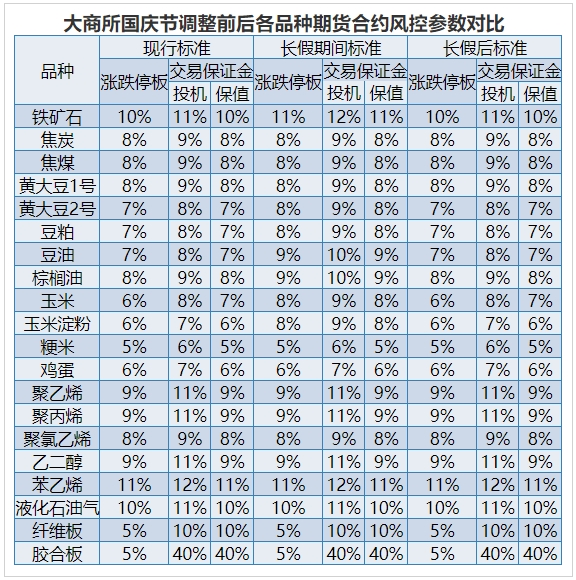
As far as the trading house is concerned, since the settlement on Tuesday, September 29, the rise and fall limit of yellow soybean No. 2, soybean meal, corn and corn starch futures contracts has been adjusted to 8%, and the margin levels of hedging and speculative trading have been adjusted to 8% and 9%, respectively. Soybean oil and palm oil futures contracts have been adjusted to 9%, hedging and speculative trading margin levels have been adjusted to 9% and 10%, respectively, and the margin levels of hedging and speculative trading have been adjusted to 8% and 9%, respectively, and the margin levels of hedging and speculative trading have been adjusted to 9% and 10%, respectively. The limit range of iron ore futures contracts was adjusted to 11%, and the levels of hedging and speculative trading margin were adjusted to 11% and 12% respectively. The limit range and trading margin level of other kinds of futures contracts remained unchanged. After the resumption of trading on Friday, October 9, the trading margin and trading margin level during the holiday period will remain unchanged on the first trading day after the festival. when the contracts with the largest positions of all varieties are not settled on the second trading day after the holiday (October 12), the margin ratio and the range of trading limit of the above futures varieties return to the original level after the settlement of the second trading day (October 12) after the resumption of trading on Friday, October 9, after the resumption of trading on Friday, the first trading day after the holiday, the margin and margin of the trading limit during the holiday period will remain unchanged.

Declaración de Fuente de Datos: Excepto la información disponible públicamente, todos los demás datos son procesados por SMM basándose en información pública, comunicación de mercado y confiando en el modelo de base de datos interna de SMM. Son solo para referencia y no constituyen recomendaciones para la toma de decisiones.

Para cualquier consulta o para obtener más información, por favor contacte: lemonzhao@smm.cn
Para más información sobre cómo acceder a nuestros informes de investigación, contacte con:service.en@smm.cn
Noticias relacionadas
Tanzania: Imwelo elige ruta de procesamiento tras aumentar la recuperación de oro al 84,5 %
25 Sep 2026 16:02 (GMT+8)
Tanzania: Imwelo elige ruta de procesamiento tras aumentar la recuperación de oro al 84,5 %
Leer más
Tanzania: Imwelo elige ruta de procesamiento tras aumentar la recuperación de oro al 84,5 %
[SMM Gold Flash] Lake Victoria Gold informó sobre nuevas pruebas metalúrgicas para mineral meteorizado en el Área C de su proyecto Imwelo, totalmente autorizado, en Tanzania. El lavado por atrición seguido de deslamado aumentó la extracción de oro en 24 horas del 49,99 % al 84,54 % en pruebas de lixiviación agitada. La recuperación en botella alcanzó el 88,15 % tras el pretratamiento, mientras que el oro recuperable por gravedad también aumentó. El trabajo fue realizado por Nesch Mintech Tanzania en Mwanza. La empresa ha identificado el lavado por atrición y el deslamado como la ruta de pretratamiento preferida para una mayor optimización del material cercano a la superficie rico en arcilla. Lake Victoria Gold afirma que los resultados complementan trabajos anteriores en material más profundo, donde se reportaron recuperaciones de aproximadamente 96–97 %. Es importante destacar que las recuperaciones reportadas corresponden a las fracciones pretratadas analizadas y aún no representan la recuperación global de la planta sobre el mineral completo; se planean más trabajos de balance de masa y optimización.
25 Sep 2026 16:02 (GMT+8)
Aurum Drilling logra una intersección de 155 g/t de oro en Boundiali, Costa de Marfil
25 Sep 2026 15:58 (GMT+8)
Aurum Drilling logra una intersección de 155 g/t de oro en Boundiali, Costa de Marfil
Leer más
Aurum Drilling logra una intersección de 155 g/t de oro en Boundiali, Costa de Marfil
[SMM Gold Flash] Aurum Resources informó nuevos resultados de ensayo de 22 pozos de diamantina que totalizan 6.172,8 metros en el depósito BST1 de su Proyecto de Oro Boundiali en Costa de Marfil. Los resultados incluyen 2,63 metros con 76,74 g/t de oro desde 195,2 metros, incluidos 1,3 metros con 155 g/t, junto con 24 metros con 6,31 g/t desde 108 metros, incluidos 7 metros con 19,25 g/t. Varias intersecciones se extienden más allá de la envolvente de recursos existente de BST1. Los resultados alimentarán la actualización planificada del Recurso Mineral de Boundiali de Aurum, prevista para principios del cuarto trimestre de 2026. La compañía señala que la mineralización permanece abierta a lo largo del rumbo y en profundidad, mientras la perforación continúa en todo el proyecto. Por lo tanto, los resultados constituyen un avance de exploración y crecimiento de recursos más que producción adicional. Boundiali cuenta actualmente con un Recurso Mineral JORC de 3,22 millones de onzas, mientras Aurum avanza en un estudio de factibilidad definitivo.
25 Sep 2026 15:58 (GMT+8)
El platino muestra vínculos más fuertes con la inflación y las tasas reales que el oro, según un estudio
25 Sep 2026 15:52 (GMT+8)
El platino muestra vínculos más fuertes con la inflación y las tasas reales que el oro, según un estudio
Leer más
El platino muestra vínculos más fuertes con la inflación y las tasas reales que el oro, según un estudio
[SMM Flash Oro y MGP] Un nuevo estudio publicado en el Journal of Commodity Markets concluye que el platino ha mostrado una correlación más amplia y persistente con la inflación y las tasas de interés reales que el oro. Los investigadores Arusha Cooray e İbrahim Özmen analizaron datos mensuales desde julio de 1999 hasta diciembre de 2024 en Estados Unidos, Alemania, Italia, Francia, Suiza y los Países Bajos, utilizando análisis de puntos de inflexión, coherencia wavelet y métodos de causalidad de Granger variables en el tiempo. El estudio encontró que las relaciones macroeconómicas del oro eran comparativamente más débiles y fragmentadas, mientras que el platino y la plata mostraron una sincronización más amplia, particularmente en Estados Unidos y Alemania. Los investigadores atribuyen la mayor sensibilidad macroeconómica del platino en parte a su considerable exposición industrial, lo que significa que su precio refleja no solo las condiciones monetarias, sino también la actividad manufacturera, la inversión y las restricciones de oferta. Los hallazgos no establecen al platino como una cobertura contra la inflación universalmente superior: las relaciones variaron según los países, los períodos y los regímenes de política monetaria. En cambio, el estudio destaca una diferencia fundamental entre los metales, ya que el papel monetario y defensivo más amplio del oro produce una respuesta diferente a la inflación y a las condiciones de las tasas reales.
25 Sep 2026 15:52 (GMT+8)