SMM9: at the 2020 (second) China Industry Expo New Materials Forum-China Automotive New Materials Application Summit Forum and China (8th) Aluminum processing Industry chain supply and demand Trading Summit, co-sponsored by Shanghai Nonferrous Metals Industry Association, Shanghai Automotive Engineering Society, Suzhou Die casting Technology Association and Shanghai Nonferrous net. Dr. Nie Cunzhu, head of aluminum alloy research office of Shanghai Huafeng material Science and Technology Research Institute, introduced the development knowledge of aluminum brazing pipe material for high temperature intercooler from the aspects of application background, alloy composition and process design.
Background
Customer demand
With the development of automobile engine technology and the implementation of more and more stringent automobile exhaust emission standards, the development of aluminum alloy tube sheet with high temperature and high strength is a general trend in the field of heat exchange.
Take the intercooler as an example:

With the upgrading of emission standards, the inlet temperature and pressure of intercoolers are getting higher and higher.
Accordingly, the demand of high-strength and heat-resistant aluminum alloy is becoming more and more urgent.
Aluminum alloy for tube material of intercooler at present
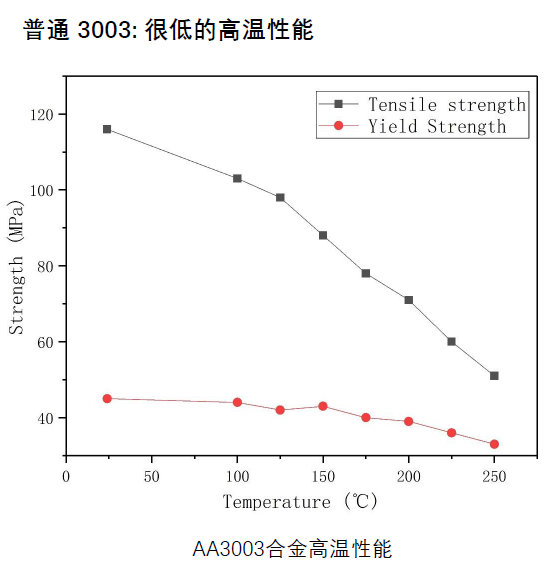
Improved 3003 (adding magnesium)
Advantages: obviously improve the high temperature performance of the alloy
(1) controlled atmosphere brazing: with the addition of 0.2-0.3% magnesium, the high temperature strength of the alloy is significantly increased (for example, compared with 3003, its strength is increased by about 200% at 230C.
(2) vacuum brazing: with the addition of 0.4-0.6% magnesium, the high temperature strength is obviously improved.
Disadvantages: reduce brazing quality (controlled atmosphere brazing) Nocolok is the main flux for aluminum alloy brazing, when magnesium exists, it reacts with flux to form MgF, so the welding quality is obviously reduced.
two。 Composition and process design
According to the theoretical and experimental data, the alloy composition is designed as follows:

Si&Fe: in the process of hot deformation, Si&Fe element can accelerate the precipitation of Mn from supersaturated solid solution and promote the formation of T phase, which is beneficial to improve the strength.
Cu: forms θ'/ θ 'strengthening phase. At the same time, the content of Cu element should not be too high, otherwise the casting and corrosion resistance of the alloy will be reduced.
The main elements of Mn: 3xxx aluminum alloy. The main results are as follows: (1) T phase can be formed, which is relatively stable at high temperature. (2) part of Mn dissolves into the matrix and plays a solid solution strengthening role. And
Al-Mn has a strong binding force between atoms, which can improve the heat resistance.
The addition of trace Zr of Zr: can form metastable phase β'(Al3Zr) under suitable heat treatment process. This phase can be used as the nucleation core of θ'/ θ 'phase and slow down the coarsening rate of θ' / θ 'phase at high temperature.
Ce: rare earth elements. (1) purify the grain boundary, (2) refine the precipitated phase.
The aging time of Sn: adding trace element Sn, alloy to reach the peak strength can be greatly shortened, mainly because Sn can promote the precipitation of strengthening phase, and can obviously reduce the size of strengthening phase and increase the number of strengthening phase.
Production process
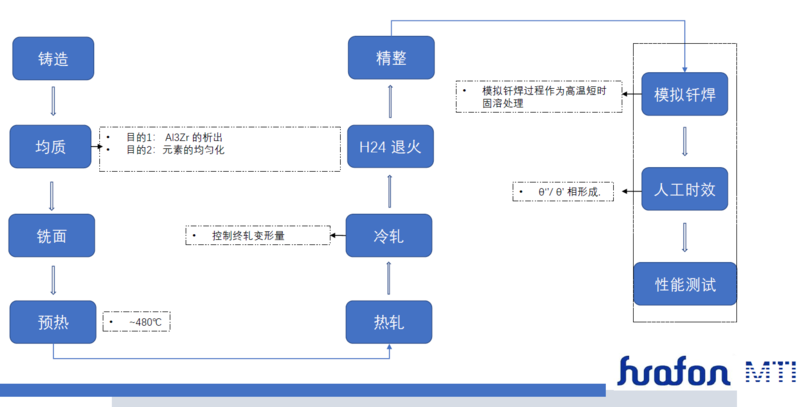
test data
The role of (-) Cerium (Ce, cerium) element
Grain boundary purification: the atomic size of Ce element is relatively large, and it is easy to precipitate at grain boundaries and crystal defects. By adding Ce, to the alloy, the defect position (such as grain boundary) of the alloy lattice is occupied, and more other elements of the alloy are dissolved in the matrix, thus increasing the deformation energy and strain energy of the alloy elements and promoting the precipitation of the dispersed phase in the post-sequence aging process.
Promote the precipitation of θ'/ θ 'phase: from the point of view of electronegativity, the electronegativity difference between Ce and Cu is 0.78, while that between Al and Cu,Al and Ce is 0.29 and 0.49, respectively. So Ce and Cu are easier to combine. At the same time, because Cu element has high binding energy, it can form CE + Cu + vacancy clusters and cause lattice distortion around the clusters, which provides a necessary condition for energy fluctuation for the precipitation of θ'/ θ 'phase.
Reducing the coarse second phase-EDS: precipitated phase is mainly Al-Cu phase, and its size is relatively small, which is favorable. In the follow-up solid solution treatment process.
Improvement of mechanical properties: the peak value of aging strength increases with the increase of Ce content. When the content of Ce exceeds a certain value, the peak strength begins to decrease.
(2) the function of Sn element
With the addition of Sn element, there is no obvious difference in casting structure.
The aging effect is improved, and Sn element can obviously shorten the time of reaching the aging peak value of Al-Cu alloy. The aging peak value of Al-Cu alloy is shortened from several days to about 4 hours.
Mechanism: by adjusting the size of the phase, the solid solution element Sn can reduce the interface energy and shear stress between the strengthening phase and the matrix, and promote the nucleation of the strengthening phase.
(3) the function of homogenization treatment
Homogenization treatment is used to dissolve the as-cast coarse second phase into the matrix and reduce the interfacial segregation of solute atoms in the alloy.
The selection of homogenization temperature should ensure that the Al-Cu phase dissolves into the matrix.
Before homogenization, Mn, Fe and Cu elements were seriously segregated. In addition, Mn and Fe elements mainly form Al- (MnFe) phase, while Cu elements mainly gather in the grain boundary in the form of Al-Cu phase. After homogenization treatment, especially the Cu elements are uniformly dispersed.
(4) the function of Zr element
The maximum temperature range of precipitation strengthened Al-Cu alloy is 150-200C. Beyond this temperature range, the strengthening phase begins to coarsen with the increase of temperature, and the corresponding high temperature strength begins to decrease.
Taking the stable Al3Zr phase particles at high temperature as the nucleation core, the low temperature strengthening phase (θ'/ θ') is precipitated on the dispersed Al3Zr phase particles, forming a compact microstructure, which can prevent the strengthening phase from coarsening at high temperature.
Under the same annealing process, the designed homogenization process can obtain higher strength of the alloy, indicating that the precipitation of Al3Zr dispersed phase can effectively prevent the movement of grain boundaries and dislocations and improve the strength of the alloy.
Brazing and artificial aging
As a solid solution treatment process, high temperature brazing makes the alloy become supersaturated solid solution, and the precipitated phase of Al3Zr will not be affected. The artificial aging process of 200 degrees is adopted, and the θ 'phase and a small amount of θ' phase are mainly formed in the alloy matrix after a certain holding time.
Summary
The rare earth element Ce can purify the grain boundary of the alloy, promote the precipitation of strengthening phase in Al-Cu alloy, and improve the aging strength of the alloy.
The addition of trace Sn element can obviously shorten the time for aging to reach the peak strength.
High temperature homogenization treatment can reduce the segregation of solute elements at grain boundaries and promote the dissolution of coarse second phase, which is beneficial to the precipitation of strengthening phase in the aging process.
Homogenization treatment not only includes the effect of high temperature homogenization, but also can realize the interaction between Al3Zr phase and low temperature strengthening phase (θ'/ θ'), form a stable microstructure and effectively improve the high temperature strength of the alloy.
"SMM online Q & A" has come to the market, price, information if you have any questions, feel free to ask!

Scan the QR code and join the SMM automobile and aluminum alloy industry exchange group