Outlook of Today's Financial and Economic data: focus on China's second-quarter GDP annualized rate and the number of Americans applying for unemployment benefits that week

Publicado: Jul 16, 2020 06:51

SMM7 March 16: today's focus on China's second-quarter GDP annualized rate and the number of Americans claiming unemployment benefits in the week ending July 11.

In terms of data,

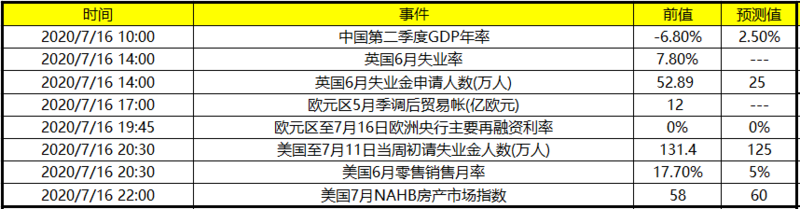
China's annual rate of GDP in the second quarter, GDP is the most extensive measurement of economic activity, but also an important indicator of China's economic health. If the index is higher than expected, the RMB should be considered strong / bullish, while if the index is lower than expected, the RMB should be considered weak / bearish.

Britain's unemployment rate in June, unemployment figures are seen as an indicator of the overall state of the economy, and it is the first economic data to be released every month. If the unemployment rate rises, it means that the British labour market is weak, which will drag down the development of the British economy and be bad for the pound. On the contrary, if the unemployment rate falls, it will be good for the pound.

The rise in jobless claims in the UK in June means that a poor job market will affect the economy or be bad for the pound, which will be good for the pound if the data is lower than expected.

After the quarterly adjustment of the euro zone trade account in May, foreign trade is one of the main factors promoting the economic growth of the euro zone, so it has considerable forecasting ability to the economy. It is the largest part of a country's balance of payments. Export data can reflect economic growth in the euro zone. Import data indicate domestic demand. Foreigners must buy their own currencies to pay for exports, which could have a big impact on the euro.

The euro zone until July 16 is the main refinancing rate for the European Central Bank, the central bank of Europe's single currency, the euro. ECB interest rate decisions have a huge impact on financial markets. If the European Central Bank announces that raising interest rates will be good for the euro, if it announces that interest rates will remain unchanged or cut interest rates, it will be bad for the euro. However, since changes in interest rates are usually expected in advance, real decisions tend not to affect the market.

The number of people applying for unemployment benefits in the week from July 11 to July 11 in the United States, as this data is released every week and is the focus of the investment market, the substantial increase in the number of unemployed people will increase the financial pressure on the US government. it is also a test for the US economy, which is suffering from "double red sickness", which is bad for the US dollar.

The monthly rate of retail sales in the United States in June, the monthly rate of retail sales in the United States, is known as "terrorist data"; retail data play an important guiding role in judging the current economic situation and prospects of a country, because retail sales directly reflect changes in consumer spending.

The NAHB real estate market index in July, the (NAHB) real estate market index of the National Association of Home Builders, was obtained through a survey of about 900 homebuilders. A target above 50 indicates a bright future for the U. S. housing market. If the indicator is higher than expected, the dollar should be considered strong / bullish, while if the indicator is lower than expected, the dollar should be considered weak / bearish.

Scan the QR code and join the SMM metal communication group.

Declaración de Fuente de Datos: Excepto la información disponible públicamente, todos los demás datos son procesados por SMM basándose en información pública, comunicación de mercado y confiando en el modelo de base de datos interna de SMM. Son solo para referencia y no constituyen recomendaciones para la toma de decisiones.

Para cualquier consulta o para obtener más información, por favor contacte: lemonzhao@smm.cn
Para más información sobre cómo acceder a nuestros informes de investigación, contacte con:service.en@smm.cn
Noticias relacionadas
[SMM Metales Preciosos Exprés]
hace 1 hora
[SMM Metales Preciosos Exprés]
Leer más
[SMM Metales Preciosos Exprés]
[SMM Metales Preciosos Exprés]
Según datos de aduanas de China, en agosto de 2026, China importó aproximadamente 8,11 toneladas de platino en bruto y polvo de platino, un 2,87 % menos intermensual y un 11,55 % más interanual. En agosto de 2026, las importaciones de paladio en bruto y polvo de paladio se situaron en unas 3,35 toneladas, un 12,04 % más intermensual y un 73,58 % más interanual.
hace 1 hora
Las exportaciones de plata de China aumentan intermensualmente en agosto; las importaciones crecen un 74,3 %; las importaciones de mineral suben un 39 % interanual
hace 3 horas
Las exportaciones de plata de China aumentan intermensualmente en agosto; las importaciones crecen un 74,3 %; las importaciones de mineral suben un 39 % interanual
Leer más
Las exportaciones de plata de China aumentan intermensualmente en agosto; las importaciones crecen un 74,3 %; las importaciones de mineral suben un 39 % interanual
[SMM Silver Express] Los datos de aduanas muestran que las exportaciones chinas de plata sin forjar al 99,99 % alcanzaron 405,98 toneladas en agosto de 2026, un 15,8 % más intermensual pero un 0,6 % menos interanual; las exportaciones acumuladas de enero a agosto alcanzaron 3.031,51 toneladas, un 2,6 % menos interanual. Las importaciones de agosto fueron de 66,24 toneladas, un 74,3 % más intermensual; las importaciones acumuladas de enero a agosto alcanzaron 951,39 toneladas. Las importaciones de mineral y concentrado de plata alcanzaron 266.055,59 toneladas en agosto, un 24,47 % más intermensual y un 39 % más interanual; las importaciones acumuladas de enero a agosto alcanzaron 1,6444 millones de toneladas, un 36,6 % más interanual.
hace 3 horas
【Análisis de SMM】Implats 2010 a 2025: Por qué más metal no siempre significa más dinero
18 Sep 2026 21:48
【Análisis de SMM】Implats 2010 a 2025: Por qué más metal no siempre significa más dinero
Leer más
【Análisis de SMM】Implats 2010 a 2025: Por qué más metal no siempre significa más dinero
El historial operativo de Implats de 2010 a 2025 muestra por qué una mayor producción no siempre implica mayores beneficios. Los precios de los metales, las interrupciones operativas, las adquisiciones y los movimientos cambiarios marcaron el desempeño. Los precios del paladio y del rodio cayeron bruscamente después del ejercicio 2021. Los resultados del ejercicio 2026 muestran una recuperación, pero una fortaleza duradera depende de operaciones seguras, procesamiento fiable, costes disciplinados y de convertir el metal en efectivo, en lugar de depender únicamente de precios favorables.
18 Sep 2026 21:48