[SMM thread] output peaked and fell, supply mountain finally loosened-SMM thread production report in July

Publicado: Jul 10, 2020 19:47 (GMT+8)


According to SMM research, in July, the blast furnace steel mill, which mainly produces building materials, produced 9.0654 million tons of thread, down 2% from June, while the reel produced 2.694 million tons, an increase of 0.67% from the previous month. In addition, before the global epidemic can not be effectively controlled, domestic steel prices are still high, and the export volume of building materials from steel mills only maintains the basic level, which is basically unchanged from last month.

Table 1: an overview of the trend of thread production in China's mainstream building materials steel mills from 2019 to now


Source: SMM

Table 2: overhaul of building materials in steel mills from June to July (in ten thousand tons)


Source: SMM

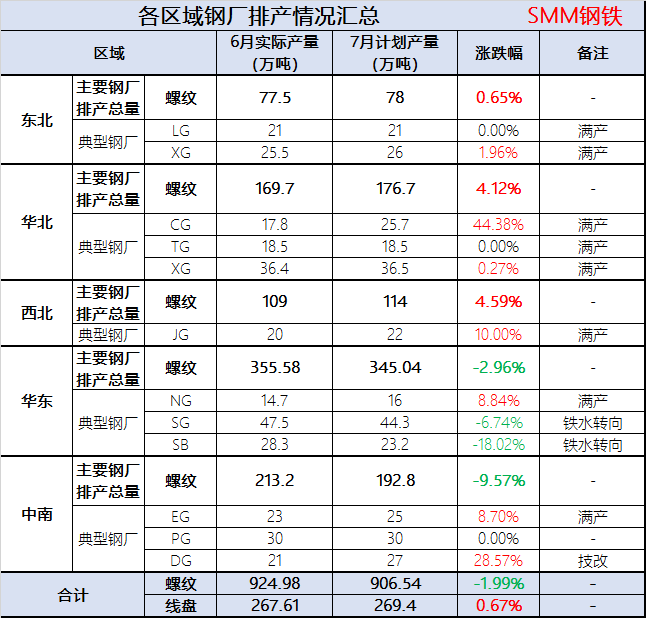
From a sub-regional point of view, the output of South-Central and East China has dropped obviously this month, while that of North China and Northeast China has shown a slight upward trend. Specifically,


Northeast China: thread production increased by 0.65% month-on-month this month

Northwest China: thread production increased by 4.59% month-on-month this month

North China: thread production increased by 4.12% this month.

Mainly due to:

At present, the national market is still in a situation of "strong in the north and weak in the south". The northeast, northwest and even North China are less affected by seasonal interference, the terminal demand is good, the merchants' shipments are smooth, and the spot price is higher than the overall price level in the south. Take Beijing as an example, as of July 10, the base price of Beijing Hegang thread is 3700mur3720 yuan / ton, while the Hangzhou market Shagang thread is only 3660,670 yuan / ton. It is quite different from the situation in previous years (in 2019, the average price of Shagang thread in Hangzhou market is 153.7 yuan / ton higher than that in Beijing), the profitability of steel mills is good, the pressure on factories and depots is relatively small, and the willingness to produce is still high.


East China: thread production decreased by 2.96% month-on-month this month.

Central and South China: thread production decreased by 9.57% month-on-month this month.


Mainly due to:

Since mid-late June, various regions in the south have been deeply affected by the "Meiyu" weather, the construction rhythm of the construction site has been seriously dragged down, merchant shipments are not smooth, and the performance of rebar with stronger seasonality is particularly weak. the enthusiasm of steel mills to produce threads has cooled slightly under the double pressure of profit and inventory, and some steel mills have chosen to turn molten iron to plate coils, profiles and strips.


Table 3: production schedule of building materials in regional steel mills from June to July 2020
 

Source: SMM

Taken together-

The output of steel mills peaked and fell as scheduled in July. At a time when China has not yet completely got rid of the seasonal interference, it is difficult for the "steel needs" of the rebar terminal to break out substantially, and it is difficult to have an obvious strong-weak relationship between the profits of steel mills producing threads and other varieties. In the later period, the supply side is likely to maintain a narrow fluctuation pattern. At the same time, the demand side gradually warmed up under the contraction of the range of rain. Under the marginal improvement of fundamentals, the upward channel of thread spot price has been quietly opened.


Declaración de Fuente de Datos: Excepto la información disponible públicamente, todos los demás datos son procesados por SMM basándose en información pública, comunicación de mercado y confiando en el modelo de base de datos interna de SMM. Son solo para referencia y no constituyen recomendaciones para la toma de decisiones.

Para cualquier consulta o para obtener más información, por favor contacte: lemonzhao@smm.cn
Para más información sobre cómo acceder a nuestros informes de investigación, contacte con:service.en@smm.cn
Noticias relacionadas
Perú prevé un aumento de 1 millón de toneladas anuales en la producción de cobre en un plazo de cinco a seis años
26 Sep 2026 01:38 (GMT+8)
Perú prevé un aumento de 1 millón de toneladas anuales en la producción de cobre en un plazo de cinco a seis años
Leer más
Perú prevé un aumento de 1 millón de toneladas anuales en la producción de cobre en un plazo de cinco a seis años
El ministro de Energía y Minas de Perú, Guillermo Shinno, afirmó que el país espera sumar alrededor de 1 millón de toneladas de producción anual de cobre en un plazo de cinco a seis años mediante nuevos proyectos mineros. El tercer mayor productor de cobre del mundo prevé una producción de 2,5 a 2,7 millones de toneladas en 2026, prácticamente sin cambios respecto a 2023, ya que la caída de las leyes del mineral y los recurrentes conflictos sociales pesan sobre la oferta. El gobierno recién elegido busca revertir ese estancamiento reduciendo la burocracia; en los dos meses transcurridos desde que asumió el cargo, las empresas mineras han intensificado su interlocución con el ministerio. Shinno señaló que los funcionarios han identificado 27 permisos que podrían eliminarse de aproximadamente 100 requisitos del sector minero, sin reducir la protección ambiental.
26 Sep 2026 01:38 (GMT+8)
El proyecto piloto de cobre BHP-Amazon EAC despierta interés del sector minero en el etiquetado bajo en carbono
25 Sep 2026 13:25 (GMT+8)
El proyecto piloto de cobre BHP-Amazon EAC despierta interés del sector minero en el etiquetado bajo en carbono
Leer más
El proyecto piloto de cobre BHP-Amazon EAC despierta interés del sector minero en el etiquetado bajo en carbono
Medios mineros en español informan que BHP y Amazon han lanzado el primer piloto de cobre de menores emisiones en Escondida utilizando Certificados de Atributos Ambientales, que certifican reducciones de emisiones dentro del entorno minero en lugar de compensarlas en otros lugares. Presentado el 22 de septiembre de 2026, el piloto aprovecha la electricidad renovable y el agua desalinizada de Escondida, y Amazon retira los certificados para vincular atributos de menor huella de carbono a su infraestructura de IA. Escondida produce alrededor de 1,2 millones de toneladas de cobre al año como la mina más grande del mundo, y se espera que la etiqueta responda a la creciente demanda de adquisición de metales con baja huella de carbono.
25 Sep 2026 13:25 (GMT+8)
Subsidiaria de Western Mining recibe licencia de 17 años para mina polimetálica en Qinghai
22 Sep 2026 16:11 (GMT+8)
Subsidiaria de Western Mining recibe licencia de 17 años para mina polimetálica en Qinghai
Leer más
Subsidiaria de Western Mining recibe licencia de 17 años para mina polimetálica en Qinghai
El 22 de septiembre, Western Mining anunció que su subsidiaria de propiedad total, Qinghai Ganxin Mining Development Co., Ltd. ("Ganxin Mining"), obtuvo recientemente una Licencia de Minería emitida por el Departamento de Recursos Naturales de la Provincia de Qinghai. La mina, denominada Mina Polimetálica de Hierro Geermu Tuwenchahan de Qinghai Ganxin Mining Development Co., Ltd., incluye hierro, cobre, oro, molibdeno, zinc, plomo y plata como minerales autorizados para su explotación. La licencia de minería tiene una validez desde el 3 de agosto de 2026 hasta el 30 de agosto de 2043.
22 Sep 2026 16:11 (GMT+8)