[SMM analysis] multiple factors drag down the futures price of iron ore below the 700th mark, but there is still a chance to rebound in the later period.

Publicado: May 26, 2020 15:44
[SMM analysis: multiple factors drag forward iron ore prices below the 700 mark but there is still a chance to rebound] overall, the current policy news is mainly negative iron ore, coupled with a pullback after the rally, short-term iron ore from strong to weak. But in terms of fundamentals, there is nothing wrong with the demand side, and it has mainly followed the mature operation in the near future. If steel demand remains strong, iron ore should still have a chance to rebound in June.

SMM5 March 26: today's black iron ore led the rise a few days ago, showing a sharp decline, falling below 700 yuan / ton. It closed the day at 698.5 yuan / ton, down 2.99%.
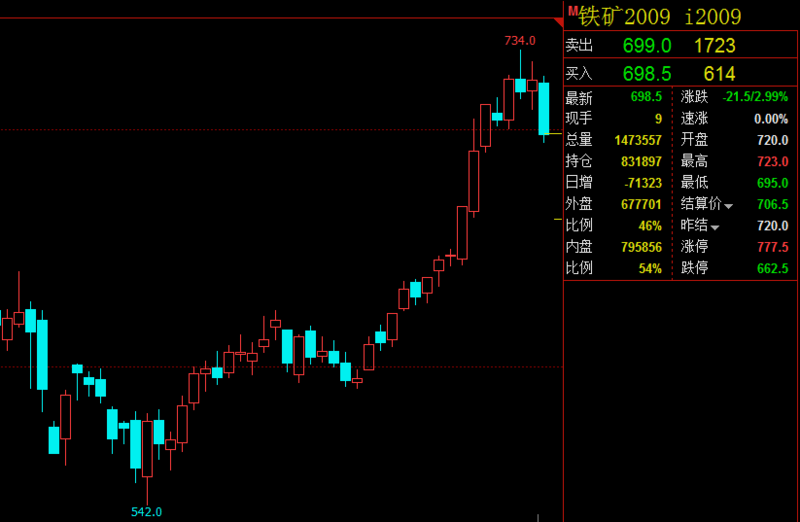
Early iron ore pulled up too sharply, touching the pressure level pullback. Since the opening of the two sessions last week, iron ore futures have risen rapidly, rising from 647 yuan / ton on May 14 to a peak of 734 yuan / ton on the 22nd, an increase of more than 13%. Although the Tangshan municipal government suddenly issued a notice to adjust the management and control measures in May, releasing a signal to relax production restrictions and low inventory support, the sharp increase in mineral prices on the disk and the negative impact of macro policies have led to a pullback in expected prices.

The shipments of foreign mines have soared, and the pressure of supply shortage has been alleviated. SMM tracking data show that the current period of incoming cargo is expected to be 13.37 million tons, a month-on-month drop of 140000 tons. In this period, the ship-to-ring ratio increased in Tangshan area and decreased in Shandong area. However, during the period, Australia's port departures increased by 1.62 million tons compared with the same period last year, an increase of 3.16 million tons, or more than 20%. Brazil's port departures also increased by 810000 in the current period compared with the previous period.

During the two sessions, a number of deputies and committee members proposed to increase domestic iron ore production and scrap consumption, which is bad for ore prices. Tan Chengxu, chairman of Angang, suggested supporting the development of domestic iron ore and setting up a development support fund; he Wenbo, member of the CPPCC National Committee and secretary of the Party Committee of the China Iron and Steel Association, suggested that the imported mineral price is contrary to the steel price, and the iron ore pricing mechanism needs to be adjusted urgently. Increase the recycling of scrap resources; Li Lizhang, deputy to the National people's Congress and chairman of Minguang of Sangang: promoting the High-quality Development of the Iron and Steel Industry

Scrap refers to the iron and steel scrap that does not become a product in the production process of the iron and steel plant (such as trimming, cutting head, etc.) and the iron and steel materials in the equipment and components scrapped after use. The composition of steel is called scrap; the composition of pig iron is called scrap, collectively referred to as scrap. At present, the total amount of scrap produced in the world every year is 3 to 400 million tons, accounting for about 45% of the total steel output, of which 85% is used as steelmaking raw materials and 10% is used for casting, ironmaking and recycled steel. At present, the arrival volume of scrap steel is decreasing, and the transaction performance is weakening, but recently, the prices of billets and finished materials have risen sharply, as well as the output of hot metal continues to rise, there is a strong support for scrap, steel mills have made profits and hot metal production has increased, and raw material prices have generally risen.

Overall, the current policy news is mainly negative iron ore, coupled with a pullback after the rally, short-term iron ore from strong to weak. But in terms of fundamentals, there is nothing wrong with the demand side, and it has mainly followed the mature operation in the near future. If steel demand remains strong, iron ore should still have a chance to rebound in June.

SMM "combination of period and present" training course

Registration contact: Lu Qingping, Iron and Steel Division of SMM

Tel: 021mur51595781 / 187MUE 1777MUE 4590
Declaración de Fuente de Datos: Excepto la información disponible públicamente, todos los demás datos son procesados por SMM basándose en información pública, comunicación de mercado y confiando en el modelo de base de datos interna de SMM. Son solo para referencia y no constituyen recomendaciones para la toma de decisiones.

Para cualquier consulta o para obtener más información, por favor contacte: lemonzhao@smm.cn
Para más información sobre cómo acceder a nuestros informes de investigación, contacte con:service.en@smm.cn
Noticias relacionadas
Australia revisa los derechos antidumping sobre el acero galvanizado de India, Malasia y Vietnam ante la preocupación por el zinc
11 Sep 2026 18:30
Australia revisa los derechos antidumping sobre el acero galvanizado de India, Malasia y Vietnam ante la preocupación por el zinc
Leer más
Australia revisa los derechos antidumping sobre el acero galvanizado de India, Malasia y Vietnam ante la preocupación por el zinc
El 9 de septiembre de 2026, Australia inició su segunda revisión por extinción de las medidas antidumping sobre la chapa de acero galvanizado procedente de India, Malasia y Vietnam, y abrió por separado una revisión por extinción de las medidas compensatorias sobre las importaciones procedentes de India. La revisión abarca el período de julio de 2025 a junio de 2026, y se prevé que el informe final se publique antes del 11 de febrero de 2027. Dado que el acero galvanizado es el principal sector de uso final del zinc, las medidas afectan directamente a los costes de exportación y a la competitividad, lo que podría repercutir en la demanda interna de zinc de Australia y en su cadena de suministro. El mantenimiento de los derechos ofrecería cierta protección a la capacidad nacional de producción de acero y de recubrimiento, mientras que su supresión podría aumentar las importaciones a bajo precio y afectar al consumo regional de zinc. El resultado final sigue sujeto a la determinación de las autoridades.
11 Sep 2026 18:30
El proyecto de expansión de 200 millones de dólares de JCC Hongyuan Copper busca aumentar la capacidad a 550.000 toneladas métricas para 2027
7 Sep 2026 15:43
El proyecto de expansión de 200 millones de dólares de JCC Hongyuan Copper busca aumentar la capacidad a 550.000 toneladas métricas para 2027
Leer más
El proyecto de expansión de 200 millones de dólares de JCC Hongyuan Copper busca aumentar la capacidad a 550.000 toneladas métricas para 2027
El proyecto de ampliación de 300.000 t/año de cátodos de cobre de JCC Hongyuan Copper, filial de Jiangxi Copper Corporation, entró el 4 de septiembre en la fase de aviso público previo a la aprobación de su evaluación de impacto ambiental, con una inversión total de aproximadamente 1.416 millones de yuanes. Está previsto que la construcción comience en septiembre de 2026 y concluya en diciembre de 2027. Una vez finalizado, la capacidad total de JCC Hongyuan pasará de 250.000 t a 550.000 t.
7 Sep 2026 15:43
El yen japonés se fortalece y el USD/JPY cae por debajo de 159 ante la especulación de intervención
3 Sep 2026 19:00
El yen japonés se fortalece y el USD/JPY cae por debajo de 159 ante la especulación de intervención
Leer más
El yen japonés se fortalece y el USD/JPY cae por debajo de 159 ante la especulación de intervención
[SMM Precious Metal Express] El yen japonés se disparó bruscamente durante la sesión del miércoles, con el USD/JPY cayendo por debajo de 159 y cerrando con una baja del 0,92% en 158,69, lo que desató especulaciones sobre una intervención cambiaria japonesa. El índice del dólar también cayó con fuerza, y un entorno de dólar más débil brindó soporte a los metales preciosos.
3 Sep 2026 19:00