(preview version) [SMM Review] how may Babu China Metallurgical Ruimu Project develop in the later stage when it is hindered by environmental issues?

Publicado: Oct 24, 2019 13:46 (GMT+8)

SMM10, March 24: it is reported that the Ramu nickel mine in (Madang), Madang province, has been closed after weeks of dispute over a mud leak into (Basamuk Bay) in Bassamuk Bay, Papua New Guinea. On Friday, the government, through its mining regulator, the Mineral Resources Administration ((MRA)), ordered the closure of Ramu Nico's operation of the (Basamuk) processing plant in Kina Basamouk from Monday.

It was reported in August that waste from the Papua New Guinea nickel plant owned by the China Metallurgical Company had leaked into nearby Basamouk Bay. The head of (MRA), the Papua New Guinea Mineral Resources Authority, said its officials, as well as officials from the Papua New Guinea Protection and Environmental Protection Agency ((CEPA)), had prepared a preliminary report on the incident. A Compan buffer tank at the Basamuk plant site overflowed about 200000 litres of raw mud. The mud overflowed and caused the sea water to change color. MCC, a subsidiary of MinMetals, is responsible for building and operating the plant, which produces nickel wet intermediates and ships them to China for use in the battery industry of electric vehicles.

A source close to MCC said the incident had no adverse impact on the environment. "this has no effect on marine life and fish. The mining and environmental departments went there, but found no problems, and there was no need to say anything about it. However, Madang Governor Peter Sheean called the Basamuk Bay mud leak "the worst environmental disaster in the history of Papua New Guinea," according to a report in the country's Post-Courier newspaper on Monday.

Ruimu Nickel and Cobalt Management (China Metallurgical) Co., Ltd. is currently the world's largest producer of nickel wet intermediates, located in Papua New Guinea, built in 2006 and officially put into production in 2012. According to market data, Ruimu produced 35353 metal tons of nickel wet intermediate products in 2018, with a yield of 108.44%, especially 3236 tons of nickel in June, with a monthly yield of 116.9%, setting the best record for wet smelting of laterite nickel ores in the world, and the annual output of nickel and cobalt both entered the top ten ranks in the world. Most of the wet intermediate products produced by China Metallurgical Ruimu are sold to China. According to customs data, the amount of nickel wet intermediates imported from Papua New Guinea accounts for more than 50% of China's total imports of wet intermediates.
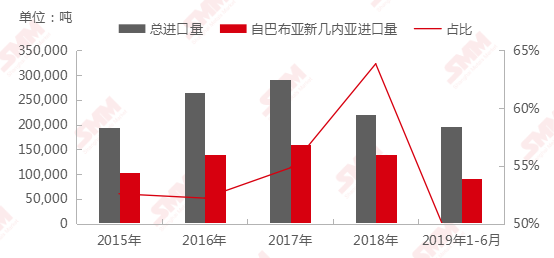
At present, at least 50% of the nickel raw materials for the production of nickel sulfate in China are provided by nickel wet intermediate products, and the production of nickel beans / powder in the past 2 months has a large loss, and only sporadic precursor factories are in use at present. Waste is difficult to obtain because of channels, the use of waste production enterprises are relatively stable. Therefore, if the production of China Metallurgical Ruimu is affected, it will affect the production of domestic nickel sulfate enterprises.

According to SMM research, it is true that local government officials have recently questioned the project on environmental issues, but the project is still in normal operation, and companies are starting to communicate with relevant government departments. In terms of actual impact, the output of the project is expected to be slightly affected next year.

According to SMM, as a benchmark project for the production of nickel wet intermediate MHP from laterite nickel mine, it can be seen from the previous leakage accident that the project really needs to be improved in terms of environmental protection, but it is not the best solution to solve the problem for enterprises to stop operating and stop production completely, and it is expected that rectification and reform plans will be properly discussed to allow the incident to develop on a normal track. For other enterprises that want to put into production of wet intermediate products, the cost pressure on environmental protection will be even greater in the future.

"Click to sign up for the recycled Metal Industry Summit Forum

Scan QR code and apply to join SMM metal exchange group, please indicate company + name + main business
 

Declaración de Fuente de Datos: Excepto la información disponible públicamente, todos los demás datos son procesados por SMM basándose en información pública, comunicación de mercado y confiando en el modelo de base de datos interna de SMM. Son solo para referencia y no constituyen recomendaciones para la toma de decisiones.

Para cualquier consulta o para obtener más información, por favor contacte: lemonzhao@smm.cn
Para más información sobre cómo acceder a nuestros informes de investigación, contacte con:service.en@smm.cn
Noticias relacionadas
【SMM Noticias Breves sobre Níquel】La ZCIT trae lluvias y tormentas eléctricas a las principales zonas de níquel de Filipinas
hace 6 horas
【SMM Noticias Breves sobre Níquel】La ZCIT trae lluvias y tormentas eléctricas a las principales zonas de níquel de Filipinas
Leer más
【SMM Noticias Breves sobre Níquel】La ZCIT trae lluvias y tormentas eléctricas a las principales zonas de níquel de Filipinas
La Zona de Convergencia Intertropical (ZCIT) está afectando actualmente a Palawan, las Bisayas y Mindanao, provocando condiciones nubladas, lluvias dispersas y tormentas eléctricas. Se espera que la ZCIT continúe afectando a Caraga, el norte de Mindanao y la mayor parte de las Bisayas hasta el 29 de septiembre, con lluvias y tormentas eléctricas que podrían prolongarse hasta el 2 de octubre debido a un sistema meteorológico adicional. Para la industria filipina del níquel, Palawan, Surigao y Homonhon podrían registrar lluvias intermitentes de moderadas a intensas, lo que podría ralentizar temporalmente el transporte por carreteras mineras, el embarque de mineral en barcazas y la carga de buques. Potencialmente, podría provocar inundaciones localizadas o deslizamientos de tierra en las zonas afectadas. SMM considera que la ZCIT representa actualmente un riesgo operativo relacionado con el clima más que una interrupción generalizada del suministro. Las lluvias intensas de corta duración podrían causar retrasos temporales en la minería y la logística, pero el impacto general dependerá de la intensidad y persistencia de las precipitaciones en cada sitio de extracción y carga.
hace 6 horas
【SMM Flash de Níquel】Mercado de mineral de níquel de Indonesia estable el 28 de septiembre
hace 6 horas
【SMM Flash de Níquel】Mercado de mineral de níquel de Indonesia estable el 28 de septiembre
Leer más
【SMM Flash de Níquel】Mercado de mineral de níquel de Indonesia estable el 28 de septiembre
El 28 de septiembre, el mercado de mineral de níquel de Indonesia se mantuvo estable, con precios sin cambios para los principales grados: Ni 1,2 %: 26,5 USD/tmh, sin cambios; Ni 1,3 %: 28,5 USD/tmh, sin cambios; Ni 1,4 %: 51,8 USD/tmh, sin cambios; Ni 1,5 %: 58,5 USD/tmh, sin cambios; Ni 1,6 %: 63,4 USD/tmh, sin cambios. En el mercado, las cuotas adicionales del RKAB para 2026 se están aprobando y liberando gradualmente, pero el total de la cuota adicional del año aún no se ha anunciado oficialmente. La atención del mercado se está desplazando gradualmente hacia la producción real de las minas y los envíos de mineral de níquel. Mientras tanto, la escasez de agua causada por El Niño sigue afectando a la industria del níquel en Célebes. Desde el 22 de septiembre, las tasas de operación de algunas líneas RKEF en IMIP han caído alrededor de un 30 %–40 %. SMM estima que, si el impacto persiste durante medio mes, la producción de NPI podría disminuir entre 50.000 y 70.000 toneladas en tonelaje físico, equivalente a aproximadamente 5.500–7.700 toneladas de níquel contenido. Hasta el 28 de septiembre, ninguna fundición de níquel en Célebes había declarado fuerza mayor.
hace 6 horas
Precio del níquel refinado SMM #1 cae a 125.700 yuanes/tm, la prima de Jinchuan sube
hace 7 horas
Precio del níquel refinado SMM #1 cae a 125.700 yuanes/tm, la prima de Jinchuan sube
Leer más
Precio del níquel refinado SMM #1 cae a 125.700 yuanes/tm, la prima de Jinchuan sube
El 28 de septiembre, el precio medio del níquel refinado SMM n.º 1 fue de 125.700 yuanes/tm, 1.200 yuanes/tm menos que el día de negociación anterior. En cuanto a las primas al contado, la prima media del níquel refinado Jinchuan n.º 1 fue de 3.800 yuanes/tm, 100 yuanes/tm más que el día de negociación anterior, mientras que el níquel electrodepositado convencional nacional osciló entre 0 y 500 yuanes/tm.
hace 7 horas