[quantitative Strategy] Wu Anjun: the key factor affecting commodity prices-M2 growth rate (4)

Published: May 30, 2019 22:41
Source: SMM

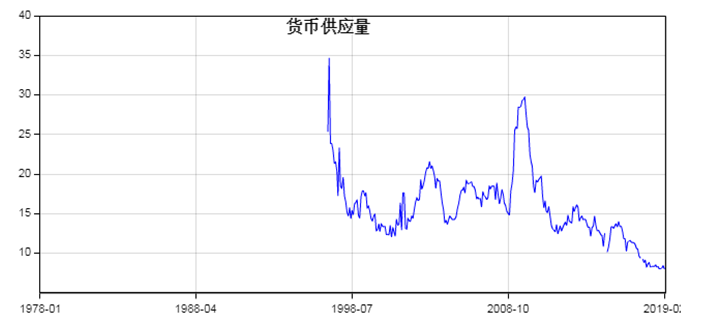
From the trend of M2, China's M2 growth rate has been in a high state before 1998, during which there have been several times of high inflation prices. From 1998 to 2008, M2 growth rate hovered between 12.3% and 20.8%, during which the economy was in a relatively stable stage of development. M2 growth soared from 15.02 per cent in September 2008 to 29.42 per cent in November 2009, apparently directly related to 4 trillion of government spending in the wake of the financial crisis. From 2013 to 2015, China's M2 growth rate slowed to 12.7% on average. Due to the implementation of the policy of "adjusting structure and removing production capacity", the overall economy is in a relatively stable stage. With M2 growth slowing from 10 per cent to 8.1 per cent in 2017, it is clear that the economy is in a weak phase. What is the relationship between M2 growth rate and the price of big merchants? Compared with nearly 40 futures varieties, it is found that when M2 growth rate develops from low to high, it is suitable to configure more futures varieties. On the contrary, when M2 growth rate decreases from high to low, more futures empty varieties should be allocated. So what is M2 growth rate?

M2 is an important indicator of money supply. M0, M1, M2, M3 are all important indicators to reflect the money supply. M1 reflects the real purchasing power in the economy; M2 reflects both the real and potential purchasing power. If M1 is growing faster, consumption and terminal markets are active; if M2 is growing faster, investment and intermediate markets are active. The central bank and the commercial banks may determine monetary policy accordingly. M1 is too high and M2 is too low, indicating that demand is strong, underinvestment, there is a risk of inflation; M2 is too high and M1 is too low, indicating that investment is overheated, demand is not strong, there is the risk of asset bubble. Generally speaking, M2 mainly measures the buying and selling activity of investment market and capital market in the economy. This index has an important impact on commodity prices, and a good grasp of this index can effectively predict the trend of futures prices.

Data Source Statement: Except for publicly available information, all other data are processed by SMM based on publicly available information, market communication, and relying on SMM‘s internal database model. They are for reference only and do not constitute decision-making recommendations.

For any inquiries or to learn more information, please contact: lemonzhao@smm.cn
For more information on how to access our research reports, please contact:service.en@smm.cn
Related News
Copper Price Decline Activated Some Buying, Shanghai Spot Copper Premiums Remained Under Pressure
1 hour ago
Copper Price Decline Activated Some Buying, Shanghai Spot Copper Premiums Remained Under Pressure
Read More
Copper Price Decline Activated Some Buying, Shanghai Spot Copper Premiums Remained Under Pressure
Intraday SHFE copper prices edged down, effectively activating some downstream buying interest. According to SMM, orders at some downstream processing enterprises increased by approximately 30% compared to the previous trading day, with part of the transactions concentrated around 103,500 yuan/mt, indicating that current price levels still held certain appeal for end-users. Inventory side, SMM data showed that social inventory in the Shanghai region was recorded at 181,800 mt, down 2,800 mt WoW from last Thursday; inventory in the Jiangsu region was 38,100 mt, up slightly by 1,200 mt WoW from last Thursday. Overall, a mild destocking trend was observed, with inventory pressure easing marginally. Market performance side, supplier offers were basically stable, and the transaction center showed no significant downward shift. Overall, supported by demand release stimulated by copper price pullbacks and mild destocking, spot prices against the SHFE copper 2606 contract are expected to remain at a discount tomorrow, continuing a generally stable trend.
1 hour ago
Declining Copper Prices Activated Some Buying, Shanghai Spot Copper Premiums Remained Under Pressure [SMM Shanghai Spot Copper]
2 hours ago
Declining Copper Prices Activated Some Buying, Shanghai Spot Copper Premiums Remained Under Pressure [SMM Shanghai Spot Copper]
Read More
Declining Copper Prices Activated Some Buying, Shanghai Spot Copper Premiums Remained Under Pressure [SMM Shanghai Spot Copper]
[SMM Shanghai Spot Copper] Intraday SHFE copper prices edged down, effectively activating some downstream buying interest. According to SMM, orders from some downstream processing enterprises increased by approximately 30% compared to the previous trading day, with some transactions concentrated around 103,500 yuan/mt, indicating that current price levels still hold certain appeal for end-users. Inventory side, SMM data showed that social inventory in the Shanghai area registered 181,800 mt, down 2,800 mt WoW from last Thursday; inventory in the Jiangsu area was 38,100 mt, up slightly 1,200 mt WoW from last Thursday. Overall, a mild destocking trend was observed, with inventory pressure easing marginally. From market performance, suppliers' offers remained basically stable, and the transaction center showed no significant downward shift. Overall, supported by demand release stimulated by copper price pullbacks and mild destocking, spot prices against the SHFE copper 2606 contract are expected to remain at a discount tomorrow, continuing a generally stable trend.
2 hours ago
Copper Prices Pulled Back with Increased Downstream Procurement, Overall Trading Slightly Better Than Last Friday [SMM South China Spot Copper]
2 hours ago
Copper Prices Pulled Back with Increased Downstream Procurement, Overall Trading Slightly Better Than Last Friday [SMM South China Spot Copper]
Read More
Copper Prices Pulled Back with Increased Downstream Procurement, Overall Trading Slightly Better Than Last Friday [SMM South China Spot Copper]
2 hours ago
[quantitative Strategy] Wu Anjun: the key factor affecting commodity prices-M2 growth rate (4) - Shanghai Metals Market (SMM)