Why do investors use copper as a hedge against inflation?

Published: Mar 7, 2018 16:31

SMM, March 7: every year, large amounts of copper are used to make a variety of goods to boost the global economy.

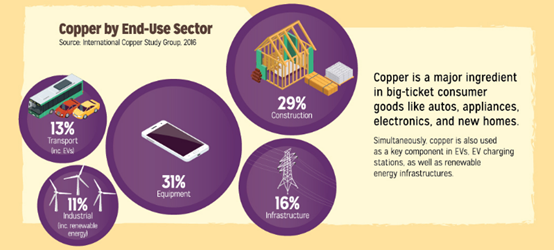
Copper is a major component of large consumer goods, such as cars (13 per cent), home appliances, electronics and new homes. At the same time, copper is widely used in many industrial areas, including telecommunications (31 per cent), utilities (16 per cent), construction (29 per cent) and industrial machinery (11 per cent).
The weathervane of the economy

The following figure shows the important role of copper in the economy and why it has become a famous economic vane.

Growing demand

When the economy is doing well and new projects continue to go into production, demand for copper will rise.

Rise in price

When demand rises, the price of copper goes up.

The market pays close attention to the price of copper

As a result of this historic relationship, analysts around the world are keeping a close eye on copper prices.

Dr. Copper.

Copper prices have long hinted at the direction of the economy, so it is known as a metal with a doctorate in economics.

In other words, while construction and manufacturing are growing, sales of copper products are also growing. But as an economic indicator, the link has other important implications, especially for investors who want to build a sound portfolio.

Rising prices; rising copper prices

When copper is interestingly linked to economic trends, its ability to protect portfolios from inflation is even more bizarre.

Rising prices come from overheating the economy and strong consumer spending-which is also one of the factors affecting copper prices. As a result of this link, research shows that for every 1 per cent increase in consumer prices since 1992, copper prices have risen by nearly 18 per cent.
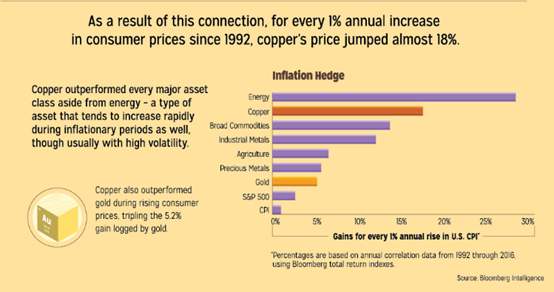
In a Bloomberg analysis, copper outperformed all major asset classes and, with the exception of energy as an inflation hedge, rose more than twice as much as gold during the rise in consumer prices.

Threaten the portfolio

Inflation can kill an unprotected portfolio.

Why? If inflation is higher than the rate of return on the portfolio, the portfolio actually produces a negative real return. (example: 2% growth-3% inflation =-1% return)

In other words, inflation can be a "hidden" threat that erodes returns, especially for fixed-income portfolios. The good news: holding copper or other commodities can prevent prices from rising.

Copper: the best way to fight inflation

In general, the use of other industrial metals is limited to specific areas, and precious metals are often driven by investor sentiment.

Copper is widely used in fields such as industry and technology, which makes it a bellwether for the economy as a whole.
Data Source Statement: Except for publicly available information, all other data are processed by SMM based on publicly available information, market communication, and relying on SMM‘s internal database model. They are for reference only and do not constitute decision-making recommendations.

For any inquiries or to learn more information, please contact: lemonzhao@smm.cn
For more information on how to access our research reports, please contact:service.en@smm.cn
Related News
"Fluctuating Copper Prices and Tight Supply Squeeze Secondary Copper Industry, Pressuring Upstream and Downstream"
16 hours ago
"Fluctuating Copper Prices and Tight Supply Squeeze Secondary Copper Industry, Pressuring Upstream and Downstream"
Read More
"Fluctuating Copper Prices and Tight Supply Squeeze Secondary Copper Industry, Pressuring Upstream and Downstream"
This week, against the backdrop of fluctuating upward copper prices, the secondary copper industry chain showed a complex situation in which extremely tight upstream raw material supply coexisted with persistent negative margins for downstream finished products. In the secondary copper rod market, SMM data showed that the operating rate fell further to 5.45% this week, down 0.38 percentage points MoM and 25.43 percentage points YoY
16 hours ago
Chile's Water Crisis Threatens Atacama's Copper and Lithium Mining Amid 14-Year Drought
Apr 3, 2026 19:10
Chile's Water Crisis Threatens Atacama's Copper and Lithium Mining Amid 14-Year Drought
Read More
Chile's Water Crisis Threatens Atacama's Copper and Lithium Mining Amid 14-Year Drought
Chile’s most pressing crisis at present is the issue of water resources. The Atacama Desert in Chile is one of the driest regions in the world and also the core area for copper and lithium ore extraction. The local area has experienced a drought for as long as 14 years, and reservoir storage has fallen to only about 30%. For miners, water resources are not a secondary issue, but an indispensable key production factor in such processes as ore processing, dust suppression, and equipment cooling. The decline in ore grade has further exacerbated the predicament
Apr 3, 2026 19:10
Trump Adjusts Metal Tariffs, Applies 50% Rate to Consumer Prices Under Section 232, Details Unclear
Apr 3, 2026 19:09
Trump Adjusts Metal Tariffs, Applies 50% Rate to Consumer Prices Under Section 232, Details Unclear
Read More
Trump Adjusts Metal Tariffs, Applies 50% Rate to Consumer Prices Under Section 232, Details Unclear
US President Trump adjusted the national security tariffs on imports of steel, aluminum, and copper, lowering the tariff rates on derivative products made from these metals, streamlining compliance procedures, and preventing the declared value of imports from being understated.A senior Trump administration official said that, under a proclamation signed by Trump, the US would continue to maintain a 50% import tariff on imports of metal commodities such as steel, aluminum, and copper pursuant to Section 232 of the Trade Act of 1974, but would apply this rate to the price paid by US consumers. It is currently unclear how the selling price—and the resulting tariffs—would be determined.
Apr 3, 2026 19:09
Why do investors use copper as a hedge against inflation? - Shanghai Metals Market (SMM)