China’s Aluminum Industry Has Gone Liquid… Including the Supply Chain

Publicado: Oct 18, 2016 18:23
A recent CRU note shined some useful light on how the reporting of aluminum inventory in China has been distorted by changes in the supply chain between smelters and downstream consumers. Our reportin

by Stuart Burns on OCTOBER 18, 2016

A recent CRU note shined some useful light on how the reporting of aluminum inventory in China has been distorted by changes in the supply chain between smelters and downstream consumers. Our reporting of primary metal inventory generally measures exchange stocks of ingot, sows and t-bars, and adds in an estimate for off-market stocks held by trade buyers and the reported inventory held by smelters.

It is a process that has generally held us in good stead for decades — with the one glaring omission of off-market stock and finance trade inventory running into millions of tons that we have no visibility on, but that’s another matter! Well add to that, says CRU, the changing nature of the Chinese aluminum manufacturing industry.

China’s Shadowy Aluminum Industry

Lured by cheap coal and, as a result, low-cost power, Chinese smelters have relocated in droves to the north and north east provinces, remote from traditional downstream clients on the east coast.

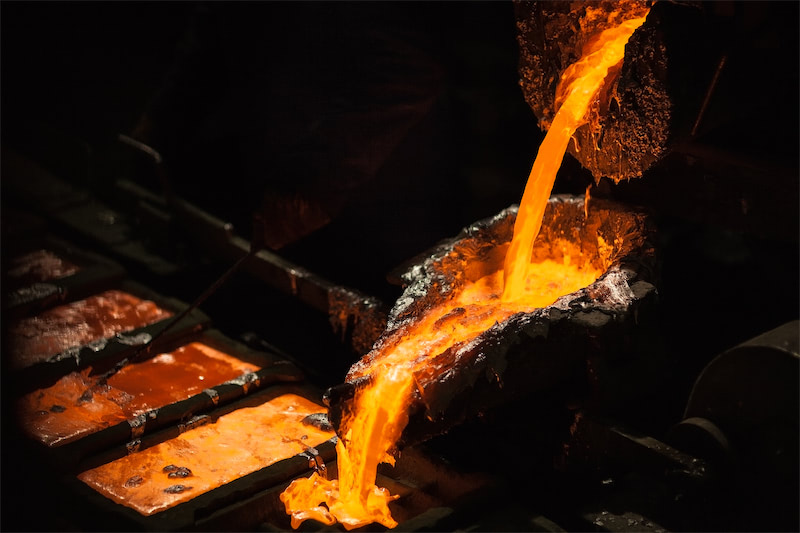
Is the future of aluminum liquid? Source: Adobe Stock/kybele.

Transportation costs are high and can be unreliable, particularly in winter. So, Chinese customers have come to their metal suppliers, relocating cast-house and direct casting facilities adjacent to the smelters. The products they, in turn, produce are higher value and better able to absorb those transportation costs. So far, so good.

The Innovation: Liquid Metal

What’s different about any that? you may ask. Haven’t manufacturers been taking advantage of proximity to suppliers for hundreds of years? Well, taking advantage of that adjacent location supplier and customer dynamic, today, has further cut costs by aligning production so the processors can take liquid metal — from which they make a range of continuously cast (CC) rods, slabs, sheets, and billets — that then go on to be rolled or extruded into downstream products. Indeed, because of the energy savings in not remelting ingot to liquid metal again this production process has direct environmental benefits that Beijing has not been slow to acknowledge and actively support.

According to CRU, liquid metal is expected to become the biggest output form from Chinese smelters in 2016, accounting for 41% of total aluminum production in China. The firm goes on to say other cast-house shape products from Chinese smelters — including billet, slab, foundry alloy, CC rod and CC strip — will account for 21% of total aluminum output in 2016. The proportion of aluminum ingot has decreased significantly over the last 10 years, to 38% from 82% in 2006 and 60% in 2011. Virtually all the new capacity introduced this decade has come in the form of cast-house products and liquid metal rather than ingot.

Inventory That’s Liquid

That makes the measurement of inventory harder if you are only counting ingot, sows and t-bars.

But that is not the only problem. Markets carefully scrutinize national and regional inventory swings, reading into them rises or falls in demand and judgements are made about the relative strength of the markets. CRU warns the shift to more remote smelting locations makes this process less reliable.

For example, in Xinjiang, the smelters have to rely on the railways to ship their metal. However, CRU says the available transport capacity by rail is not always enough. When fruit or cotton needs to be transported to other provinces from Xinjiang, less perishable or lower value products, including aluminum ingot, will simply not get moved. That results in a fall in inventory to consumers in southern or eastern markets, but the inventory drawdown is read by analysts as a rise in demand when, in reality, it is only a transportation bottleneck.

Nowhere has the shortening of the supply chain between smelter and consumer been as widely adopted as it is in China. Large centrally planned smelters such as those in Russia or new, integrated smelter-processor facilities such as those in the Middle East have adopted the same environmentally beneficial and cost-reducing processes but where examples have ranged up to at most one to two hundred thousand tons (and in most case only tens of thousands), in China those numbers are running at some12 million tons. As so often is the case in China, the sheer scale is transformational.
 

Declaración de Fuente de Datos: Excepto la información disponible públicamente, todos los demás datos son procesados por SMM basándose en información pública, comunicación de mercado y confiando en el modelo de base de datos interna de SMM. Son solo para referencia y no constituyen recomendaciones para la toma de decisiones.

Para cualquier consulta o para obtener más información, por favor contacte: lemonzhao@smm.cn
Para más información sobre cómo acceder a nuestros informes de investigación, contacte con:service.en@smm.cn
Noticias relacionadas
La producción de baterías de litio de China aumentará un 9 % en septiembre, impulsada por la demanda mundial de almacenamiento de energía
hace 14 horas
La producción de baterías de litio de China aumentará un 9 % en septiembre, impulsada por la demanda mundial de almacenamiento de energía
Leer más
La producción de baterías de litio de China aumentará un 9 % en septiembre, impulsada por la demanda mundial de almacenamiento de energía
Según datos de encuestas mensuales de múltiples cadenas industriales, se espera que los programas de producción de baterías de litio de China en septiembre superen los 330 GWh, lo que supone un aumento intermensual de aproximadamente el 9 %. Las celdas de almacenamiento de energía representan aproximadamente 130 GWh, casi el 40 % del total. El crecimiento del almacenamiento de energía proviene principalmente de proyectos a gran escala en el extranjero, con múltiples estaciones de almacenamiento en Oriente Medio, Europa y Estados Unidos apresurándose a conectarse a la red antes de fin de año. Los clientes extranjeros están adquiriendo de forma concentrada celdas de almacenamiento de gran capacidad de 314 Ah y superiores, y las líneas de producción existentes de los principales fabricantes de baterías están completamente reservadas hasta mediados de octubre.
hace 14 horas
Las ventas de vehículos de nueva energía en septiembre de 2026 aumentan un 45,6 % interanual y su cuota de mercado se acerca al 50 %
hace 14 horas
Las ventas de vehículos de nueva energía en septiembre de 2026 aumentan un 45,6 % interanual y su cuota de mercado se acerca al 50 %
Leer más
Las ventas de vehículos de nueva energía en septiembre de 2026 aumentan un 45,6 % interanual y su cuota de mercado se acerca al 50 %
Los datos de CAAM muestran que en septiembre de 2026 la producción y las ventas de vehículos de nueva energía alcanzaron 1,617 millones y 1,604 millones respectivamente, con un aumento interanual del 42,7 % y del 45,6 %. La cuota de vehículos de nueva energía sobre el total de ventas de vehículos nuevos alcanzó el 49,7 %. La producción y las ventas acumuladas de vehículos de nueva energía de enero a septiembre alcanzaron aproximadamente 12,6 millones, con una cuota de mercado cercana a la mitad. Las exportaciones de vehículos de nueva energía en septiembre fueron de 222.000 unidades, más del doble interanual. Los datos de CPCA muestran que las ventas minoristas nacionales de turismos de nueva energía en septiembre fueron de aproximadamente 1,296 millones de unidades, un 15,5 % más interanual, con una penetración mensual del 57,8 %, un nuevo récord.
hace 14 horas
El proyecto de aluminio de Ruijin, valorado en 135 millones de dólares, está cerca de completarse y se pondrá en marcha en noviembre.
hace 14 horas
El proyecto de aluminio de Ruijin, valorado en 135 millones de dólares, está cerca de completarse y se pondrá en marcha en noviembre.
Leer más
El proyecto de aluminio de Ruijin, valorado en 135 millones de dólares, está cerca de completarse y se pondrá en marcha en noviembre.
El proyecto de 150.000 t/año de placas, láminas y láminas delgadas de aluminio de Ruijin New Materials Technology Co., Ltd., que adquirió el terreno en abril y comenzó la construcción a finales de abril de este año, ha completado su taller n.º 1. La instalación de los equipos internos se encuentra en la etapa final. Se han instalado seis hornos de mantenimiento y seis hornos de fusión, y el montaje del laminador está en curso. El horneado de los hornos está previsto para finales de septiembre, la producción de prueba alrededor del 15 de octubre y la puesta en marcha formal se espera para noviembre. La inversión total es de aproximadamente 900 millones de RMB, con 300 millones de RMB previstos para este año.
hace 14 horas