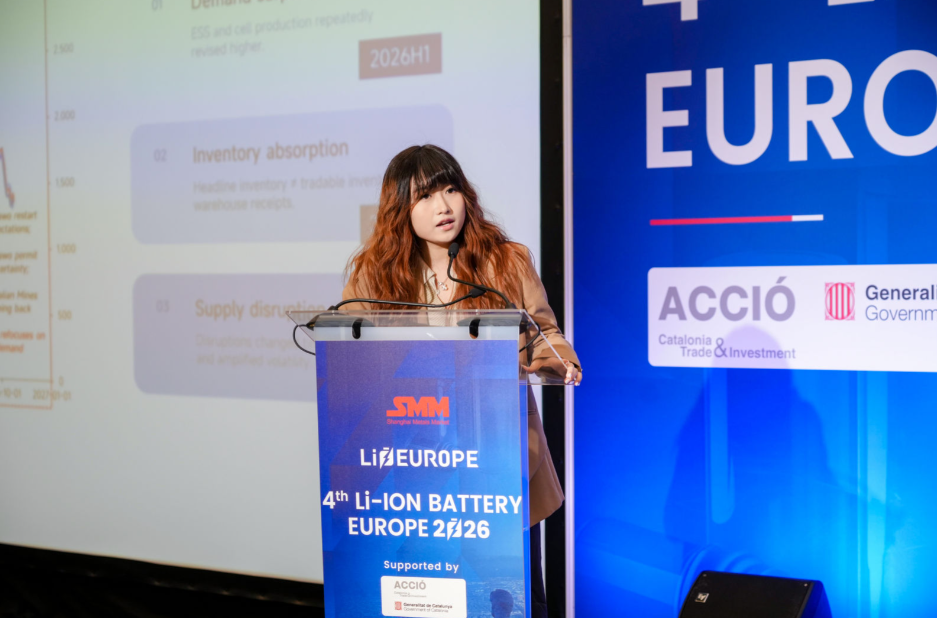
At the 2026 (4th) European Lithium Battery Summit hosted by Shanghai Metals Market (SMM) and supported by Catalonia Trade & Investment (ACCIÓ)Key Takeaways for the Global Lithium Market:
1. Demand remains resilient but increasingly concentrated
Energy storage systems are becoming the key source of lithium demand growth, while EV growth is normalizing as penetration rates mature. Demand remains supportive but is increasingly sensitive to project economics, policy, and lithium prices.
2.
The curve has already priced in the 2027 surplusForward prices are currently set almost entirely on the assumption of full commissioning of announced project pipelines. SMM's project-level model shows the 2027 surplus at just 105,000 mt LCE—about 3.6% of demand—and this is based on optimistic assumptions on both the supply and demand sides. Since both sides share the same baseline, what truly matters is the gap between them: a supply shortfall of just 3.6 percentage points relative to demand would completely erase the surplus.
3. Marginal pricing is shifting toward integrated economics
Low-cost brine and mature Australian mines remain firm, while high-cost lepidolite and independent toll processing smelting capacity constitute the primary supply response. Price support increasingly depends on resource costs and the profit distribution between miners and converters.
4. Expect volatility, not a new supercycle
Healthy demand and intermittent supply disruptions support the downside, while capacity growth and downstream price sensitivity cap the upside. The base case is a volatile, sideways-moving market with event-driven rebounds rather than a sustained structural bull market.
01 Where Are We in the Lithium Cycle?
Market Review: The Third Cycle Driven by ESS
According to SMM spot price observations, lithium prices have experienced three distinct upward cycles over the past decade or so.
First cycle (the end of 2015–early 2018): Stimulated by China's NEV subsidy policies, power battery demand expanded rapidly, and lithium carbonate prices climbed sharply from H2 2015, staying high from 2017 to early 2018. In 2019, a significant reduction in subsidies, combined with concentrated supply releases, led to a deep pullback in lithium prices.
Second round (H2 2020-end 2022): China's NEV market gradually shifted from policy-driven to endogenous growth, and with supply-side constraints, lithium prices continued to rise, peaking in H2 2022 before a sharp correction from 2023. On the policy front, NEV purchase subsidies officially ended in 2023, while vehicle purchase tax reduction and exemption continued (exempt from 2024 to 2025, halved from 2026 to 2027).
Third round (H2 2025-present): With EV demand growth slowing, energy storage demand has taken over as the core growth engine. In H1 2026, the price center shifted notably higher from the previous year's low, briefly surging above 200,000 yuan/mt in May. Meanwhile, supply-side disruptions such as Zimbabwe's lithium concentrates export ban and the commissioning pace of domestic mines also provided support for prices.
2026 is not just a rebound triggered by supply disruptions
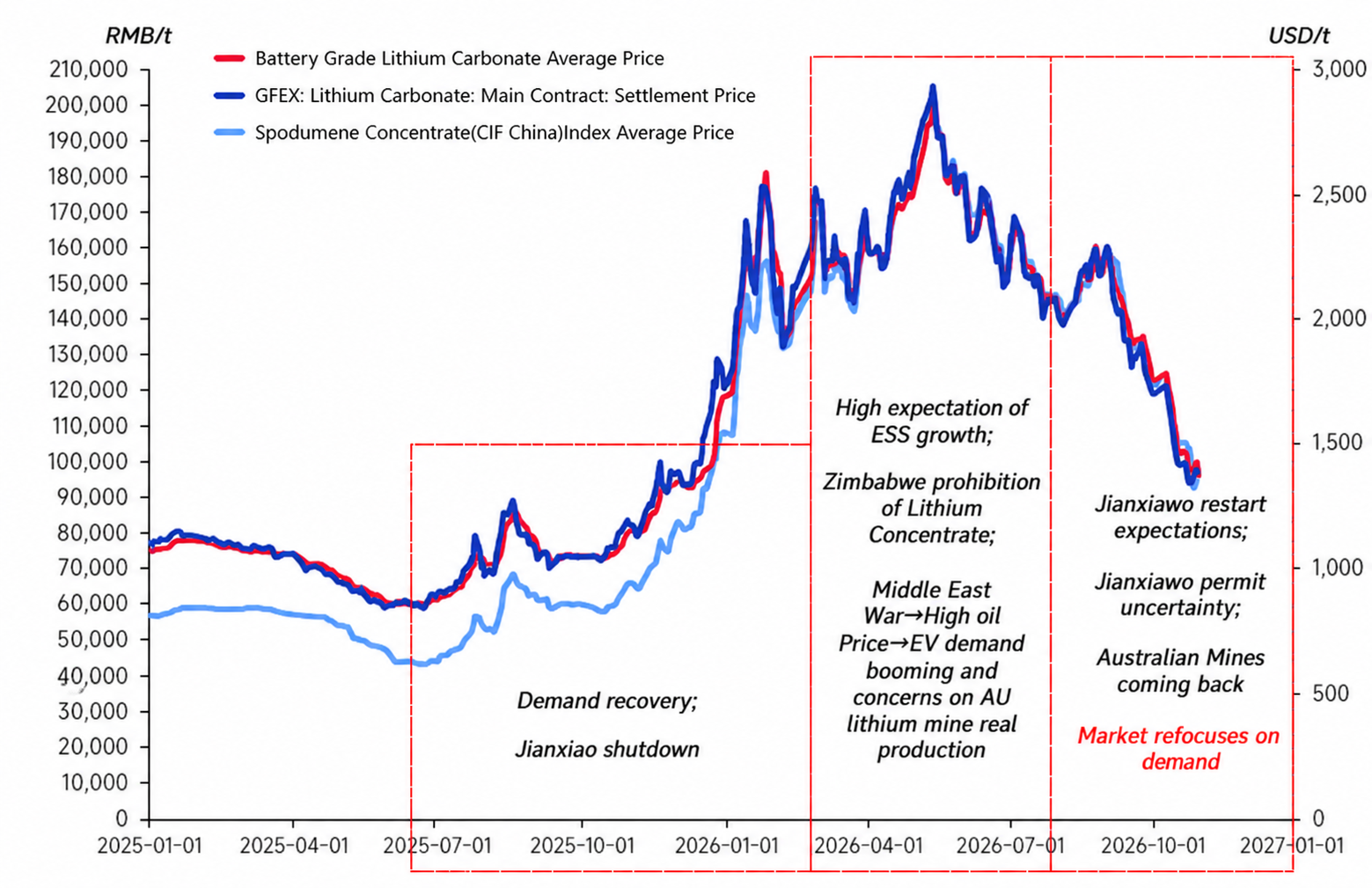
Supply disruptions explain the price surge, while demand and inventory explain the higher price floor.
01 Demand surprise - H1 2026
Energy storage and battery production were repeatedly revised upward.
02 Inventory absorption - H2 2026
Total inventory # tradable inventory # warrants.
03 Supply disruptions - 2026
Disruptions changed time expectations and amplified volatility.
02 Demand outlook: Standalone ESS becomes the new growth engine
China's NEV subsidies are steadily being phased out, Europe's subsidies are gradually returning, the US has almost completely eliminated all subsidies, while other regions are seeing surging NEV demand amid rising oil prices.
SMM expects that from 2026 to 2030, global NEV annual sales will grow at a CAGR of around 10%, BEV passenger car sales will grow at a CAGR of around 8%, and the global NEV penetration rate is forecast to reach around 35% by 2030.
Average vehicle battery capacity depends on the sales mix, which together with sales determines EV battery demand
SMM believes that power battery demand depends on two variables: NEV sales and average vehicle battery capacity; and average vehicle battery capacity itself is determined by the sales mix. In the Chinese market, SUVs account for 55% of passenger NEV sales, while A00-class mini cars account for only 4%. The large-vehicle-dominated mix itself pushes up average battery capacity. This trend is accelerating: in June 2026, PHEV vehicle battery capacity rose 42% YoY, BEV model vehicle battery capacity rose around 15% YoY, and overall NEV average battery capacity grew 28%.
Extending this trend to 2030, SMM expects global power battery demand to grow from around 1,700 GWh in 2026 to around 3,400 GWh, with sales growth being the primary driver of demand, and rising vehicle battery capacity being the secondary driver of power battery demand.
In addition, from the perspective of installation mix, SMM expects that even if sales growth slows, the rise in vehicle battery capacity driven by vehicle mix upgrades will continue to support battery demand; the source of growth is shifting from "selling more vehicles" to "installing more per vehicle."
The energy storage market is mainly policy-driven, while AIDC is the future story
According to SMM forecasts, current energy storage market demand growth is mainly driven by policies in various countries. From 2026 to 2030, global ESS battery demand is expected to grow at a CAGR of 22%.
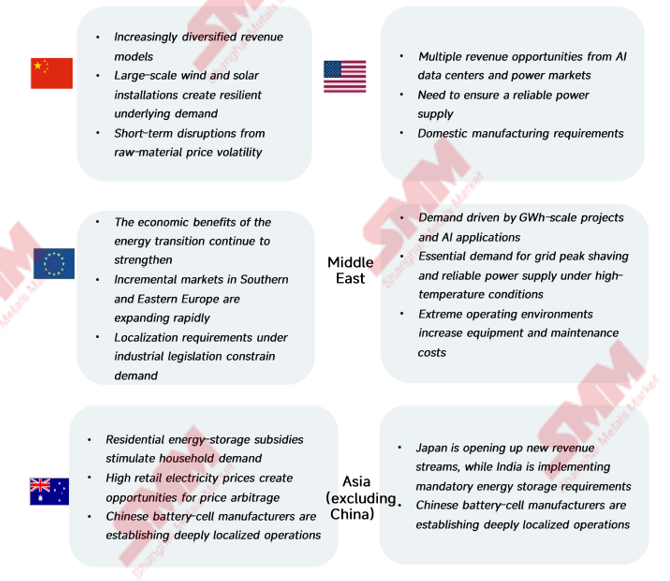
Energy storage becomes the fastest-growing segment
SMM forecasts the production growth of global lithium-ion battery cells, power battery cells, ESS battery cells, and consumer battery cells, expecting ESS battery cells to be the fastest-growing segment among the four, with growth of around 23%. Although other battery cell production also shows year-by-year growth, their growth rates lag behind the energy storage segment.
What is priced in, what is not, and what could break market expectations
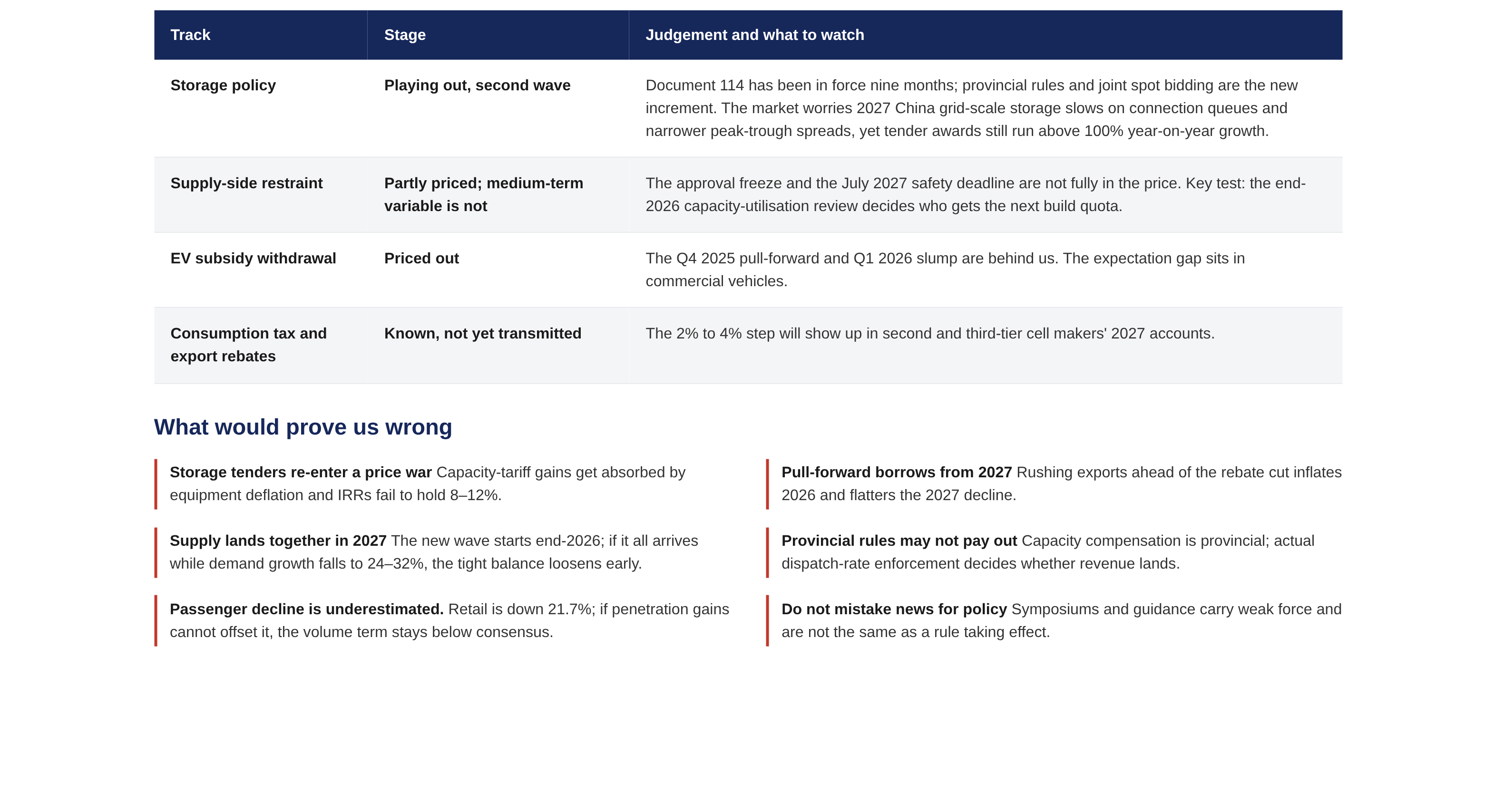
Technology evolution is reshaping lithium demand; sodium will not threaten lithium market demand
SMM expects that technology evolution is reshaping rather than weakening lithium demand - by 2030, LFP batteries are still expected to dominate the market with a share of around 70%. New technologies such as solid-state batteries and LMFP are beginning to penetrate but remain limited in volume, and sodium-ion battery share will only rise to 4%, far from enough to threaten lithium's market position.
03 Resource supply: Can upstream supply respond quickly?
Absorbing a 3.6 percentage point supply gap in 2027; absorbing 6.9 percentage points in 2026
Both sellers and buyers in the lithium market from 2026 to 2027 are optimistic, so adjusting both simultaneously barely affects the balance - only the gap between the two matters.
Where does the growth come from:
Among new supply in 2026, spodumene and brine contribute the main growth, while lepidolite supply declines. In 2027, lepidolite turns to an increase of around 130 kt - accounting for 24% of the full-year growth, and is also the single segment most affected by policy.
Adjusting supply and demand simultaneously is futile
Both sellers and buyers are optimistic, so cutting one side alone is meaningless. If supply and demand are both cut by 10%, the 2027 oversupply eases only slightly, with limited overall impact on supply and demand. What truly determines the balance is the difference in actual delivery: every 1 percentage point of supply shortfall corresponds to a balance change of 23 kt in 2026 and 29 kt in 2027.
2027 can only tolerate half the margin of error of 2026
It should also be noted that this surplus buffer is thinning rapidly. Calculations show that in 2026 the market can absorb a 6.9 percentage point supply gap without falling into shortage, but by 2027 this tolerance shrinks to only 3.6 percentage points - a halving - because the demand base is expanding, and the same relative deviation corresponds to a larger absolute volume. If Zimbabwe's concentrates export ban is strictly enforced from January 1, 2027, it would cause a supply loss of around 159 kt (5.4 percentage points), exceeding the entire 2027 tolerance, and the market would shift directly from surplus to shortage.
The sources of flexibility vary by region - some have none at all
SMM forecasts the lithium resource supply mix for China, South America, Australia, Africa, and other countries and regions, with specific analysis as follows:
South America: No flexibility, only the baseline
In 2027, South America's lithium resource production is around 670,000 mt, with 90% of total production coming from salt lake brine. Brine relies on evaporation ponds, with a production adjustment cycle of 12-24 months, meaning that regardless of price fluctuations or policy deadline changes, 2027 production can hardly be altered. In other words, South America is the market's "baseline," never a variable for adjustment - this is both a source of stability and a limitation: when facing shortages, it cannot fill the gap.
Australia: The truly effective adjustment valve
Australia's production of around 700,000 mt in 2027 is all short-cycle resources (all raw materials except brine), and only 4% comes from assets not yet in production, making it the most reliable data set. Its flexibility is evident: Mt Cattlin has zero production before 2027, while Ngungaju and Finniss carry the production resumptions growth. When the market needs to contract or expand, Australia is the only supply source that can respond quickly.
Africa and China: Variables bearing construction risk
Of total 2027 production across all regions, around 420,000 mt comes from assets not yet in production, accounting for about 14% of total production, with two-thirds located in Africa and China. This portion of production inherently carries "construction risk": both commissioning timing and ramp-up pace are uncertain. Compared with the tolerance calculations above, if just 25% of this 420,000 mt of production falls short, it would be enough to wipe out all of the 2027 surplus - in other words, with a tolerance of 3.6 percentage points, the commissioning progress in Africa and China is the single largest variable determining the direction of the 2027 balance.
Two assets carry a quarter of 2027 new capacity
According to SMM forecasts, under the optimistic 2027 supply scenario, global LCE additions are expected to reach around 558,000 mt, with growth highly concentrated - the Jianxiawo and Manono projects alone account for 26%, and the top ten projects account for 62%. At the regional level, China will contribute around 42% of 2027 new capacity, but nearly 40% of its growth is tied to the single Jianxiawo project, while Yichun lepidolite mines will contribute the main decline. In Africa, 30% of production comes from assets not yet in production, making it the region with the highest concentration of ramp-up risk; only Australia's figures are almost entirely composed of operating mines, with the highest certainty.
04 Lithium chemicals balance and inventory: Strong demand continues to absorb high supply
China lithium carbonate supply-demand balance forecast, September 2026-September 2027
SMM reviews and forecasts the domestic lithium carbonate market supply-demand balance from September 2026 to September 2027. From September to December 2026, under the influence of year-end downstream stockpiling expectations and production cuts or halts at salt lake enterprises due to severe cold weather, the domestic lithium carbonate market is expected to show tight supply. From January to March 2027, under the influence of factors such as the Chinese New Year holiday, the market will show a tight balance. From May to September 2027, the lithium carbonate market will shift back to tight supply. For the full year 2027, the market will show a slight tight supply situation.
Global lithium carbonate market supply-demand balance forecast, September 2026-September 2027
SMM expects that from September to December 2026, the global lithium carbonate market will show a supply shortage. At the beginning of 2027, it will enter an oversupply situation, reaching the highest surplus level in February, after which the supply surplus will narrow rapidly. From September to December 2027, the global lithium carbonate market is expected to shift back to tight supply.
Overall, from 2026 to 2027, the global and Chinese lithium carbonate markets are expected to show varying degrees of tight supply, with 2026 showing a clear tight supply situation. In 2027, this situation will ease slightly, but the overall market will remain in undersupply.
05 Pricing mechanism and price outlook: How supply-demand balance, inventory, cost, and futures shape prices; what determines the lithium price ceiling
China's lithium prices are driven by fundamentals, anchored by costs, and amplified by expectations
Price = direction (fundamentals) + floor (cost curve and discipline) + deviation (inventory and expectations).
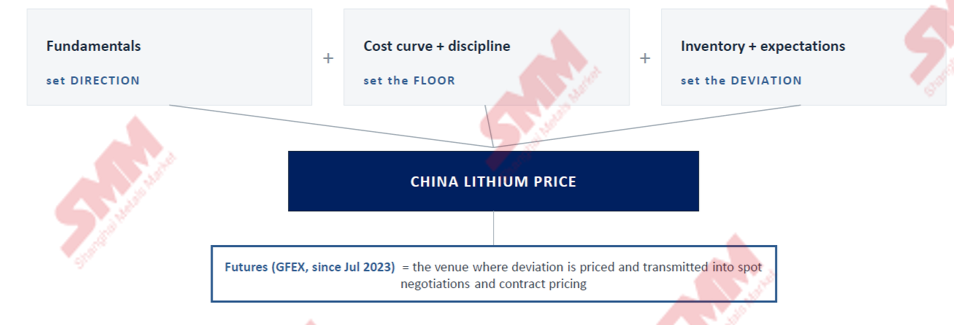
Salt inventory fell 42%, but port ore inventory doubled
According to SMM data, from April 30, 2026 to October 22, 2026, China's weekly lithium carbonate inventory fell by about 42%, but from the week of May 15, 2026 to October 23, 2026, port ore inventory doubled.