SMM News, Nov 7:
Metals market:
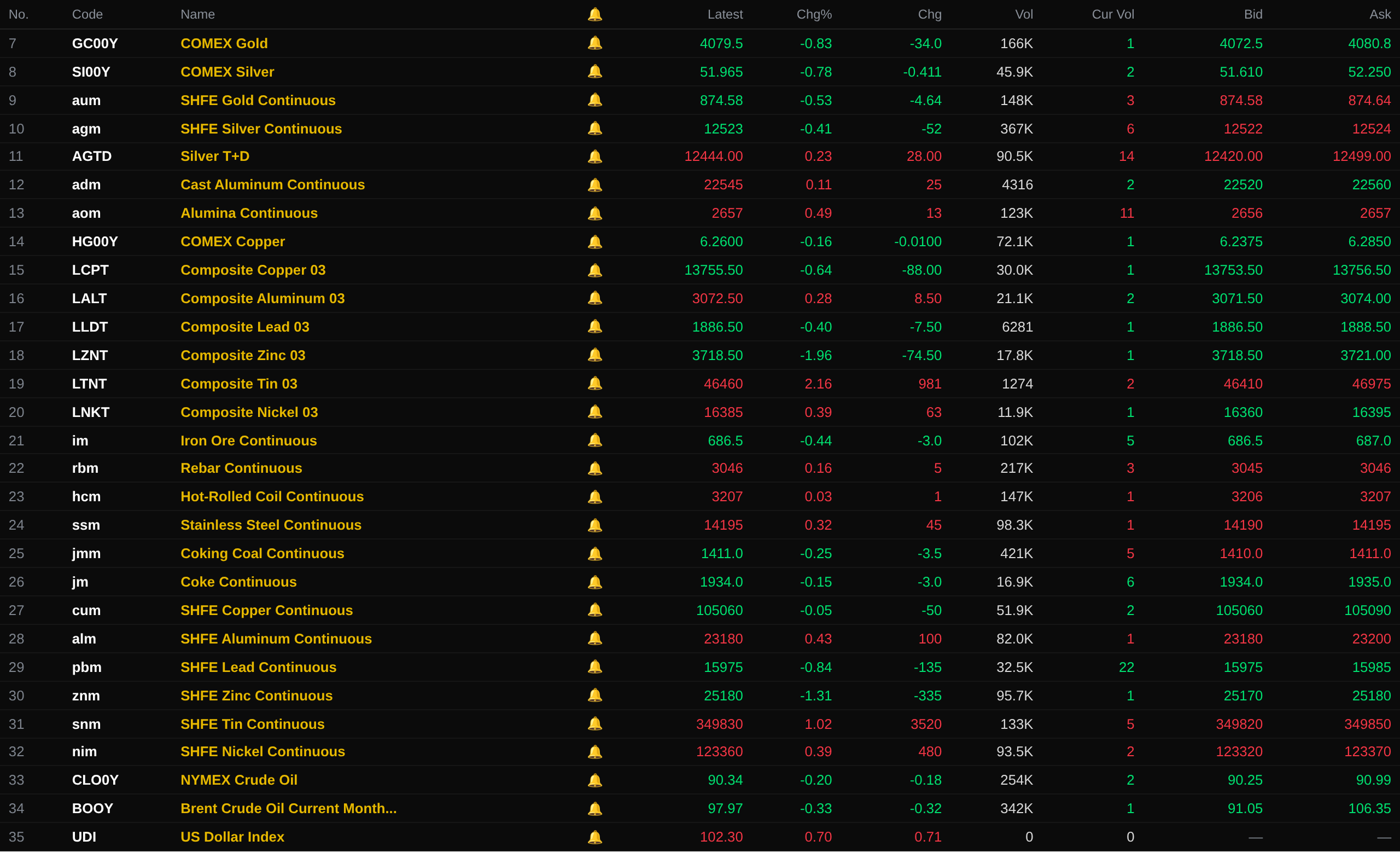
Overnight, base metals in the domestic market showed mixed performance. SHFE copper edged down 0.05%, and SHFE aluminum rose 0.43%. SHFE lead fell 0.84%. SHFE zinc dropped 1.31%, while SHFE tin gained 1.02%. SHFE nickel rose 0.39%. In addition, the most-traded alumina futures contract rose 0.49%, and the continuous casting aluminum contract increased 0.11%.
Overnight, ferrous metals showed mixed performance. The continuous stainless steel contract rose 0.32%. Iron ore fell 0.44%. Rebar and hot-rolled coil both edged up, with gains within 0.2%. For coking coal and coke: the most-traded coking coal contract fell 0.25%, and the most-traded coke contract declined 0.15%.
Overnight, in overseas metals, LME base metals showed mixed performance. LME copper fell 0.64%, while LME aluminum rose 0.28%. LME lead slipped 0.4%. LME zinc dropped 1.96%. LME tin climbed 2.16%. LME nickel rose 0.39%.
Overnight, precious metals:COMEX gold fell 0.83%; COMEX gold closed higher on the weekly chart, up 4.63% for the week. COMEX silver fell 0.78%; COMEX silver rose on the weekly chart, up 5.46% for the week. Overnight, the continuous SHFE gold contract fell 0.53%, while SHFE gold rose 0.92% on the weekly chart. The continuous SHFE silver contract fell 0.41%; SHFE silver extended its weekly decline to seven consecutive weeks, with a weekly drop of 0.06%.
As of 8:03 on Nov 7, overnight closing prices:
Macro front
China:
[State Council executive meeting: Accelerate the implementation progress of major projects and the “six networks” construction]Li Qiang chaired an executive meeting of the State Council. The meeting noted that it is necessary to deeply grasp the Party Central Committee’s scientific judgment on the economic situation and the requirements for the next steps in work deployment, strengthen confidence in development, effectively enhance the sense of responsibility and urgency, and solidly advance the implementation and effectiveness of various policies to ensure the completion of the main annual targets and tasks for economic and social development. Efforts should continue to focus on key areas, accelerate the implementation progress of major projects and the “six networks” construction, support enterprises in expanding investment in equipment upgrades and intangible assets, strengthen online-offline and urban-rural linkages in consumption, and smooth the virtuous cycle between investment and consumption. (Jin10 Data APP)
[State Council executive meeting: Improve the capital market stabilization mechanism, enhance the stock market’s intrinsic stability, and promote the steady and sound development of the capital market]Li Qiang chaired an executive meeting of the State Council. The meeting noted that it is necessary to make full and effective use of various policy-based funds, and disburse in a timely and full manner all types of payments involving grassroots-level entities and enterprises, so as to better leverage the policy effects of fiscal-financial coordination in boosting domestic demand. It is necessary to solidly carry out work on stabilizing employment, preventing risks, and ensuring people’s livelihoods, strengthen employment services for key groups, and provide employment support to graduates in difficulty from households lifted out of poverty, minimum-living-standard households, and zero-employment households. We will take solid and detailed steps to identify and rectify safety production risks and hazards, and resolutely prevent the occurrence of major and particularly serious accidents. We will continue to defuse risks in areas such as local government debt and small and medium-sized financial institutions. We will improve the market-stabilising mechanisms of the capital market, strengthen the intrinsic stability of the stock market, and promote the stable and sound development of the capital market. We will strengthen efforts to ensure supply and stabilise prices and provide assistance to people in difficulty, accelerate post-disaster recovery and reconstruction in affected areas, and earnestly ensure the resettlement and living support of disaster-affected people. We should carefully study the economic work approach for next year, strengthen cross-year policy coordination, and promote sustained economic improvement. (Jin10 Data APP)
[Beijing: By 2030, the total urban housing stock will remain stable, and the supply structure will be better aligned with changes in demand]Recently, the Beijing Municipal Commission of Housing and Urban-Rural Development issued the Beijing Municipal Housing Development Plan for the 15th Five-Year Plan Period. The Plan proposes that by 2030, the total urban housing stock will remain stable, the supply structure will be better aligned with changes in demand, the supply system combining government support and the market will be further improved, the real estate market will continue to operate steadily, the housing system that encourages both renting and buying will continue to be improved, the spatial layout of housing will continue to be optimised, the functions of work, residence, commerce and services will be more integrated, urban renewal in the residential sector will be vigorously advanced, and more families will live in safe, comfortable, green and smart "good houses". By 2035, efforts will be made to achieve a higher level of livability, and housing development will be more closely coordinated with factors such as population, industry, land, transportation and ecology. During the 15th Five-Year Plan period, the city will accelerate the establishment of a new model for real estate development, improve the basic systems for real estate, and continue to optimise the structure and pace of supply of residential land and commercial housing. (Jin10 Data APP)
[Sichuan: Support private enterprises in participating in the development and utilisation of strategic mineral resources such as lithium ore, phosphate ore, vanadium-titanium magnetite and potash ore]The Sichuan Provincial Development and Reform Commission issued the Work Measures for Promoting High-Quality Development of Private Investment in Sichuan Province. Among them, it proposes to support private capital in participating in mineral resource development. Private enterprises are supported in participating in the development and utilisation of strategic mineral resources in the province, such as lithium ore, phosphate ore, vanadium-titanium magnetite and potash ore. In the transfer of mining rights, private enterprises are supported in obtaining mining rights through market-based means in accordance with laws and regulations. Private enterprises are supported in cooperating with state-owned enterprises to jointly participate in market-based bidding for mining rights within and outside the province, and to deepen upstream and downstream industrial collaboration through means such as equity transfer and cross-shareholding. Private enterprises are encouraged to participate in geological surveys of strategic minerals in accordance with laws and regulations, and after results are achieved and successfully transferred, rewards and incentives will be given as prescribed. (Jin10 Data APP)
[GFEX releases lithium hydroxide futures and lithium hydroxide options contracts and related rules]GFEX announced that the Guangzhou Futures Exchange Lithium Hydroxide Futures Contract, the Guangzhou Futures Exchange Lithium Hydroxide Options Contract, and the Guangzhou Futures Exchange Detailed Rules for Lithium Hydroxide Futures and Options Business have been reviewed and approved by the Board of Directors of Guangzhou Futures Exchange and reported to the China Securities Regulatory Commission, and are hereby released for implementation from the date of release. The listing and trading schedule for lithium hydroxide futures and lithium hydroxide options contracts will be notified separately.
US dollar:
The overnight US dollar index rose 0.7% to 102.3. Weekly performance: the US dollar index rose for a second consecutive week, gaining 0.32% for the week.
US nonfarm payrolls increased by 165,000 in October, far exceeding expectations of 65,000, while the unemployment rate fell to 4.1%. The strong jobs data pushed the probability of a 25-basis-point rate hike by the US Fed in December to nearly 80%, and the US dollar index rose 0.71% to 102.31, its biggest one-day gain since 17 June. Fed officials Williams, Musalem and Daly all stressed that inflationary pressures persist. (Jin10 Data APP)
San Francisco Fed President Mary Daly said the Fed is prepared to raise rates further if needed, and that monetary policy still needs to be tightened, though how much more tightening is required and when to act will depend on further information. Daly stressed that the Fed must proceed cautiously. (Jin10 Data APP)
Fed official Williams said in his latest remarks: "The US labour market is currently exceptionally stable and solid. The resilience of the US economy is remarkable, and growth has strengthened somewhat.Inflation in the US is currently too high and has persisted for too long, and it must be brought down to 2% in a timely manner. Energy prices are feeding through to airfares in the expected way, and we have also seen a limited impact of artificial intelligence on prices of items such as chips. We have already witnessed the transmission of tariff effects, and that impact is now largely behind us."
In addition, the US Bureau of Labor Statistics: August nonfarm payrolls were revised up from an increase of 133,000 to an increase of 186,000, an upward revision of 53,000; September nonfarm payrolls were revised up from an increase of 29,000 to an increase of 60,000, an upward revision of 31,000. After these revisions, nonfarm payrolls for August and September combined were 84,000 higher than previously reported. (Jin10 Data APP)
However, some analysts noted that investors are generally fatigued by the frequent and substantial revisions to US employment data. That also explains why the Treasury market was relatively mediocre today. The US two-year Treasury yield is currently around 4.53%, only a few basis points higher than before the data release. RBC US rates strategist Izaac Brook said: "I think this much-stronger-than-expected jobs report did not release much 'new' signal. It again shows that non-farm payrolls data remain highly volatile, while the labour market overall remains healthy—something the market already knew. (Jin10 Data APP)
White House National Economic Council Director Hassett said in his latest remarks: “We are studying the strong job growth over the past three months. Even if the data center sector slows down, the economy is still expected to achieve robust growth. Data centers still have ample room to grow. Trump respects localities that do not want data centers built. Inflation should slow down. We will respect the judgement of Fed Chairman Warsh and the US Fed.” (Jin10 Data APP)
The University of Michigan preliminary survey shows that US consumer sentiment edged up about 6%. Expectations for personal finances and business conditions improved across multiple areas, but the improvement was concentrated among independent voters. Although confidence among low-wealth and middle-wealth consumers rebounded, confidence among high-wealth consumers holding large stock positions fell 5% after recent sharp stock market fluctuations. In addition, consumer comments show that concerns about an AI bubble are intensifying. However, compared with AI-related concerns, the cost of living remains the top concern for consumers. About 57% of respondents spontaneously mentioned that high prices have eroded their living standards, the highest level since May this year and up from 46% before the Iran conflict erupted in February. Although consumer sentiment improved this month, it is still down 10% compared with February. The survey was conducted from October 20 to November 2. In the two months before the midterm elections, more than two-thirds of consumers expected Democrats to win control of the House, and more than half also expected Democrats to win the Senate. One-year-ahead inflation expectations fell to 4.3% this month from 4.7% last month. Although this is the lowest level since August, it remains significantly higher than the 3.4% recorded in February before the Iran conflict erupted and higher than all readings in 2024. Long-term inflation expectations edged down to 3.4% from 3.5% in October, still notably above the 2.8%–3.2% range seen in 2024. (Jin10 Data APP)
In other currencies:
Bank of Japan Governor Ueda Kazuo: Rising prices of energy-related products are starting to push up Japanese consumer prices. Depending on the severity of the shock, the BOJ may need to use unconventional tools again. Unconventional monetary policy tools have produced some positive effects, but they cannot fully replace interest rate cuts when rates are in positive territory. If we need to use unconventional tools again, we should think about how to minimise the negative side effects. Consumer prices are currently around 3% and are expected to rise further early next year. We are watching other central banks’ actions very carefully because they affect asset prices, including exchange rates and interest rates. (Jin10 Data APP)
Canada’s unemployment rate rose to 6.7% in October, as the number of job seekers increased and employment edged down, reflecting persistent labour market weakness. Wholesale and retail trade employment fell by 28,800 in October, continuing a downtrend over the past year with a cumulative loss of 113,100 jobs. The YoY decline was concentrated in Ontario, Quebec, and British Columbia. However, labour market weakness did not stop the Bank of Canada from raising interest rates last week, as the central bank focused more on inflation risks. Bank of Canada Governor Macklem said the central bank has no preset path for interest rates and will make decisions meeting by meeting. Before the jobs report, overnight index swap markets priced in a 40% probability of another rate hike by the Bank of Canada in December. Although the Bank of Canada believes the energy shock triggered by the Middle East conflict is intensifying inflation risks, Canadian economic growth is also expected to slow as US tariffs continue to drag on the economy. (Jin10 Data APP)
UBS strategists expect the Bank of England to raise interest rates again in February next year, lifting the terminal rate to 4.25%. The BOE signalled the possibility of further rate hikes on Thursday after updating its inflation forecasts and projecting inflation to rise to about 5% by mid-2027. UBS strategists said this implies at least one more 25bp rate hike, and further hikes cannot be ruled out. LSEG data show the market has now fully priced in two cumulative rate hikes by the BOE by mid-2027. (Jin10 Data APP)
On the macro front:
Next week will bring China’s October CPI YoY, China’s October PPI YoY, Germany’s September seasonally adjusted trade balance, Eurozone November Sentix investor confidence, US September wholesale sales MoM, China’s October M2 money supply YoY, US October New York Fed 1-year inflation expectations, Japan’s September trade balance, France’s Q3 ILO unemployment rate, US October NFIB small business optimism index, US weekly change in ADP employment for the week ending October 24, US October unadjusted CPI YoY, US October unadjusted CPI YoY, US October seasonally adjusted CPI MoM, US October seasonally adjusted core CPI MoM, US October unadjusted core CPI YoY, China’s October trade balance in US dollar terms, China’s October trade balance, Germany’s October final CPI MoM, UK Q3 preliminary GDP YoY, UK September three-month GDP MoM, UK September manufacturing output MoM, UK September seasonally adjusted goods trade balance, UK September industrial output MoM, US initial jobless claims for the week ending November 7, US October existing home sales annualised, France’s October final CPI MoM, Eurozone Q3 revised GDP YoY, Eurozone Q3 preliminary seasonally adjusted employment QoQ, Eurozone September seasonally adjusted trade balance, Canada’s September wholesale sales MoM, US October PPI YoY, US October PPI MoM, China’s October total electricity consumption YoY, and China’s October total electricity consumption, among other data.
Next week also watch: 2027 FOMC voting member and Chicago Fed President Goolsbee speaks; 2027 FOMC voting member and Richmond Fed President Barkin speaks; BOE Governor Bailey speaks on central bank independence; the BOJ releases the summary of opinions from the October monetary policy meeting; Fed Governor Waller speaks; 2026 FOMC voting member and Dallas Fed President Logan speaks; the G7 foreign ministers’ meeting is held, with foreign ministers from Saudi Arabia, Egypt, South Korea, Kenya, Brazil, and Ukraine also attending; the US, Russia, and Ukraine meet in Abu Dhabi on November 10–11; the Bank of Canada releases its monetary policy meeting minutes; 2028 FOMC voting member and Kansas City Fed President Schmid speaks; 2026 FOMC voting member and Philadelphia Fed President Paulson speaks; the US, Russia, and Ukraine meet in Abu Dhabi on November 10–11; 2026 FOMC voting member and Cleveland Fed President Hammack speaks; 2027 FOMC voting member and Chicago Fed President Goolsbee speaks; 2027 FOMC voting member and San Francisco Fed President Daly speaks; FOMC permanent voting member and New York Fed President Williams speaks; the National Energy Administration releases total electricity consumption data around the 15th of each month; 2027 FOMC voting member and San Francisco Fed President Daly speaks; Fed Vice Chair Jefferson speaks.
Crude oil:
Both oil futures fell overnight, with WTI down 0.2% and Brent down 0.33%. On the weekly chart, WTI futures posted a second straight weekly decline, down 13.23% for the week; Brent fell sharply on the week, down 13.63%.
On November 6 local time, US President Trump said the US is communicating with Iran. In addition, Qatari Prime Minister and Foreign Minister Mohammed bin Abdulrahman Al Thani said at an event in Oxford, UK, that day that the US and Iran had failed to reach a “comprehensive agreement.” He stressed that both sides should accept a “good agreement” rather than pursue a “perfect agreement.” (CCTV)
On the evening of the 6th local time, according to a statement from Iraq’s Foreign Ministry, Iraqi Foreign Minister Hussein spoke by phone with Iranian Foreign Minister Araghchi. In the call, Araghchi reviewed Iran’s plan for resuming preparations for negotiations, which includes setting a timetable related to starting the negotiation process, reopening the Strait of Hormuz, restoring the points contained in the memorandum of understanding reached in Pakistan, and adding points related to Iran’s nuclear issue. Hussein proposed forming a committee of ministers from multiple countries in the region that would mediate between Iran and the US and discuss how to reach a peaceful understanding, to help resolve existing disputes and enhance regional stability. (CCTV)
OPEC crude production rebounded further last month, gradually approaching pre-war levels. A Bloomberg survey shows that Saudi Arabia led the continued recovery in crude supply from the Gulf region. The survey shows OPEC crude production rose by 930,000 barrels per day in October to 22.8 million barrels per day, about 88% of the pre-war daily production level of relevant members in February. As the leader of OPEC, Saudi Arabia contributed most of the growth. Although hostilities triggered by the US-Iran conflict continue, Saudi Arabia is gradually resuming tanker shipments through the Strait of Hormuz and loading crude along the Red Sea coast. Production increases in Iraq and Kuwait were offset by declines in Nigeria and Iran. Among them, affected by the US maritime blockade, Iran’s crude production fell to its lowest level in at least 30 years. The recovery in OPEC supply has helped international oil prices pull back from last month’s highs, bringing hope for easing high fuel cost pressure on the global economy. This week, Brent crude futures briefly fell to around $98 per barrel after US President Trump signalled de-escalation following the Republican midterm election defeat. (Jin10 Data APP)
In addition, according to foreign media reports, at least four companies—Trafigura Group, Vitol, Mercuria, and Abu Dhabi National Oil Company (ADNOC)—are in talks with the US government to apply to purchase or lease some tankers that have been placed on the US sanctions list for involvement in illegal oil transportation, in order to ease the global tanker capacity shortage and reduce transportation costs. The talks involve about 50 of the roughly 1,600 vessels currently under US sanctions, including very large crude carriers capable of carrying 2 million barrels of crude. The US Treasury is reviewing the applications and may adopt a case-by-case authorisation approach rather than a blanket waiver. No final decision has been made, and the approval timing has not been determined. However, it remains uncertain whether the measures can effectively push down oil prices. Re-activating idle tankers is expected to increase actual capacity, but some older tankers have maintenance and safety risks. As of November 4, the US had sanctioned 1,568 vessels, including 462 crude oil tankers. The US also needs to prevent relevant authorisations from providing funds to sanctioned entities, and US licences cannot lift other sanctions imposed by the EU and the UK. (Jin10 Data APP)
HSBC Holdings said: Although Middle East exports remain broadly stable and fundamentals have barely changed, oil prices remain highly sensitive to geopolitical news. The oil market has less protection against another supply loss. A renewed disruption of 2 million to 3 million barrels per day of oil supply caused by attacks on tankers or infrastructure would push the market back into deficit and put upward pressure on oil prices. Persistent security risks and low inventory keep oil price risks skewed to the upside in the very near term, until new rerouted capacity begins to ease crude tightness in early 2027. (Jin10 Data APP)